The Eurasian Wryneck: An Enigmatic Bird of the Woodlands
The Eurasian Wryneck (Jynx torquilla) is a fascinating and enigmatic bird, captivating ornithologists and birdwatchers alike with its unique behaviors and elusive nature. This remarkable avian species belongs to the woodpecker family, yet it possesses characteristics that set it apart from its more commonly recognized relatives. As an inhabitant of forests, woodlands, and farmlands across Europe and Asia, the Eurasian Wryneck’s distinctive traits and ecological role make it a subject of great interest and importance.
Physical Characteristics
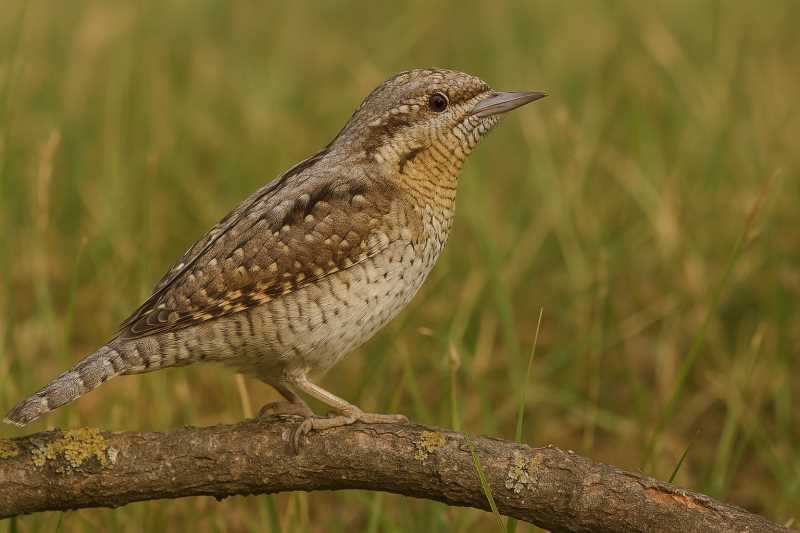
The Eurasian Wryneck is a small bird, measuring approximately 16 to 18 centimeters in length, with a wingspan ranging from 25 to 30 centimeters. Its plumage is predominantly brown and grey, intricately patterned with cryptic markings that provide excellent camouflage against tree bark. This intricate patterning is not only a defense mechanism against predators but also a vital adaptation for its woodland habitat.
One of the most intriguing features of the Eurasian Wryneck is its ability to rotate its head almost 180 degrees, a characteristic shared with owls. This peculiar behavior, coupled with its habit of twisting its neck in a snake-like manner when threatened or disturbed, gives the bird its common name. The Wryneck’s beak is short and pointed, adapted for its specialized diet.
Habitat and Distribution
The Eurasian Wryneck is a migratory bird, with a breeding range extending across Europe and parts of Asia, from Spain and the British Isles to the eastern reaches of Russia and China. During the winter months, it migrates to sub-Saharan Africa and southern Asia to escape the harsh northern climates. The bird favors open woodlands, orchards, and farmland edges, where it can find its primary food source: ants and their larvae.
Its preference for habitats with scattered trees and shrubs aligns with its feeding habits. The Eurasian Wryneck is known for its ground foraging behavior, using its long, sticky tongue to extract ants from crevices and underground nests. This specialized feeding technique places it in a unique ecological niche, reducing competition with other insectivorous birds.
Behavior and Communication
The Eurasian Wryneck is a solitary bird outside of the breeding season, but during spring, it becomes more vocal as males establish territories and attract mates. Its call is a series of high-pitched, repeated notes that resonate through the woodlands, a distinctive sound that birdwatchers often use to locate these elusive creatures.
Despite belonging to the woodpecker family, the Eurasian Wryneck does not exhibit the characteristic drumming behavior. Instead, it relies on its vocalizations to communicate and establish its presence. This deviation from typical woodpecker behavior is another aspect that makes the Wryneck an intriguing subject for study.
Breeding and Nesting
Breeding begins in late spring, with pairs forming monogamous bonds for the duration of the season. The Eurasian Wryneck is a cavity nester, taking advantage of existing holes in trees or man-made structures. Unlike other woodpeckers, it does not excavate its own nest but relies on natural cavities or those created by other species.
The female lays a clutch of 7 to 10 white, glossy eggs, which both parents incubate over a period of 12 to 14 days. Once hatched, the chicks are altricial, meaning they are born blind and helpless, relying entirely on their parents for feeding and protection. The fledging period lasts approximately 20 to 23 days, after which the young birds leave the nest to explore their surroundings.
Conservation Status
Currently, the Eurasian Wryneck is classified as a species of Least Concern by the International Union for Conservation of Nature (IUCN). However, its populations have experienced declines in certain regions, primarily due to habitat loss and changes in land use, such as the intensification of agriculture and deforestation.
Conservation efforts are focused on preserving suitable habitats and promoting sustainable land management practices that support the bird’s ecological requirements. Maintaining a mosaic of open woodlands, hedgerows, and mixed-use landscapes is crucial for the conservation of this species.
Conclusion
The Eurasian Wryneck is a testament to the diversity and adaptability of avian life. Its unique behaviors, specialized diet, and migratory patterns underscore the complexity of the ecosystems it inhabits. As we continue to study and protect this remarkable bird, we gain valuable insights into the intricate web of life that defines our natural world. For bird enthusiasts and conservationists alike, the Eurasian Wryneck serves as a reminder of the wonders that await discovery in our own backyards.
By fostering an appreciation for this enigmatic species and its habitat, we can contribute to the preservation of biodiversity and the health of our planet’s ecosystems. The Eurasian Wryneck, with its mysterious charm and ecological significance, certainly earns its place among the most fascinating avian inhabitants of our world.
Related posts