Introduction
The Eastern Hooded Pitta, Pitta novaeguineae, is a compact, vividly coloured forest bird of New Guinea and several nearby islands. It belongs to the pitta family, Pittidae, a group of mainly ground-feeding Old World birds known for bright plumage, short tails and secretive behaviour in dense vegetation.
For many years, this bird was treated as part of a wide-ranging Hooded Pitta complex. Modern taxonomic treatments recognise the New Guinea form as a separate species from the Western Hooded Pitta, Pitta sordida, based on differences in plumage, vocalisations and genetic evidence. The Eastern Hooded Pitta is also distinct from the Biak Hooded Pitta, Pitta rosenbergii, which is restricted to Biak Island.
Despite its striking colours, the species is often difficult to see. It usually moves quietly through leaf litter and low vegetation, and observers may hear its clear, repeated call before glimpsing a green-and-chestnut bird crossing a forest trail. It is resident across its range rather than a long-distance migrant, although local movements may occur in response to food availability, weather and breeding conditions.
Physical Description
The Eastern Hooded Pitta is a small to medium-sized pitta, measuring approximately 16–19 cm in length. Published measurements are often based on the former, broader Hooded Pitta complex, so exact figures for Pitta novaeguineae alone should be treated as approximate. The body is compact, with a large head, strong slightly downcurved bill, short tail and relatively long legs suited to walking and hopping on the forest floor.
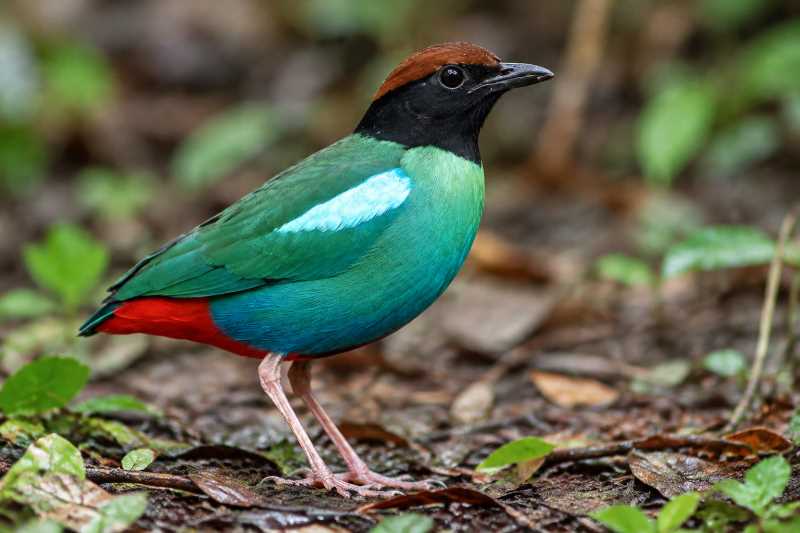
Adults have a predominantly green back, mantle and wings. The head and throat are black, creating the hooded appearance that gives the species its English name. The crown is rich chestnut or reddish brown, while the lower underparts are red, particularly around the belly, vent and undertail coverts. A blue to blue-green area on the shoulder or wing coverts may be visible when the bird moves or turns in good light. The combination of a black head, chestnut crown, green body and red lower underparts is characteristic.
The plumage is generally glossy rather than dull, but the bird can appear surprisingly inconspicuous in shadow. Green upperparts blend with vegetation, while the black head is easily lost against dark foliage. The red underparts are usually seen only briefly as the bird hops, turns or raises its wings.
Males and females are not known to show obvious sexual dimorphism. Both sexes are similar in size and colour, and reliable sexing in the field is generally not possible without observing behaviour, a pair at a nest or birds handled for scientific study. Plumage variation between island populations can be more useful taxonomically than differences between the sexes.
Three geographically distinctive forms are commonly associated with the species: the nominate form, P. n. novaeguineae, found mainly on New Guinea and nearby western islands; P. n. goodfellowi of the Aru Islands; and P. n. mefoorana of Numfor. These forms may differ subtly in colour and proportions, but field identification should normally be based on the species-level pattern and location rather than attempting to assign a subspecies from a brief view.
Information on immature plumage is limited in comparison with that available for better-studied pittas. Young birds are expected to be duller and less sharply patterned than adults, with reduced contrast in the head, crown and underparts. Because juvenile records are scarce and the species was formerly included in a larger complex, descriptions of immature birds should be treated cautiously.
Range and Habitat
The Eastern Hooded Pitta is endemic to New Guinea and a group of neighbouring islands. Its main range extends across lowland and foothill areas of both Indonesian New Guinea and Papua New Guinea. It also occurs on islands including Waigeo, Batanta, Salawati and Misool in the Raja Ampat region, the Aru Islands south-west of New Guinea, Numfor in Cenderawasih Bay, and some islands near the eastern end of New Guinea, including Karkar and parts of the Bismarck Archipelago.
The precise limits of the species’ range depend partly on taxonomy. Older records may have been reported simply as Hooded Pitta, Pitta sordida, because the New Guinea populations were historically treated as subspecies. Historical bird lists, expedition reports and online observations may therefore require re-evaluation under the current species treatment.
The species is primarily associated with humid lowland forest, including primary rainforest, swamp forest, forest margins, dense secondary growth and areas with a well-developed understorey. It prefers shaded ground with leaf litter, fallen branches and enough cover for a small terrestrial bird to move without being exposed. Streams, damp gullies and lightly disturbed forest can provide suitable foraging conditions, especially where earthworms, snails and other invertebrates are abundant.
Most records are from low elevations, generally below about 500 m, although the species has been reported locally to approximately 1,200 m. It is best regarded as a lowland and lower foothill bird rather than a montane specialist. In areas where forest has been cleared, it may persist in secondary vegetation if dense ground cover and moist soil remain, but heavily degraded or open landscapes are less suitable.
The species is resident and endemic to the Australasian region. There is no well-established evidence that it undertakes regular long-distance migration. Its quiet, ground-oriented habits mean that apparent changes in local abundance may reflect detectability, rainfall, breeding activity or observer effort rather than genuine population movements.
Geographic variation is important. The Aru Islands and Numfor support distinctive island forms, while birds from mainland New Guinea and the western Papuan islands are generally assigned to the nominate subspecies. Island populations may be especially vulnerable to habitat loss because their available forest is limited, although the global species range remains extensive.
Where to See This Species
The Eastern Hooded Pitta is not a routine roadside bird. It is usually found by walking slowly through suitable forest, listening for its call and watching shaded trails, damp clearings and quiet edges. Local guides are strongly recommended in both Indonesian New Guinea and Papua New Guinea, where access, permits, transport and safety arrangements can change.
Varirata National Park, Central Province, Papua New Guinea
Varirata National Park is a documented site for Eastern Hooded Pitta in Papua New Guinea. Birding tour reports have recorded the species in the park’s forested habitats, including searches along trails and around the park’s lowland and foothill vegetation. The park lies on the Sogeri Plateau east of Port Moresby and includes rainforest, secondary forest, eucalypt woodland and other habitat types. The pitta is most realistically sought in shaded forest with dense undergrowth and leaf litter, especially during quiet early-morning walks.
Nearby accommodation: Port Moresby is the nearest practical base, with hotels, guest houses, lodges and self-catering accommodation. Some visitors also use accommodation in the Sogeri area when operating with local transport and guides.
Malagufuk village forest, Southwest Papua, Indonesia
The forest around Malagufuk village in the Klasow Valley is a recognised wildlife-viewing locality where Eastern Hooded Pitta has been documented in recent birding records and photographic observations. The surrounding lowland forest supports a broad assemblage of Papuan birds, and the pitta has been located along forest tracks and near locally managed hides. This is a realistic site for observers prepared to walk slowly through humid forest and to work with community guides. Sightings are not guaranteed, and local access arrangements should be confirmed before travelling.
Nearby accommodation: Malagufuk village itself provides basic community-based accommodation and camping-style arrangements, while Sorong is the nearest larger gateway with hotels, guest houses and other visitor accommodation.
Nimbokrang forest and birding tracks, Papua Province, Indonesia
Nimbokrang and its surrounding forest tracks are established birding localities in the lowlands west of Jayapura. Eastern Hooded Pitta has been documented there in modern media records and birding observations, although older reports may use the former name Hooded Pitta. The species is generally sought in swamp forest, hill forest and dense vegetation along local tracks rather than in open village areas. Because many birding sites around Nimbokrang are reached through local roads, forest paths or community land, visitors should arrange access and guiding locally rather than assuming that every track is freely accessible.
Nearby accommodation: Nimbokrang village is the most practical local base, with simple guest-house or homestay-style options. Jayapura provides a wider choice of hotels and guest houses for visitors requiring more facilities.
Behaviour and Diet
The Eastern Hooded Pitta is mainly terrestrial. It walks and hops through leaf litter, frequently pausing to listen or scan the ground before making a quick movement beneath cover. Its short tail and strong legs are typical of a bird adapted to moving through dense forest-floor vegetation rather than spending long periods in the canopy.
It is usually encountered alone or in pairs. During the breeding period, pairs are strongly territorial and may respond to playback or an approaching observer, although the use of playback should be restrained and follow local birding guidelines. Outside the breeding season, individuals may be less vocal and more difficult to locate. The species’ secretive behaviour means that a bird can remain close to a trail while escaping detection by moving only a short distance at a time.
The diet consists principally of ground-dwelling invertebrates. Likely and documented food items include insects, insect larvae, beetles, ants, termites, earthworms, snails and other small invertebrates found in damp soil and leaf litter. The bird may probe, turn or flick aside leaves with its bill, then seize prey from the ground. Small fruits and berries are also taken, so the species is not exclusively insectivorous.
Foraging is often most productive after rain, when earthworms and other invertebrates become active near the surface. This may partly explain why pittas are associated with moist forest floors, stream margins and shaded gullies. The bird’s preference for quiet, structurally complex habitat also helps it avoid predators while searching for food.
The species’ call is an important way to detect it. It has been described as a clear, flute-like or whistle-like phrase, often delivered repeatedly from dense vegetation. Calling may be most noticeable in the early morning or late afternoon, although local conditions and breeding activity influence vocal behaviour. Observers should listen carefully between calls because the bird may remain hidden and may not move immediately after vocalising.
Breeding information for the Eastern Hooded Pitta is less complete than for some Asian pittas. Available accounts indicate that breeding is seasonal and may be associated with the wet season or periods of increased food availability. The nest is built on or close to the ground and is a domed structure made from leaves, roots, fibres and other plant material, with an entrance on the side. Its shape and placement can make it difficult to distinguish from a natural pile of forest debris.
Pairs are territorial during breeding, and both adults are believed to participate in incubation and the care of young. Clutch size is not well documented for the species as currently defined. More detailed information on nesting dates, incubation, fledging and parental roles is still needed, especially from the different island populations.
Identification Tips
Look for a compact, short-tailed bird moving on the forest floor rather than a bird perched high in the canopy. The most useful field marks are:
- a black head and throat forming a distinct hood;
- a rich chestnut crown;
- green back, mantle and wings;
- blue or blue-green on the shoulder or wing coverts, sometimes visible only in flight or when the bird turns;
- red lower belly, vent and undertail area;
- a stout bill, long legs and a characteristic hopping gait.
The species is often identified first by a flash of green and chestnut or by the repeated whistle of a hidden bird. Watch the edges of fallen logs, damp leaf litter, streamside trails and dense undergrowth. It may cross an open patch quickly before disappearing into cover.
The most important comparison is with other members of the former Hooded Pitta complex. In western and mainland South-East Asia, the Western Hooded Pitta, Pitta sordida, has a broadly similar black-headed, green-and-chestnut appearance, but it does not normally occur in the same geographic range as the Eastern Hooded Pitta. On Biak Island, the Biak Hooded Pitta, Pitta rosenbergii, is the relevant geographic counterpart. Distribution is therefore essential to identification.
The Eastern Hooded Pitta should not be confused with the Papuan Pitta, Erythropitta macklotii, which occurs in parts of the same region. The Papuan Pitta has a different overall pattern, including a more extensive contrasting facial and underpart design, and belongs to a different pitta lineage. On sites where both species occur, careful attention to the head pattern, breast colour and overall body pattern is necessary.
Avoid relying on colour alone in poor light. The black hood may appear dark brown, the chestnut crown may be difficult to see and the red lower underparts may be hidden. A combination of voice, habitat, behaviour and geographic location provides a more reliable identification than a brief impression of colour.
Conservation Status
The Eastern Hooded Pitta is currently assessed as Least Concern. This category reflects its relatively broad geographic distribution and the absence of evidence that its global population is declining rapidly enough to meet the criteria for a threatened category. A precise global population estimate is not available, and the species’ secretive habits make population monitoring difficult.
The principal conservation concern is habitat loss and degradation. Lowland forest in New Guinea and nearby islands is affected by logging, agricultural expansion, plantation development, mining, roads, settlement growth and local clearance. Fragmentation can reduce the quality of forest-floor habitat even where some canopy remains, particularly if leaf litter dries out, undergrowth is removed or streams are disturbed.
Island populations may face additional risks because they occupy smaller and more isolated areas. The Numfor form and the Aru Islands form deserve attention in regional conservation planning, even though the species is not currently globally threatened. Taxonomic changes can also affect conservation priorities, because populations once treated as subspecies of a widespread bird may prove to have more restricted distributions when assessed separately.
Conservation measures should include protection of remaining lowland and foothill forest, maintenance of forest corridors, careful management of roads and logging, and support for community-based stewardship. Wildlife tourism can provide an incentive for forest protection when it is locally managed and does not disturb nesting birds or sensitive habitat. Further field surveys are needed to clarify distribution, abundance, breeding biology and the status of island populations.
Frequently Asked Questions
What is the scientific name of the Eastern Hooded Pitta?
The scientific name is Pitta novaeguineae. It is a member of the pitta family, Pittidae, and is recognised as a separate species from the Western Hooded Pitta, Pitta sordida.
Where does the Eastern Hooded Pitta live?
It occurs mainly in New Guinea, including both Indonesian New Guinea and Papua New Guinea, as well as nearby islands such as parts of the Raja Ampat group, the Aru Islands, Numfor and some islands near eastern New Guinea.
What does the Eastern Hooded Pitta eat?
It feeds mainly on invertebrates found in leaf litter and damp soil, including insects, larvae, earthworms and snails. It also takes berries and other small fruits.
Is the Eastern Hooded Pitta migratory?
It is considered a resident species rather than a long-distance migrant. Local movements may occur, but regular seasonal migration has not been established.
How can the Eastern Hooded Pitta be identified?
Look for a black head and throat, chestnut crown, green upperparts, blue-green shoulder markings and red lower underparts. It usually hops on the forest floor and is more often heard than seen.
Is the Eastern Hooded Pitta endangered?
The species is currently classified as Least Concern. Nevertheless, forest clearance, fragmentation and degradation remain important local threats, particularly on islands and in heavily developed lowland areas.
References
- IOC World Bird List
- BirdLife International
- Birds of the World, Cornell Lab of Ornithology
Related posts