Introduction
The Crimson Topaz, Topaza pella, is a large and spectacular hummingbird of northern South America. It belongs to the hummingbird family Trochilidae and is found mainly in lowland rainforest, especially near streams, rivers, gallery forest and granite outcrops. The species is non-migratory and is known for the dramatic contrast between the adult male’s crimson plumage and the greener, more subdued plumage of the female.
Physical Description
The Crimson Topaz is one of the larger hummingbirds. Adult males measure approximately 21–23 cm in total length and weigh about 11–18 g. Females are considerably smaller, measuring about 13–14 cm and weighing approximately 9–12.5 g.
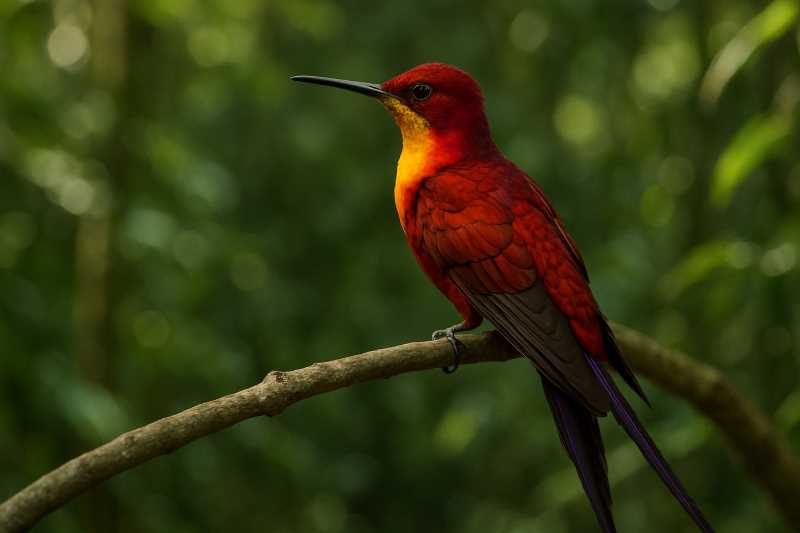
The adult male has a velvety black head and face, a golden-green throat bordered by black, and brilliant crimson to reddish upperparts and underparts. The central tail feathers are bronzy green, while the outer tail feathers are rufous or chestnut. Two elongated central tail feathers extend beyond the shorter feathers and may cross near the tip. The bill is long, black and slightly curved.
Females lack the male’s elongated tail feathers and are predominantly green above, with paler green, golden and reddish tones below. Their outer tail feathers are broadly rufous. Immature birds resemble females, although young males gradually develop the darker head and brighter crimson plumage of adults.
Several geographic forms have been described, and differences in bill size, body size and plumage have been reported across the range. These variations should be treated cautiously because the taxonomy of the Topaza hummingbirds has a complex history.
Range and Habitat
The Crimson Topaz occurs in northern South America, including eastern Venezuela, Guyana, Suriname, French Guiana and northern and western Brazil. Its distribution is associated mainly with the Guiana Shield and adjacent Amazonian lowlands, with some populations extending farther south in Brazil.
It usually inhabits lowland rainforest, often below about 500 m elevation. The species is particularly associated with forest edges, gallery forest, riverbanks, small streams and blackwater creeks. It may also occur around granite outcrops and in forest containing flowering shrubs and trees. Nests are frequently placed close to water, so intact streamside vegetation is important habitat.
The Crimson Topaz is not considered migratory. Local movements may occur as birds search for flowering plants or defend feeding territories, but regular long-distance migration has not been established.
Where to See This Species
Iwokrama Rainforest Reserve, Potaro-Siparuni, Guyana
The Iwokrama Rainforest Reserve supports extensive lowland rainforest, streams and forest-edge habitat suitable for the Crimson Topaz. The species has been documented at Atta Rainforest Lodge and along the Rewa River within the broader Iwokrama landscape. Look near flowering plants, forest clearings and watercourses, particularly with an experienced local guide.
Nearby accommodation: Atta Rainforest Lodge and other forest lodges or camps in the Iwokrama and North Rupununi area provide practical bases for wildlife viewing.
Brownsberg Nature Park, Brokopondo District, Suriname
The Crimson Topaz has been recorded at Brownsberg Nature Park, where forest trails, streams and flowering vegetation provide appropriate habitat. Sightings are not guaranteed, so birders should check quiet forest edges and watercourses and allow time for scanning the canopy and listening for territorial calls.
Nearby accommodation: Brownsweg is the nearest practical settlement, with guest houses, lodges and other basic accommodation available in the surrounding area.
Reserva Extrativista Beija-Flor-Brilho-de-Fogo, Amapá, Brazil
This protected extractive reserve in Amapá is a documented breeding locality for the Crimson Topaz. Scientific observations there have recorded nests, eggs and nestling development, confirming the species’ use of preserved lowland forest close to streams. Access should be arranged through local authorities or an authorised guide because extractive reserves may have specific entry and visitor requirements.
Nearby accommodation: Macapá is the main practical gateway for accommodation, with hotels, guest houses and organised transport into more remote areas of Amapá.
Behaviour and Diet
The Crimson Topaz is generally solitary and territorial. Males defend feeding areas from other hummingbirds and may use rapid display flights, feather flashing and aggressive chases to deter intruders. The species can be noisy, and calls may reveal a bird before it becomes visible in the canopy or along a stream.
Its diet consists mainly of nectar from a range of flowering plants. It also takes small insects and other arthropods, including prey captured in flight. This combination provides both energy and protein. By transferring pollen between flowers, the species contributes to pollination within its forest habitat.
The female builds the nest, incubates the eggs and cares for the young. The nest is a shallow cup made from soft plant fibres, including seed fibres, and secured with spider web. It is commonly attached to a branch or twig above water. A clutch normally contains two white eggs. Breeding information varies across the range, but nesting activity has been recorded during different parts of the year in different regions.
Identification Tips
- The adult male is identified by its large size, black head, golden-green throat, brilliant crimson body and two elongated central tail feathers.
- The female is a large green hummingbird with rufous outer tail feathers and no elongated central tail streamers.
- The combination of a green-and-gold throat, crimson body and strongly extended central tail feathers makes an adult male especially distinctive.
- The related Fiery Topaz, Topaza pyra, is the most important potential comparison. It is generally smaller and differs in the details of its black head and breast band, throat colour, tail pattern and bill proportions.
- In dense forest, listen for repeated sharp or chattering calls and watch stream margins, flowering vegetation and exposed perches in the canopy.
Conservation Status
The Crimson Topaz is currently assessed as Least Concern on the IUCN Red List. Its overall population has not been reliably quantified, and available assessments indicate a declining trend rather than a stable or increasing population.
The principal long-term concern is the loss and degradation of lowland rainforest through deforestation, logging, agricultural expansion, mining, infrastructure development and fragmentation. Damage to river corridors and streamside vegetation may be especially important because the species often feeds and nests near water. Changes in flowering patterns caused by climate variation could also affect local food availability, although the scale of this impact is not well established.
Protection of large rainforest reserves, forested river corridors and intact stream margins remains important. Continued field surveys are also needed because the species can be difficult to detect in the canopy and because local populations, including some geographically restricted forms, may face greater risks than the global assessment suggests.
Frequently Asked Questions
Where can the Crimson Topaz be found?
It occurs in northern South America, including Venezuela, Guyana, Suriname, French Guiana and northern and western Brazil. It is mainly associated with lowland rainforest near rivers, streams and forest edges.
What does the male Crimson Topaz look like?
The adult male has a black head, a golden-green throat, brilliant crimson plumage and two elongated central tail feathers. Its large size and vivid colour pattern make it one of the most distinctive hummingbirds in its range.
How is the female Crimson Topaz different from the male?
The female is smaller and mainly green, with paler underparts and rufous outer tail feathers. It lacks the male’s brilliant crimson body and elongated central tail feathers.
What does the Crimson Topaz eat?
It feeds mainly on flower nectar and supplements its diet with small insects and other arthropods. Insects provide important protein, particularly for growing young.
Is the Crimson Topaz migratory?
No regular long-distance migration is known. Birds may move locally in response to flowering conditions, food availability or territorial requirements.
Is the Crimson Topaz endangered?
The species is currently classified as Least Concern globally, but its population is believed to be declining. Deforestation, habitat fragmentation and degradation of rainforest and streamside vegetation remain important concerns.
References
- BirdLife International
- IUCN Red List of Threatened Species
- IOC World Bird List
Related posts