Introduction
The Blue-winged Teal, Spatula discors, is a small North American dabbling duck in the family Anatidae. It breeds mainly in shallow wetlands and grassland habitats across Canada, Alaska and the northern and central United States, then migrates south to winter in the southern United States, Mexico, the Caribbean, Central America and parts of northern South America. Its contrasting male plumage and powder-blue wing patch make it one of the more recognisable small ducks in the Americas.
Physical Description
Blue-winged Teal are compact ducks measuring approximately 36–41 centimetres in length, with a wingspan of about 56–62 centimetres. Adults generally weigh 230–545 grams, with some variation between individuals and sexes.
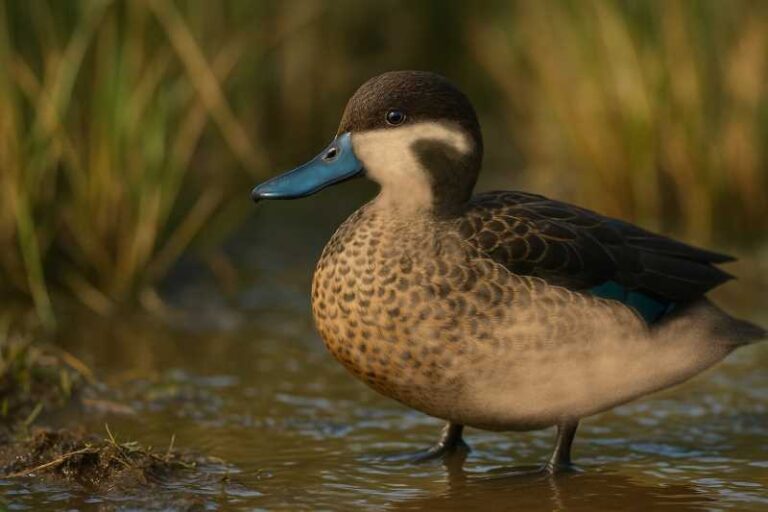
Breeding males have a slate-blue head, a prominent white crescent between the bill and eye, a dark-spotted brown breast and flanks, a small white patch near the rear flank, and a black rump and tail. The powder-blue upperwing coverts are usually concealed when the bird is resting but become conspicuous in flight. The wing also shows a green speculum.
Females are mottled brown overall, with a darker eye-line, a relatively large dark bill and a duller blue wing patch. Their cryptic plumage provides camouflage while nesting. Juveniles resemble females but are generally duller and less sharply marked. Non-breeding males, known as eclipse males, temporarily lose much of their breeding plumage and can appear similar to females.
Range and Habitat
Blue-winged Teal are long-distance migrants. Their breeding range extends from southeastern Alaska and much of Canada south through the northern and central United States. The Prairie Pothole Region of the Great Plains and Canadian Prairies is an important breeding area, although the species also nests in other suitable wetland landscapes.
During the breeding season, the species uses shallow freshwater wetlands, prairie potholes, marshes, small ponds, flooded grasslands, sloughs and wet meadows. Nests are usually placed on the ground in dense grass or other herbaceous vegetation near water rather than directly beside the open shoreline.
In autumn, many Blue-winged Teal leave the breeding grounds earlier than most other North American ducks. Wintering birds occur in the southern United States, Mexico, the Caribbean, Central America and northern parts of South America. Winter habitat includes freshwater and brackish marshes, shallow lakes, flooded fields, rice fields, estuaries, mangroves and other vegetated wetlands. The species generally prefers shallow, calm water and often avoids large expanses of open water.
Behaviour and Diet
Blue-winged Teal are active dabblers that feed mainly in shallow water. They collect food from the surface, submerge the head and bill, or tip forward with the tail raised to reach submerged material. They dive only rarely. Birds may occur in pairs, small groups or larger migratory flocks, and they commonly associate with other dabbling ducks.
Their diet is opportunistic and changes with season and local availability. It includes aquatic insects, insect larvae, crustaceans, snails, clams and other small invertebrates, as well as seeds, grains, algae, duckweed, pondweed and other aquatic vegetation. Females tend to consume more animal matter during egg production, while seeds and plant material are particularly important during migration and winter.
Pairs often form during winter or spring migration. The female selects the nesting site and makes a shallow scrape, which she lines with grasses and down. A typical clutch contains about 6–14 eggs, and incubation usually lasts approximately 23–24 days, although published ranges vary. The female performs the incubation and leads the precocial ducklings to water soon after hatching. Young birds become capable of flight at roughly 40 days of age.
Identification Tips
- Look for a very small dabbling duck with a relatively large, dark bill and a rounded head.
- In a breeding male, the slate-blue head and sharply contrasting white facial crescent are distinctive.
- In flight, both sexes show a pale powder-blue patch on the upperwing coverts, often accompanied by a green speculum.
- Females and eclipse males are mottled brown and can be difficult to identify at a distance. The dark eye-line, pale facial markings and blue wing patch are useful clues.
- Female Blue-winged Teal can resemble female Cinnamon Teal. The two species may require careful comparison, especially in western North America, where their ranges overlap. Female Blue-winged Teal usually have a colder, more grey-brown appearance and a more evident dark eye-line, but individual variation can make separation difficult.
- Green-winged Teal are similarly small but lack the Blue-winged Teal’s powder-blue wing patch. Their males have a different head pattern, with a green eye-patch rather than a white facial crescent.
- Northern Shovelers may also show blue on the wing, but they are larger and have a much broader, spatulate bill.
Conservation Status
The Blue-winged Teal is currently assessed as Least Concern globally. It remains one of the more abundant North American ducks, and broad North American monitoring has generally indicated a stable population over several decades, although trends vary between regions and time periods.
The principal conservation concerns are the loss and degradation of wetlands and grassland nesting habitat. Wetland drainage, agricultural conversion, urban development, pesticide exposure, lead contamination and collisions with power lines can affect the species. Conditions on wintering grounds and along migration routes are also important because the birds depend on a chain of suitable wetlands across several countries.
Effective conservation measures include protecting prairie potholes and other shallow wetlands, maintaining native grassland cover around breeding sites, restoring drained wetlands, reducing pesticide and lead exposure, and managing migratory habitats throughout the Americas. Responsible waterfowl-hunting regulations and international cooperation also contribute to population management.
Frequently Asked Questions
Where does the Blue-winged Teal live?
It breeds mainly in Canada, Alaska and the northern and central United States. It winters from the southern United States and Mexico through the Caribbean and Central America to parts of northern South America.
What does a Blue-winged Teal eat?
It eats aquatic insects, larvae, crustaceans, snails, clams, seeds, grains, algae, duckweed, pondweed and other aquatic vegetation. Animal food is especially important for laying females and growing ducklings.
How can you identify a male Blue-winged Teal?
The breeding male has a slate-blue head, a conspicuous white crescent between the bill and eye, a brown spotted body, a black rear end and a pale blue wing patch visible in flight.
Do female Blue-winged Teal have blue wings?
Yes. Females also have a powder-blue upperwing patch, although it is usually duller and is most easily seen when the bird flies.
Where do Blue-winged Teal nest?
Females usually nest on the ground in dense grass or other herbaceous vegetation near shallow wetlands. The nest is concealed by surrounding plants and lined with grass and down.
Are Blue-winged Teal endangered?
No. The species is currently classified globally as Least Concern. Nevertheless, wetland loss, grassland conversion, pollution and other pressures remain important local and regional conservation issues.
References
- Cornell Lab of Ornithology. 2026. Blue-winged Teal: Life History. All About Birds. Accessed 8 September 2026. https://www.allaboutbirds.org/guide/Blue-winged_Teal/lifehistory
- Cornell Lab of Ornithology. 2026. Blue-winged Teal: Identification. All About Birds. Accessed 8 September 2026. https://www.allaboutbirds.org/guide/Blue-winged_Teal/id
- Gill, F., Donsker, D. and Rasmussen, P. (eds). 2026. IOC World Bird List, version 15.2. International Ornithologists’ Union. Accessed 8 September 2026. https://www.worldbirdnames.org/new/ioc-lists/
- Integrated Taxonomic Information System. n.d. Spatula discors (Linnaeus, 1766), Blue-winged Teal. Accessed 8 September 2026. https://www.itis.gov/servlet/SingleRpt/SingleRpt?print_version=SCR&search_topic=TSN&search_value=1192577&source=from_print
- Smithsonian’s National Zoo and Conservation Biology Institute. n.d. Blue-winged Teal. Accessed 8 September 2026. https://nationalzoo.si.edu/animals/blue-winged-teal
- U.S. Fish and Wildlife Service. n.d. Blue-winged Teal. Accessed 8 September 2026. https://www.fws.gov/species/blue-winged-teal-anas-discors
- U.S. Geological Survey. 2023. North American Breeding Bird Survey Results and Analysis, 1966–2019. Eastern Ecological Science Center. Accessed 8 September 2026. https://www.usgs.gov/tools/north-american-breeding-bird-survey-results-and-analysis
- BirdLife International. n.d. Blue-winged Teal, Spatula discors, species information as represented in BirdLife Data Zone country records. Accessed 8 September 2026. https://www.datazone.birdlife.org/country/dominican-republic/ibas
Related posts