Introduction
The Choco Tinamou, also known as the Chocó Tinamou, is a rare and poorly known forest bird of the humid foothills of eastern Panama and north-western Colombia. Its accepted scientific name is Crypturellus kerriae. Like other tinamous, it is primarily terrestrial and is more often heard than seen in dense forest.
Physical Description
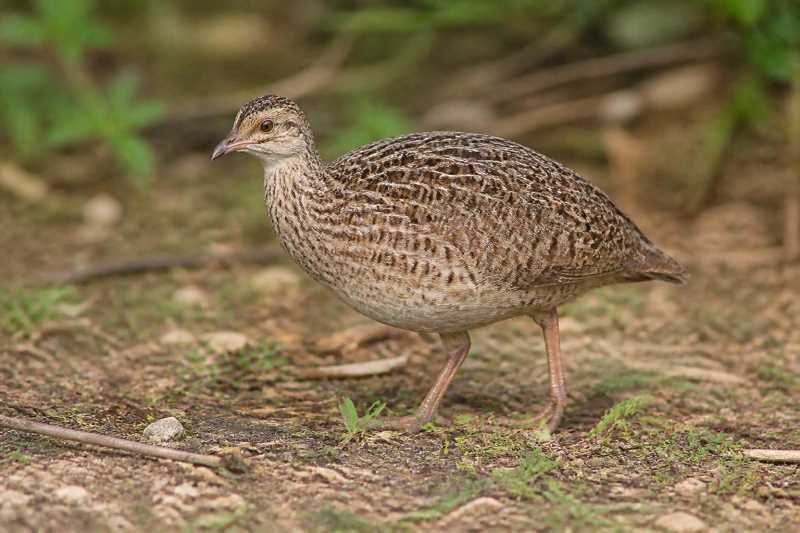
The Choco Tinamou is a small to medium-sized tinamou, measuring approximately 25–30 centimetres in length. It has dark brown upperparts, a blackish crown, slate-grey sides to the neck, a whitish throat and subtle dusky barring across the body. The legs are reddish, providing a useful identification feature when the bird is briefly visible on the forest floor.
The sexes are similar, although females are generally darker and may show heavier barring on the wing-coverts and breast, with greyer flanks. Its subdued, earthy plumage provides effective camouflage among leaf litter, roots and shaded undergrowth.
Range and Habitat
The Choco Tinamou has a small, fragmented range in the Chocó–Darién region. It is known from south-eastern Panama, particularly the Darién region near the Colombian border, and from north-western Colombia, including parts of Chocó Department.
It inhabits humid primary forest, especially forested foothills and steep lower mountain slopes. Documented records have come from approximately 300–760 metres above sea level, although broader range descriptions include both lowland and montane forest. The species is non-migratory and is associated with dense, wet evergreen forest rather than open or heavily disturbed habitats.
Where to See This Species
The Choco Tinamou is exceptionally difficult to observe. Visits should be arranged with experienced local guides, and listening for its quiet, mournful whistle is often more productive than searching visually. Access to some parts of its range may also depend on local permissions, weather and current park arrangements.
Darién National Park, Darién Province, Panama
Darién National Park protects the principal known Panamanian range of the species, including forested slopes around the Cerros de Quía and Cerro Pirre area. The bird has been recorded in the park and may be detected by its call in humid foothill forest, although sightings are uncommon. Birding expeditions have searched for it around the Rancho Frío area, where access normally requires substantial logistical planning and local support.
Nearby accommodation: Yaviza and El Real are practical gateway settlements for arranging transport, guides and basic guest-house or lodge accommodation before entering the park. Camping or ranger-station arrangements may be required for extended visits, subject to current permission.
Ensenada de Utría National Natural Park, Chocó, Colombia
The species is documented from Ensenada de Utría and has been regularly heard in suitable forest in the park and surrounding Serranía del Baudó habitat. The combination of humid foothill forest, dense undergrowth and protected habitat makes Utría one of the more realistic Colombian locations for a carefully guided search, although the bird remains elusive.
Nearby accommodation: Bahía Solano and Nuquí are the main practical gateway areas, with guest houses, small hotels, eco-lodges and community-run accommodation available depending on the access route and season.
Behaviour and Diet
The Choco Tinamou is a ground-dwelling bird that usually walks or runs through leaf litter and dense undergrowth. It is secretive and reluctant to fly, although it may flush suddenly when approached. Its low, faint, mournful call is typically described as a repeated three-note whistle and is often the best way to detect its presence.
Little is known about its detailed ecology. Available information indicates that it feeds mainly on fallen fruit and seeds, with small invertebrates probably taken opportunistically. As in other tinamous, the nest is expected to be placed on the ground, and the male is thought to undertake incubation and much of the early care of the young. Species-specific information on breeding dates, clutch size and nesting success remains limited.
Identification Tips
- Listen for a low, soft and mournful three-note whistle from dense forest undergrowth.
- Look for a compact, dark brown tinamou moving quietly through leaf litter rather than flying through the canopy.
- Note the blackish crown, grey sides of the neck, pale throat, subtle barring and reddish legs.
- The Choco Tinamou is darker and more subdued than many brighter or more strongly patterned tinamous in the region.
- A brief view may reveal only a dark, chicken-shaped ground bird disappearing into vegetation, so sound recordings and repeated observations are particularly valuable.
Conservation Status
The Choco Tinamou is currently listed as Near Threatened on the IUCN Red List. It has a restricted distribution, few confirmed localities and limited ecological information. The population is considered to be declining as suitable forest is lost or degraded.
The principal threats are deforestation, forest fragmentation, timber extraction, agricultural expansion, mining, road construction and settlement. Hunting may also affect birds in areas where people have regular access to the forest. Protection within Darién National Park and Ensenada de Utría is important, but conservation also depends on maintaining forest outside protected areas, improving knowledge of the species’ distribution and working with local and Indigenous communities.
Frequently Asked Questions
Where does the Choco Tinamou live?
It occurs in humid forest foothills of south-eastern Panama and north-western Colombia, particularly in the Darién and Chocó regions.
Is the Choco Tinamou endangered?
It is currently classified as Near Threatened. Habitat loss and degradation are the main concerns, but the species is still poorly studied and its population size is not well known.
What does the Choco Tinamou eat?
It is believed to feed mainly on fallen fruit and seeds, with small invertebrates also likely to form part of its diet.
How can the Choco Tinamou be identified?
The main clues are its dark brown plumage, blackish crown, pale throat, greyish neck sides, reddish legs and quiet three-note whistle. It is usually detected by sound rather than seen clearly.
Where is the best place to look for this species?
Darién National Park in Panama and Ensenada de Utría National Natural Park in Colombia are documented protected areas within its range. Both require patience, suitable local guidance and careful attention to access conditions.
Does the Choco Tinamou migrate?
No migration is known. It is considered a resident forest species, although its movements within its restricted range are not well documented.
References
- BirdLife International
- IUCN Red List of Threatened Species
- Parques Nacionales Naturales de Colombia
Related posts