Introduction
The Chestnut-throated Monal-Partridge, Tetraophasis obscurus, is a large, little-known pheasant in the family Phasianidae. It is endemic to the high mountains of western and central China, where it occupies coniferous forest, rhododendron shrubland and rocky vegetation near the tree line. The species is also known as the Chestnut-throated Partridge and Verreaux’s Monal-Partridge.
Physical Description
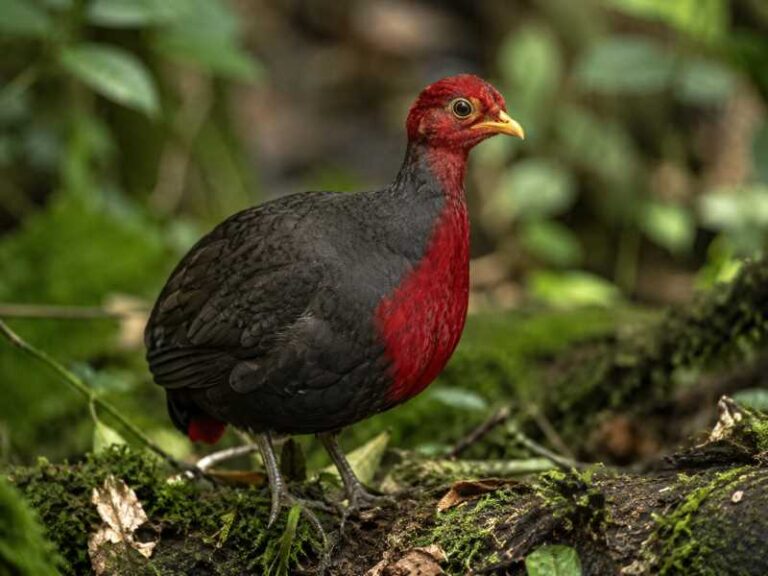
This robust partridge-like bird measures about 45–54 cm in length, with published field accounts commonly giving approximately 48 cm. Adults have mainly grey-brown or dull olive-brown upperparts, a greyish breast with fine dark markings, buff-brown wings with barring and a relatively long, broad tail. The tail is dark and shows a conspicuous pale or white terminal band when spread.
The diagnostic feature is the chestnut to dark brown throat and fore-neck, often bordered by a paler throat ring. The orbital skin around the eye is bright red, and the bill is strong and relatively heavy. Males and females are broadly similar, although females are slightly smaller. Juveniles are less well documented and appear duller, with a less strongly developed throat pattern.
Range and Habitat
The Chestnut-throated Monal-Partridge is a resident Chinese endemic. Its recognised range extends across parts of Gansu, Qinghai and Sichuan, including mountain systems such as the Minshan and Qionglai ranges. Older sources also refer to eastern Tibet in describing its wider historical distribution, but modern species accounts generally focus on western and central China.
It is associated with montane coniferous and mixed forest, especially near the upper forest boundary. It also uses rhododendron, willow and juniper shrubland, alpine grassland and steep, rocky slopes with scattered shrubs. Documented habitats range from approximately 2,700 m to more than 4,000 m above sea level, with some observations close to or above the local tree line.
The species is resident rather than a long-distance migrant. Local seasonal movements may occur, including movement to higher ground in spring and summer and use of lower or more sheltered habitat during winter.
Behaviour and Diet
This is an elusive, mainly ground-dwelling bird that forages through forest margins, shrubland and alpine vegetation. It may occur singly, in pairs or in small groups. Field observations have recorded groups of approximately three to five birds, although social organisation is not well understood.
Its diet is dominated by plant material, including leaves, flowers, seeds and roots. Invertebrates may also be taken, particularly when available, but detailed information on the species’ diet remains limited. Birds forage among leaf litter, grasses and low shrubs rather than spending much time in the canopy.
The species can be difficult to observe but is conspicuous when alarmed. It may run or move downslope into cover after being flushed, and it can give loud warning calls. During display or alarm, the crest feathers may be raised and the tail spread, revealing the broad pale terminal band.
Breeding information is scarce. A study in Sichuan recorded nests on or near the ground and clutch sizes of three to five eggs. Incubation in that study lasted approximately 27–28 days, with the female undertaking incubation. Chicks are mobile soon after hatching and remain with the adult bird while foraging.
Identification Tips
Look for the following combination of features:
- A large, heavy-bodied partridge with a relatively long, broad tail.
- Grey-brown or olive-brown plumage with a grey, finely marked breast.
- A chestnut or dark brown throat and fore-neck.
- Bright red skin around the eye and a strong bill.
- A broad pale or white terminal band visible when the tail is spread.
- A preference for steep mountain slopes, coniferous forest edges, rhododendron thickets and alpine shrubland.
The most relevant comparison is the Buff-throated or Szechenyi’s Monal-Partridge, Tetraophasis szechenyii. The two forms are similar in size, structure and habitat. Tetraophasis obscurus is distinguished mainly by its chestnut throat, whereas T. szechenyii generally has a much paler buff or yellow-buff throat. The extent of the pale throat ring can vary, so throat colour is usually more reliable than the ring alone.
Conservation Status
The Chestnut-throated Monal-Partridge is currently assessed as Least Concern on the global IUCN Red List assessment represented by BirdLife International. This replaces older references that described the species as Near Threatened.
The species remains of conservation interest because its mountain habitat is localised and can be fragmented. Reported concerns include forest degradation, loss of mature coniferous habitat, disturbance near the tree line and other forms of habitat alteration. Historical observations also mention hunting or shooting in some areas, although the scale of current pressure is not well quantified.
Protection of remaining montane forest and shrubland, effective management of nature reserves, prevention of unsustainable hunting and further field surveys are important conservation measures. Reliable estimates of the total population are not currently available, so claims about population size should be treated cautiously.
Frequently Asked Questions
Where does the Chestnut-throated Monal-Partridge live?
It occurs only in mountainous areas of western and central China, particularly in parts of Gansu, Qinghai and Sichuan. It inhabits coniferous and mixed forest, rhododendron shrubland, alpine grassland and rocky slopes near the tree line.
What does the Chestnut-throated Monal-Partridge look like?
It is a large grey-brown partridge with a long, broad tail, red orbital skin and a distinctive chestnut or dark brown throat. A pale terminal band on the tail is especially noticeable when the bird spreads its tail.
How high does this species live?
It is a high-altitude bird generally recorded from about 2,700 m to more than 4,000 m above sea level. In some localities it occurs close to or above the tree line.
What does the Chestnut-throated Monal-Partridge eat?
Its diet is chiefly plant-based and includes leaves, flowers, seeds and roots. It may also take invertebrates, but detailed dietary studies are limited.
Is the Chestnut-throated Monal-Partridge endangered?
No. Its current global assessment is Least Concern, although habitat degradation and fragmentation remain conservation concerns and the species is not well studied.
How can it be distinguished from Szechenyi’s Monal-Partridge?
The throat is the most useful field character. The Chestnut-throated Monal-Partridge has a chestnut or dark brown throat, while Szechenyi’s Monal-Partridge usually has a paler buff or yellow-buff throat. Their ranges also differ, which can help with identification.
References
- BirdLife International. 2024. Chestnut-throated Partridge Tetraophasis obscurus Species Factsheet. BirdLife DataZone. Available at: https://datazone.birdlife.org/species/factsheet/chestnut-throated-partridge-tetraophasis-obscurus (accessed 8 September 2026).
- Gill, F., Donsker, D. and Rasmussen, P., eds. 2026. IOC World Bird List, version 15.2. International Ornithological Congress. Available at: https://www.worldbirdnames.org/ (accessed 8 September 2026).
- Klaus, S., Ploner, R., Sun, Y.-H. and Fang, Y. 2003. The Chestnut-throated Partridge (Tetraophasis obscurus) in the Lianhuashan Nature Reserve, Gansu, China: Ecological observations and taxonomic questions. Journal of Ornithology 144(2): 197–200. https://doi.org/10.1046/j.1439-0361.2003.03007.x
- Ying, W.-L., Gong, J.-W., Liu, N.-F. and Wang, X.-T. 2008. Habit of Tetraophasis obscurus in Mao County, Sichuan. Chinese Journal of Zoology 43(2): 73–76.
- Meng, Y., Dai, B., Ran, J., Li, J. and Yue, B. 2008. Phylogenetic position of the genus Tetraophasis (Aves, Galliformes, Phasianidae) as inferred from mitochondrial and nuclear sequences. Biochemical Systematics and Ecology 36(8): 626–637. https://doi.org/10.1016/j.bse.2008.01.007
- Ogilvie-Grant, W. R. 1893. Catalogue of the Game Birds in the Collection of the British Museum, Volume 22. British Museum (Natural History), London. Available at: https://wallace-online.org/converted/supplementary/specimens/1893_BMbirds_WSPEC351.22.pdf (accessed 8 September 2026).
Related posts