Introduction
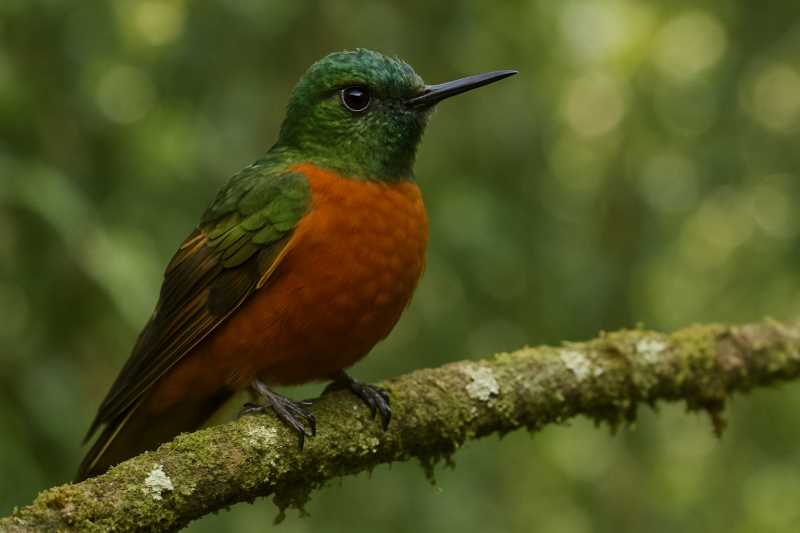
The Chestnut-breasted Coronet (Boissonneaua matthewsii) is a medium-sized hummingbird of the northern and central Andes. Its rich chestnut underparts contrast with metallic green upperparts, making it a distinctive species of humid montane forest and cloud-forest edges.
Physical Description
The Chestnut-breasted Coronet is approximately 12 centimetres long. It has a straight, black bill, a green head and upperparts, and chestnut underparts extending from the throat and breast towards the belly. The wings are dark, and the tail is relatively short with dusky to bronze-green tones.
Males and females are broadly similar in appearance, although females may appear slightly duller. Juveniles are less richly coloured than adults and may show less clearly defined chestnut plumage. The species lacks the prominent iridescent throat patch seen in several similar Andean hummingbirds.
Range and Habitat
The species occurs in Colombia, Ecuador and northern Peru, mainly on the eastern slopes of the Andes, with additional records from suitable montane habitat on parts of the western Andean slopes. It is generally associated with humid montane forest, cloud forest, forest edges, clearings and flowering vegetation.
It is usually found between about 1,500 and 3,300 metres above sea level, although the exact elevational range varies locally. The Chestnut-breasted Coronet is considered resident rather than a long-distance migrant, but individuals may move locally or seasonally in response to flowering conditions and changes in elevation.
Where to See This Species
Tapichalaca Reserve, Zamora-Chinchipe, Ecuador
Tapichalaca Reserve protects humid montane forest in southern Ecuador and has documented records of Chestnut-breasted Coronet. Forest trails, flowering plants and lodge surroundings provide suitable places to watch for this species, particularly where hummingbird activity is concentrated.
Nearby accommodation: The reserve has lodge accommodation, with additional guest houses and small hotels available in nearby settlements such as Valladolid and the wider Zamora-Chinchipe area.
Abra Patricia Reserve, Amazonas and San Martín, Peru
The high-elevation cloud forests of Abra Patricia support a diverse hummingbird community, and the Chestnut-breasted Coronet is included on the reserve’s bird checklist. Look along forest roads, trails, flowering vegetation and established hummingbird viewing areas.
Nearby accommodation: Lodge accommodation is available at Abra Patricia, with further guest houses, lodges and hotels in the Alto Mayo and Moyobamba area.
Behaviour and Diet
The Chestnut-breasted Coronet is active during the day and usually forages in the understorey, subcanopy and lower canopy. It feeds mainly on nectar from flowering plants, helping to transfer pollen between flowers as it moves through the forest. It also takes small insects and spiders, which provide important protein, particularly during periods of breeding and chick-rearing.
Like other coronets, it may defend productive flowers or feeding stations from other hummingbirds. Encounters can involve rapid chases, hovering and short darting flights. The species is generally encountered alone while feeding, although several birds may gather temporarily where flowers are abundant.
The female builds the nest and raises the young. Hummingbird nests are typically made from soft plant material, moss and other fibres bound with spider silk, although detailed breeding information for this species is limited.
Identification Tips
- Look for the combination of metallic green upperparts and rich chestnut underparts.
- The bird has a straight black bill and a relatively compact, robust appearance.
- It lacks the conspicuous iridescent throat patch of many other Andean hummingbirds.
- In poor light, the green plumage can appear dark and the chestnut breast may be the most obvious feature.
- The Chestnut-breasted Coronet can be compared with other Boissonneaua coronets. The chestnut underparts distinguish it from the buff-tailed and velvet-purple coronets, while the absence of a strongly contrasting iridescent throat helps separate it from several Coeligena hummingbirds.
Conservation Status
The Chestnut-breasted Coronet is currently assessed as Least Concern. Its broad Andean distribution includes protected areas, but the species remains dependent on humid montane forest and may be affected locally by deforestation, agricultural expansion, forest fragmentation and changes in flowering patterns.
Protecting remaining cloud forests, maintaining habitat corridors and conserving flowering plants are important measures for this species. More detailed monitoring would help clarify local population trends and the possible effects of climate change on its elevational range and food resources.
Frequently Asked Questions
Where does the Chestnut-breasted Coronet live?
It lives in humid montane forests, cloud forests, forest edges and clearings in Colombia, Ecuador and northern Peru, usually at middle to high Andean elevations.
What does the Chestnut-breasted Coronet eat?
Its diet consists mainly of nectar, supplemented by small insects and spiders. Nectar provides energy for flight, while animal prey supplies protein and other nutrients.
Is the Chestnut-breasted Coronet migratory?
It is generally regarded as a resident Andean hummingbird rather than a long-distance migrant. Local or seasonal movements may occur as birds follow flowering resources or move between elevations.
How can the Chestnut-breasted Coronet be identified?
The most useful field marks are its metallic green head and upperparts, rich chestnut underparts, straight black bill and lack of a prominent iridescent throat patch.
Where is the Chestnut-breasted Coronet easiest to see?
Reliable viewing opportunities include Tapichalaca Reserve in southern Ecuador and Abra Patricia Reserve in northern Peru. Forest edges, flowering plants, lodge gardens and hummingbird viewing areas are especially worth checking.
Is the Chestnut-breasted Coronet endangered?
No. It is currently classified as Least Concern, although habitat loss and fragmentation remain local threats to the montane forests on which it depends.
References
- BirdLife International
- IUCN Red List of Threatened Species
- IOC World Bird List
Related posts