Introduction
The Burmese Collared Dove, Streptopelia xanthocycla, is a medium-sized dove of central Myanmar. It was formerly treated as a geographically isolated form of the Eurasian Collared Dove, Streptopelia decaocto, but is recognised as a separate species by the IOC World Bird List and supported as distinct by recent genetic research. Its most notable field mark is the bright yellow ring around the eye.
Physical Description
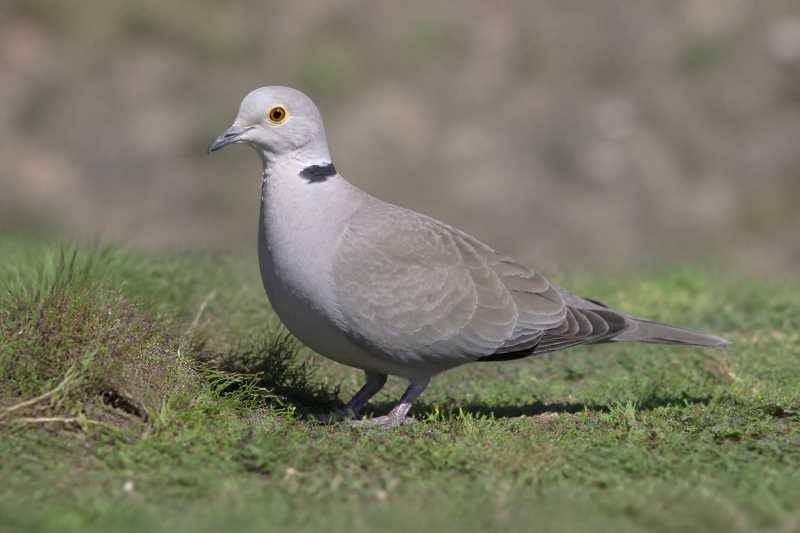
The Burmese Collared Dove is about 30–32 cm long. It has a compact dove-like body, a relatively long tail and a narrow black half-collar across the back of the neck. The plumage is generally warm grey-brown to earthy brown, with a slightly darker overall appearance than the Eurasian Collared Dove. The head and breast may show a soft pinkish or vinaceous wash.
The bright yellow orbital ring is the most diagnostic feature. The iris is dark, while the bill is slender and the legs and feet are pinkish to reddish. The sexes are broadly similar, although females may be slightly smaller and less richly coloured. Young birds are generally duller and may show a less clearly defined collar and orbital ring until they acquire adult plumage.
Range and Habitat
The Burmese Collared Dove is primarily associated with the dry zone of central Myanmar, especially the Irrawaddy River basin and adjoining areas of the Mandalay Region. Reports from neighbouring parts of China have been published, but the species is most securely documented from Myanmar. It is not a long-distance migrant and is generally regarded as resident.
It uses open and semi-open habitats, including farmland, villages, temple grounds, scrub, scattered woodland, river margins and lightly developed areas. In suitable landscapes it may forage close to houses and use trees, poles, roofs and other elevated structures as perches. The original assumption that it is widely distributed across Thailand, Laos, Vietnam and Cambodia is not supported by current species accounts, which place the core range in central Myanmar.
Where to See This Species
Lawkananda Wildlife Sanctuary, Mandalay Region, Myanmar
The sanctuary near Nyaung-U is a documented site for the Burmese Collared Dove. Local conservation reporting describes the species as occurring throughout the sanctuary, where open woodland, dry scrub, cultivated edges and human-used areas provide suitable feeding and perching habitat. It may be encountered in pairs while searching for fallen grain and other seeds near paths, clearings and settlements.
Nearby accommodation: Nyaung-U and the wider Bagan area provide the most practical base, with hotels, guest houses, lodges and other visitor accommodation.
Bagan Archaeological Zone, Mandalay Region, Myanmar
The open dry-country landscape around Bagan and Nyaung-U is one of the most reliable publicly accessible areas for looking for this species. Bird records and local birdwatching reports document Burmese Collared Doves in the archaeological zone, where temple grounds, farmland, scattered trees and village edges create suitable habitat.
Nearby accommodation: Nyaung-U and Old Bagan offer the nearest established accommodation areas, including hotels, guest houses, lodges and self-catering options.
Behaviour and Diet
Burmese Collared Doves are mainly active during daylight hours. They are often seen in pairs or small groups, although several birds may gather where food is plentiful. They commonly perch on trees, wires, roofs and other prominent structures before descending to the ground to feed.
The diet is believed to consist mainly of seeds, grains and other plant material gathered from open ground. Birds may forage in fields, village margins, temple compounds and around homes, where spilled grain and cultivated crops are available. Small fruits and other plant foods may also be taken.
The call is an important behavioural and identification feature. Compared with the familiar three-part call of the Eurasian Collared Dove, the Burmese Collared Dove is usually described as giving a softer, distinctive two-note coo. Pairs may call repeatedly from exposed perches, particularly during territorial or breeding activity.
Detailed breeding information for this species remains limited. Available accounts describe the typical collared-dove pattern of a simple twig nest placed in a tree or shrub, with both adults involved in incubation and care of the young. The usual clutch is reported as two eggs, but the timing and frequency of breeding may vary with local food and weather conditions.
Identification Tips
- Look first for the vivid yellow ring surrounding the eye, which contrasts with the pale facial feathers.
- Note the generally darker, warmer brown-grey plumage compared with the Eurasian Collared Dove.
- The narrow black half-collar on the back of the neck is characteristic, but it should be assessed together with the eye ring and overall colour.
- The species is usually seen in open country, farmland, villages and dry woodland rather than dense forest.
- Listen for the call. A two-note coo can help distinguish it from the more familiar three-note call of the Eurasian Collared Dove.
- Identification should not rely on the eye ring alone, because lighting and individual variation can make orbital colour appear less obvious.
Conservation Status
The Burmese Collared Dove is commonly treated as Least Concern, although conservation assessments may differ depending on whether the taxon is evaluated separately from the Eurasian Collared Dove. No reliable global population estimate is available for the species.
Its ability to use farmland, villages, temple grounds and other human-modified habitats appears to reduce the immediate risk from habitat loss. Nevertheless, the species has a relatively restricted known range, so the conversion of dry-zone habitat, changes in agricultural practices, disturbance and the loss of mature trees could become important local pressures. Continued surveys in central Myanmar would help clarify its distribution, population trend and conservation needs.
Frequently Asked Questions
Where is the Burmese Collared Dove found?
It is primarily found in central Myanmar, especially around the Irrawaddy River basin and the Mandalay Region. Bagan, Nyaung-U and Lawkananda Wildlife Sanctuary are documented areas for the species.
How can the Burmese Collared Dove be identified?
The strongest identification features are the bright yellow eye ring, darker brown-grey plumage and black half-collar on the back of the neck. Its two-note call can provide additional confirmation.
Is the Burmese Collared Dove the same as the Eurasian Collared Dove?
It was formerly regarded as a subspecies of the Eurasian Collared Dove, but the IOC World Bird List recognises it as Streptopelia xanthocycla. Recent genetic research also supports treating the Burmese population as a separate species.
What does the Burmese Collared Dove eat?
It feeds mainly on seeds and grains collected from the ground. It may also take other plant material, including small fruits, particularly around farmland, villages and temple grounds.
Is the Burmese Collared Dove migratory?
It is generally considered resident rather than migratory. Individuals may move locally in response to food availability, breeding conditions or disturbance.
References
- IOC World Bird List
- BirdLife International
- Bulletin of the British Ornithologists’ Club
Related posts