The Enigmatic Brown Lory: A Jewel of the Avian World
Introduction
The Brown Lory, scientifically known as Chalcopsitta duivenbodei, is a captivating species of parrot that has fascinated ornithologists and bird enthusiasts alike. Found primarily in the dense rainforests of New Guinea, this bird is celebrated for its striking plumage, playful demeanor, and intriguing behaviors. Despite its appeal, the Brown Lory remains relatively understudied, making it a subject of ongoing interest and research.
Taxonomy and Evolution
The Brown Lory belongs to the family Psittaculidae, which encompasses a diverse range of parrots known for their vibrant colors and social nature. The genus Chalcopsitta comprises several lory species, each exhibiting unique characteristics. The Brown Lory is closely related to other members of its genus, sharing common ancestors with the Black Lory and the Yellow-streaked Lory.
This species is named in honor of Dutch naturalist Duivenbode, who made significant contributions to the documentation of New Guinea’s avifauna. The evolutionary history of the Brown Lory can be traced back to the Gondwanan supercontinent, where early ancestors of parrots diversified and adapted to various ecological niches.
Physical Characteristics
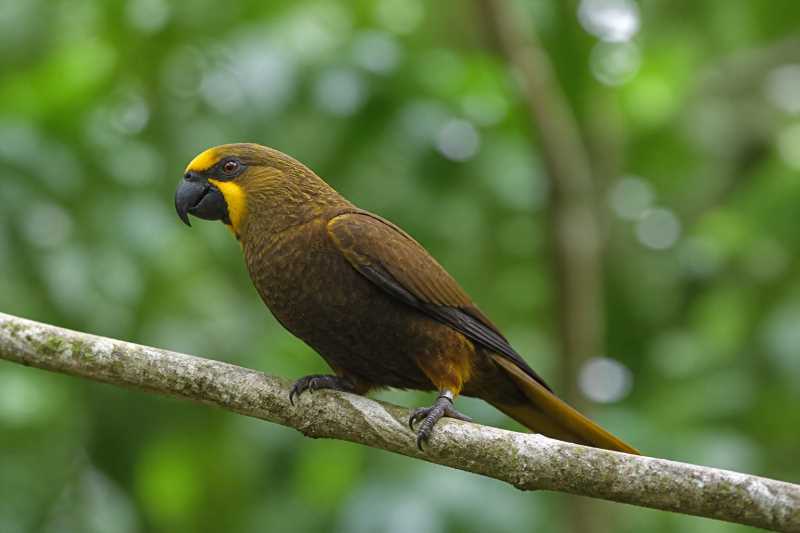
The Brown Lory is aptly named for its predominantly brown plumage, which is highlighted by subtle shades of green, blue, and yellow. This bird measures approximately 31 centimeters in length, with a wingspan that allows for agile flight through its forest habitat. One of its distinguishing features is the vibrant orange-yellow patch located on its chest, which contrasts beautifully with its darker body.
The Brown Lory’s beak is robust and slightly curved, adapted for its specialized diet. Its eyes are framed by a ring of bare skin, which can vary in color from white to blue, adding to its distinct appearance. Both males and females share similar coloration, making them difficult to differentiate based solely on external features.
Habitat and Distribution
The natural habitat of the Brown Lory is the lowland and montane rainforests of New Guinea, where it thrives in humid, tropical conditions. These forests provide the bird with an abundance of food sources and nesting sites. The Brown Lory is known to inhabit both primary and secondary forests, displaying some adaptability to human-altered landscapes.
New Guinea’s rich biodiversity offers a suitable environment for the Brown Lory, allowing it to coexist with numerous other bird species. Despite its adaptability, habitat destruction due to logging and agricultural expansion poses a significant threat to its population.
Behavior and Social Structure
Brown Lories are highly social birds, often observed in small flocks that engage in playful interactions. Their social nature is evident in their vocalizations, which include a variety of squawks, whistles, and mimicry. These vocalizations are crucial for communication within flocks, especially during foraging and flight.
Their playful behavior extends to their interactions with humans, as they are known to be curious and approachable. This trait, while endearing, has led to their popularity in the pet trade, raising concerns about their conservation status in the wild.
Diet and Feeding Habits
The diet of the Brown Lory is primarily composed of nectar, pollen, and fruits. Their specialized brush-tipped tongues enable them to efficiently extract nectar from flowers, playing a vital role in pollination. In addition to nectar, they consume a variety of fruits, seeds, and occasionally insects.
Brown Lories are known to feed in the upper canopy of the forest, where they can find abundant food sources. Their feeding habits contribute to the ecological health of their habitat by aiding in seed dispersal and pollination.
Reproduction and Lifespan
Brown Lories are monogamous birds, forming strong pair bonds that last for several breeding seasons. They typically nest in tree cavities or hollow branches, where they lay a clutch of two to three eggs. Both parents participate in incubating the eggs and caring for the chicks.
The incubation period lasts approximately 24 to 26 days, after which the chicks hatch and are cared for by both parents. The fledging period lasts about 8 to 10 weeks, during which the chicks develop the necessary skills for independent survival. In the wild, Brown Lories can live up to 20 years, although their lifespan in captivity can be longer with proper care.
Conservation Status
The IUCN Red List currently classifies the Brown Lory as a species of Least Concern, indicating that its population is stable. However, this status does not negate the threats posed by habitat destruction, illegal trapping, and the pet trade. Conservation efforts are essential to ensure the long-term survival of this species in its natural habitat.
Organizations and conservationists are working to protect New Guinea’s rainforests and promote sustainable practices that benefit both the environment and local communities. Public awareness campaigns and legal protections are crucial components of these efforts, aiming to minimize the impact of human activities on the Brown Lory’s habitat.
Conclusion
The Brown Lory, with its unique characteristics and ecological significance, is a testament to the rich biodiversity of New Guinea’s rainforests. While it remains a symbol of natural beauty, ongoing conservation efforts are vital to safeguard its future. Through research, habitat protection, and public education, we can ensure that the Brown Lory continues to thrive in the wild for generations to come.
References
- Forshaw, J. M. (2006). Parrots of the World: An Identification Guide. Princeton University Press.
- Juniper, T., & Parr, M. (1998). Parrots: A Guide to Parrots of the World. Yale University Press.
- BirdLife International. (2023). Species factsheet: Chalcopsitta duivenbodei. Retrieved from BirdLife International
Acknowledgments
The research and insights provided in this article are made possible by the dedicated efforts of ornithologists, conservationists, and the local communities of New Guinea.
Related posts