Böhm’s Bee-eater: Nature’s Vibrant Jewel
The Böhm’s Bee-eater, scientifically known as Merops boehmi, is a captivating bird species that belongs to the Meropidae family. This avian gem is renowned for its vivid plumage and fascinating behaviors, making it a subject of great interest for ornithologists and bird enthusiasts alike.
Physical Characteristics
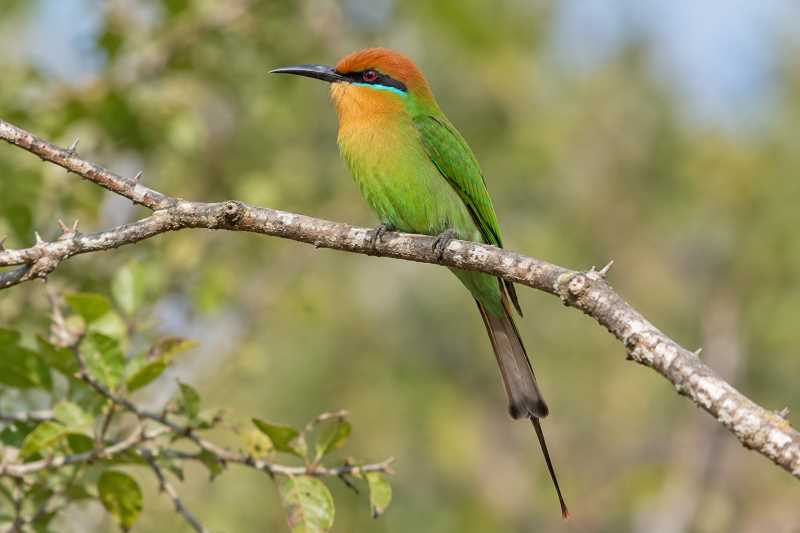
Böhm’s Bee-eater is a medium-sized bird, typically measuring around 22 to 24 centimeters in length. Its plumage is a dazzling display of colors, predominantly green with a striking blue throat and a distinctive black eye stripe that runs through its crimson eyes. The bird’s underparts are a gentle yellow, creating a beautiful contrast with its predominantly green body. The tail is elongated with central feathers that extend beyond the rest, adding to its graceful appearance.
Both males and females share similar plumage, which is not only visually appealing but also serves as a camouflage against predators while perched among foliage. Juveniles, however, exhibit slightly duller colors compared to adults, which gradually brighten as they mature.
Habitat and Distribution
Böhm’s Bee-eater primarily inhabits the subtropical and tropical regions across Eastern Africa. Its range spans several countries, including Tanzania, Malawi, Zambia, and Mozambique. These birds thrive in open woodlands, savannas, and forest edges, often near water sources where their prey is abundant.
Their habitat selection is closely tied to the availability of insects, their primary food source. They are often observed in areas with scattered trees or along riverbanks, where they can easily spot and capture flying insects.
Behavioral Traits
One of the most captivating aspects of Böhm’s Bee-eater is its feeding behavior. As their name suggests, bee-eaters predominantly feed on bees and other flying insects. They are skilled aerial hunters, often seen perched on a branch or wire, scanning the surroundings for movement. Once an insect is spotted, they launch into a swift, acrobatic flight to snatch it from the air.
A fascinating aspect of their hunting technique is their ability to handle stinging insects like bees. Before consumption, Böhm’s Bee-eater will repeatedly hit the insect against a hard surface to remove the sting and venom. This behavior not only showcases their adaptability but also their intelligence in handling potentially harmful prey.
Böhm’s Bee-eaters are social birds, often found in small flocks. They exhibit cooperative breeding behavior, where non-breeding individuals assist in raising the young. This social structure enhances their survival and breeding success, as more eyes are available to spot predators and more individuals can care for the offspring.
Breeding and Nesting
The breeding season for Böhm’s Bee-eater typically coincides with the onset of the rainy season when food is plentiful. They are cavity nesters, often excavating burrows in sandy banks or termite mounds. These burrows can be up to a meter deep, providing a safe and secure environment for their eggs and chicks.
A typical clutch consists of two to five eggs, which are incubated by both parents. The cooperative breeding system means that other group members may also assist with incubation and feeding of the chicks, ensuring a higher success rate for the brood.
Conservation Status
Currently, Böhm’s Bee-eater is classified as Least Concern by the International Union for Conservation of Nature (IUCN). This status reflects their relatively stable population and wide distribution. However, like many species, they are not immune to threats.
Habitat destruction due to agricultural expansion and deforestation poses significant challenges to their survival. Additionally, the use of pesticides can reduce insect populations, directly impacting their food supply.
Conservation efforts aimed at preserving natural habitats and promoting sustainable agricultural practices are vital for ensuring the continued survival of Böhm’s Bee-eater. Raising awareness about the ecological role of these birds can also contribute to their protection.
Conclusion
Böhm’s Bee-eater is more than just a visually stunning bird; it is an integral part of the ecosystems it inhabits. By controlling insect populations, they play a crucial role in maintaining ecological balance. Their social behaviors, intelligence, and adaptability make them a fascinating subject for study and admiration.
For birdwatchers and nature enthusiasts, observing Böhm’s Bee-eater in its natural habitat offers a glimpse into the vibrant world of these charismatic birds. As we continue to learn about and appreciate the natural world, it is our responsibility to ensure that such species thrive for generations to come.
By fostering a deeper understanding and appreciation of Böhm’s Bee-eater, we can contribute to the conservation of this remarkable species and the diverse ecosystems they inhabit.
Related posts