Introduction
The Black-bellied Thorntail (Discosura langsdorffi) is a small South American hummingbird in the family Trochilidae. It is recognised for the male’s highly modified tail feathers, contrasting black underparts and vivid green plumage. The species is resident rather than migratory, although local movements may occur in response to flowering conditions.
Physical Description
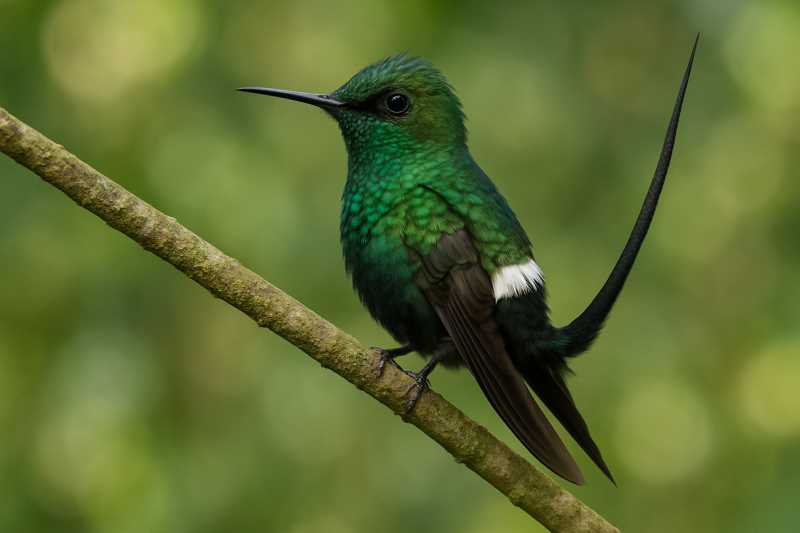
The Black-bellied Thorntail is a very small hummingbird with marked sexual dimorphism. Adult males measure roughly 12 to 13.7 centimetres in total length, including the elongated tail, while females are about 7.4 to 7.6 centimetres long. Much of the difference is caused by the male’s greatly extended outer tail feathers.
The male has green upperparts, a dark belly, a contrasting white area on the flanks and lower back, and a coppery or reddish band across the lower throat and upper breast. The tail is dark, slightly forked and strongly modified, with narrow outer feathers that give the species its thorntail appearance. The wings are dark and the bill and feet are black.
The female has a much shorter tail and is generally less brightly marked. She is mainly dark green above, with paler or greyish underparts, a white rump band, white markings around the throat and a noticeable pale malar stripe. Young birds resemble females and acquire adult male plumage gradually as they mature.
Range and Habitat
The Black-bellied Thorntail occurs in Bolivia, Brazil, Colombia, Ecuador, Peru and Venezuela. Its distribution is divided between two broad regions. The nominate form, D. l. langsdorffi, occurs in eastern Brazil, particularly in Bahia, Espírito Santo and Rio de Janeiro. The form D. l. melanosternon occupies parts of the western and central Amazon Basin, from southern Venezuela and south-eastern Colombia through eastern Ecuador and eastern Peru to northern Bolivia and western Brazil.
In Amazonia, the species is associated mainly with humid tropical forest, forest edges, clearings and flowering trees in the canopy and middle levels. In eastern Brazil, it is linked with Atlantic Forest habitats, including montane forest, cloud-forest margins, rocky shrubland and other relatively undisturbed upland vegetation. Records are often scattered, and the bird can be difficult to detect because it spends much of its time above eye level.
The species is resident within its range. Its distribution is geographically divided, and the two recognised subspecies differ in range and some plumage details.
Where to See This Species
The Black-bellied Thorntail is local and easily overlooked. Look for it around flowering trees and forest edges, especially in areas with mature native vegetation. Identification and access conditions should be checked locally before travelling.
Parque Nacional do Caparaó, Minas Gerais and Espírito Santo, Brazil
The Black-bellied Thorntail has been recorded in the Caparaó region, where Atlantic Forest, montane forest and upland vegetation provide suitable habitat for the eastern Brazilian form. Birdwatchers should concentrate on forest edges, flowering trees and quieter trails rather than relying only on open viewpoints. The park is an established birdwatching destination with public visitor facilities and camping areas.
Nearby accommodation: Alto Caparaó is the main gateway, with pousadas, hotels and campsites. Additional accommodation is available around Pedra Menina and Dores do Rio Preto on the Espírito Santo side.
Parque Nacional da Tijuca, Rio de Janeiro, Brazil
The species has been documented from the Atlantic Forest of Rio de Janeiro, including the area protected by Tijuca National Park. The park’s regenerating forest, mature canopy and accessible trails make it one of the more practical places to search in the state. It is most likely to be encountered by patiently checking flowering trees and forest margins, particularly during periods of increased hummingbird activity.
Nearby accommodation: Rio de Janeiro provides a wide range of hotels, guest houses, self-catering accommodation and hostels, with the city serving as the principal base for visits to the park.
Parque Nacional da Serra das Lontras, Bahia, Brazil
Serra das Lontras protects important Atlantic Forest habitat within the known range of the nominate subspecies. The park’s humid forest, steep terrain and flowering vegetation are suitable for a species that can forage in the middle and upper levels of woodland. Access may be more demanding than at better-developed urban parks, so visitors should confirm local arrangements and use authorised routes or guides where required.
Nearby accommodation: Una, Arataca and Ilhéus are the most practical bases, offering pousadas, guest houses and hotels suited to visits to the surrounding Atlantic Forest reserves.
Behaviour and Diet
The Black-bellied Thorntail is an agile, fast-flying hummingbird that usually forages alone or in pairs. It may move quickly between flowers and can be difficult to follow as it works through the middle and upper vegetation. Males may defend productive flowering areas, although detailed information on territorial behaviour is limited.
Its diet consists mainly of nectar from flowering plants. In Amazonian forest it is associated with flowering trees, including ingás and other nectar-producing species. It also takes small insects and other arthropods, which provide important protein and nutrients. By transferring pollen between flowers, the species contributes to the reproduction of native plants.
Breeding information remains limited. The female builds a small cup-shaped nest, generally using plant fibres and spider silk, and is responsible for incubation and care of the young. Clutches usually contain two eggs, and the incubation period is reported to be about 13 days. Males perform display flights that may include controlled movements of the tail and close passes near the female.
Identification Tips
- Look for a very small hummingbird with a conspicuous white rump or lower-back band and dark underparts.
- An adult male is distinctive because of the long, narrow outer tail feathers, coppery breast band and black belly with pale flank markings.
- Females and juveniles are less spectacular, with shorter tails, darker green upperparts and pale markings around the throat and rump.
- The bird often remains in the canopy or middle storey, so scanning flowering trees is usually more productive than watching low vegetation.
- The short-tailed female can be confused with other small green hummingbirds. The combination of the white rump band, dark belly, pale flank and habitat is useful for confirmation.
Conservation Status
The Black-bellied Thorntail is currently assessed as Least Concern on the IUCN Red List. This global category does not mean that all populations are secure. Habitat loss, forest fragmentation, selective logging, agricultural expansion and other forms of land-use change affect parts of its range.
The eastern Brazilian population is of particular conservation interest because its Atlantic Forest habitat has been extensively reduced and fragmented. National conservation assessments identify the taxon as a priority for Atlantic Forest conservation, and protected areas such as Serra das Lontras, Caparaó and other forest reserves help retain suitable habitat. Continued protection of native forest, maintenance of flowering resources and improved monitoring are important for the species’ long-term security.
Frequently Asked Questions
Where is the Black-bellied Thorntail found?
It occurs in Bolivia, Brazil, Colombia, Ecuador, Peru and Venezuela. Its range includes Amazonian forest and Atlantic Forest in eastern Brazil.
Is the Black-bellied Thorntail migratory?
It is generally considered resident. Local movements may occur as birds follow flowering resources, but it is not known as a long-distance migrant.
How can the male be identified?
The male has green upperparts, a black belly, pale flank markings, a coppery breast band and greatly elongated outer tail feathers. These tail feathers are the most distinctive feature.
What does the Black-bellied Thorntail eat?
It feeds mainly on nectar, supplemented by small insects and other arthropods. It often visits flowering trees in forest and along forest edges.
Where can this species be seen in Brazil?
Documented protected areas include Parque Nacional do Caparaó, Parque Nacional da Tijuca and Parque Nacional da Serra das Lontras. It is local and can require patient searching in suitable forest habitat.
Is the Black-bellied Thorntail endangered?
The species is currently classified as Least Concern globally. Nevertheless, habitat loss and fragmentation remain important regional threats, especially in the Atlantic Forest.
References
- BirdLife International
- IUCN Red List of Threatened Species
- Instituto Chico Mendes de Conservação da Biodiversidade
Related posts