Introduction
The Black-bellied Bustard (Lissotis melanogaster), also known as the Black-bellied Korhaan, is a ground-dwelling bustard of sub-Saharan Africa. It inhabits open grasslands, savannas and lightly wooded country, where its contrasting male plumage and unusual courtship display make it a distinctive species for experienced birdwatchers.
Physical Description
The Black-bellied Bustard is a robust, long-legged bird measuring approximately 58 to 65 centimetres in length. Its bill and legs are generally dull yellowish, while the upperparts are tawny-buff with dark markings.
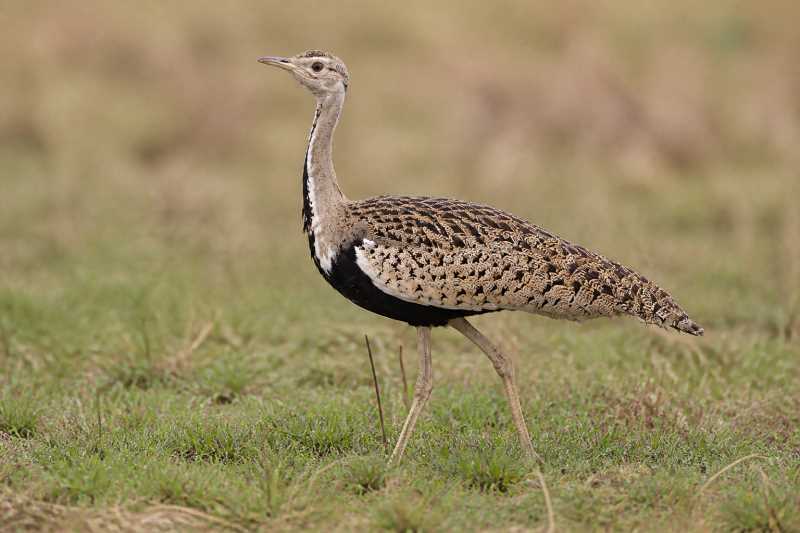
Adult males are strongly patterned. They have a black belly and breast, a narrow black stripe down the front of the neck, and a boldly marked head with contrasting black, white and buff areas. The wings show prominent white areas in flight, contrasting with darker flight feathers.
Females are more cryptic. They are mainly buff-brown with fine darker mottling and vermiculations across the head, neck, breast and upperparts, and they lack the male’s extensive black underparts. Juveniles resemble females but are generally duller and more heavily marked. The sexes are therefore readily distinguishable in the field, especially when the male is standing in open grassland.
Range and Habitat
The species occurs widely but unevenly across sub-Saharan Africa, from parts of West Africa eastwards through Ethiopia and southwards into eastern and southern Africa, including South Africa. Its distribution is influenced by rainfall, habitat condition and local vegetation structure.
Black-bellied Bustards favour tall, open grassland, grassy savanna and lightly wooded areas. They may also occur in miombo and other open woodland, cultivated fields, pastures, fallow land and damp grassland near vleis or dambos. Some populations use habitats at elevations approaching 2,500 metres, although most records are from lowland and mid-altitude country.
The species is generally regarded as resident or locally mobile rather than a long-distance migrant. Movements may occur in response to seasonal rainfall, changing grass cover and the availability of invertebrate prey.
Where to See This Species
Kruger National Park, Mpumalanga and Limpopo, South Africa
The Black-bellied Bustard is included on the official Kruger bird checklist. SANParks identifies the Pretoriuskop region as one of the better areas in the park for finding this species, particularly in suitable open grassland and savanna habitat. Early morning and late afternoon searches along quieter roads and open clearings can be productive, although the bird may remain difficult to detect in tall grass.
Nearby accommodation: Kruger rest camps, safari lodges and campsites are available within and around the park. Hazyview is a practical gateway for access to the southern section.
Lake Mburo National Park, Western Region, Uganda
The Uganda Wildlife Authority lists the Black-bellied Bustard among the notable birds of Lake Mburo National Park. The park’s mixture of open acacia savanna, grassland, woodland and wetland margins provides suitable habitat, with the Rwonyo area recognised as an important birdwatching locality. It is best searched for on game drives or guided walks through open savanna and grassy areas.
Nearby accommodation: Lodges, tented camps and campsites are available around Lake Mburo National Park, while Mbarara is the main regional service town.
Behaviour and Diet
Black-bellied Bustards are primarily diurnal and spend most of their time walking through grassland rather than perching. They are usually seen singly or in pairs, although temporary gatherings may occur where food or suitable habitat is concentrated.
The diet is varied. Invertebrates such as grasshoppers, beetles, ants and other insects form an important part of it, supplemented by seeds, berries, flowers and green plant material. Small vertebrates may occasionally be taken, but they are not considered a major part of the normal diet.
Courtship is most conspicuous during the rainy or breeding season. The male may display from a low mound or other raised position before performing a slow, deliberate flight with exaggerated wingbeats. He may also puff out the throat and neck, raise the tail, expose the white wing panels and give distinctive popping, wheezy or guttural calls.
Nesting takes place on the ground. The female lays a small clutch, usually one or two eggs, in a shallow scrape among grass or near low vegetation. She undertakes incubation and care of the young, while the chicks are precocial and able to leave the nest soon after hatching.
Identification Tips
- Look for a medium-sized bustard with a long neck, long legs and a relatively slender profile.
- An adult male shows a striking black belly and breast, a black neck stripe and strong black, white and buff facial patterning.
- A female or juvenile is much plainer, appearing buff-brown and finely mottled below and above.
- White wing panels are conspicuous when the bird flies and can help confirm an otherwise distant sighting.
- The species is usually found walking through tall grass or open savanna, often freezing or relying on camouflage before flushing.
- Do not confuse the female with a male seen at a distance, as the sexes are markedly different in appearance. Hartlaub’s Bustard is a potentially confusing relative in parts of eastern Africa, but the Black-bellied Bustard generally has a more extensive black belly in the adult male and occurs in taller, often wetter grassland habitats.
Conservation Status
The Black-bellied Bustard is currently classified as Least Concern on the IUCN Red List. Its global population has not been reliably quantified, and the overall trend is considered to be declining or suspected to be declining in response to habitat degradation.
Important threats include the conversion and fragmentation of grassland for agriculture, settlement and infrastructure. Overgrazing, inappropriate fire regimes and the loss of tall grassland can reduce suitable habitat. Hunting may also affect local populations in some parts of the range.
Conservation measures include protecting remaining grasslands and savannas, maintaining appropriate grazing and fire management, and safeguarding populations within national parks, game reserves and other protected areas. Monitoring is particularly important in regions where grassland conversion is rapid.
Frequently Asked Questions
What is the scientific name of the Black-bellied Bustard?
The accepted scientific name is Lissotis melanogaster. The species is also widely known as the Black-bellied Korhaan.
Where does the Black-bellied Bustard live?
It occurs across parts of sub-Saharan Africa, inhabiting tall grassland, grassy savanna, lightly wooded country, cultivated areas and damp open habitats.
How can a male Black-bellied Bustard be identified?
The adult male has a black belly and breast, a narrow black stripe on the front of the neck, a strongly patterned head and prominent white areas in the wings.
What does the Black-bellied Bustard eat?
Its diet includes insects and other invertebrates, together with seeds, berries, flowers and green plant material. Small vertebrates may occasionally be eaten.
Is the Black-bellied Bustard migratory?
It is generally considered resident or locally mobile rather than a long-distance migrant. Seasonal movements may follow rainfall and changes in food availability.
Is the Black-bellied Bustard threatened?
It is globally classified as Least Concern, but habitat loss, grassland degradation, overgrazing, altered fire regimes and local hunting can threaten populations.
References
- IUCN Red List of Threatened Species
- IOC World Bird List
- SANParks
Related posts