Introduction
The Biscutate Swift (Streptoprocne biscutata) is a large South American swift in the family Apodidae. It is best known for its fast, agile flight, dark plumage and broken white collar. The species occurs mainly in Brazil, with a more restricted range extending into northeastern Argentina and possibly Paraguay, while records from Bolivia have also been documented.
Physical Description
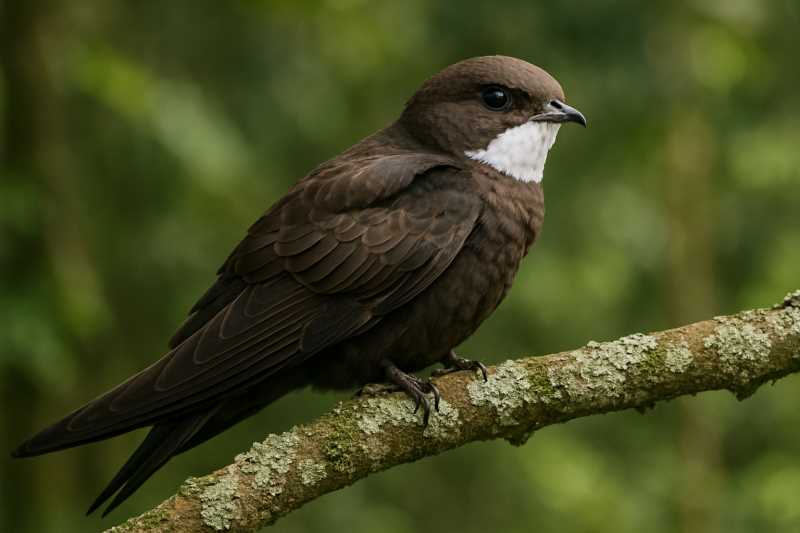
The Biscutate Swift is approximately 22 centimetres long and has a compact, streamlined body, long pointed wings and an almost square tail. Adults are predominantly sooty blackish-brown, with paler brown tones on the forehead, chin and around the eyes. The wing and tail feathers are darker on their outer webs and paler grey-brown on the inner webs.
A broad white band crosses the upper breast, while a narrower white marking extends across the nape and sides of the neck. These white areas do not form a complete collar, which is an important identification feature. The sexes are similar in appearance. Juveniles resemble adults but may show pale greyish-white feather edges on the underparts and pale tips to the tail feathers. The northern subspecies, S. b. seridoensis, is generally smaller than the nominate subspecies.
Range and Habitat
The Biscutate Swift is distributed mainly through eastern and southern Brazil. The nominate subspecies ranges from Minas Gerais southwards through parts of the Atlantic Forest region to Paraná, Santa Catarina and Rio Grande do Sul, continuing into Misiones Province in northeastern Argentina. A northern population, represented by S. b. seridoensis, occurs in parts of northeastern Brazil, including the Seridó region and areas from Piauí and Rio Grande do Norte south towards Bahia. Records from Bolivia have been confirmed, while the species remains uncertain or hypothetical in Paraguay in some regional taxonomic treatments.
It uses a variety of landscapes, including humid and dry forest, cerrado, caatinga, open country and rocky terrain. Cliffs, caves, canyons and other vertical rock formations are particularly important for roosting and nesting. The species is resident in parts of southern Brazil, but the northern population appears to move seasonally, with birds occurring farther north mainly during the austral winter months.
Where to See This Species
Parque Nacional de Aparados da Serra, Rio Grande do Sul, Brazil
The Biscutate Swift has been documented at Itaimbezinho Canyon within Parque Nacional de Aparados da Serra. The park’s deep canyon walls, waterfalls and open skies provide suitable conditions for a swift that nests and roosts around rocky formations. Look overhead around canyon rims and vertical cliffs, particularly when groups of swifts are actively feeding or calling.
Nearby accommodation: Cambará do Sul is the main gateway and offers pousadas, guest houses, hotels and self-catering accommodation.
Parque Nacional Cavernas do Peruaçu, Minas Gerais, Brazil
The species is included in official bird records for Parque Nacional Cavernas do Peruaçu. The park’s limestone canyons, caves, cliffs and surrounding dry woodland provide suitable habitat, although sightings are likely to be localised and may depend on season and weather. Visitors should scan the airspace above canyon systems and rocky entrances rather than expect the birds to remain perched in view.
Nearby accommodation: Fabião and Januária provide guest houses, small hotels, pousadas and self-catering accommodation for visitors to the park.
Behaviour and Diet
The Biscutate Swift is an aerial insectivore that captures flying insects in the air. It spends much of its active time in flight, using rapid wingbeats, glides and sharp changes of direction while foraging above forests, open country, cliffs and valleys. It may occur in single-species groups and can sometimes associate with other large swifts, including the White-collared Swift.
The species is sociable around roosting and nesting sites, where colonies may occupy caves, crevices or ledges on vertical rock faces. Its calls help maintain contact between birds in flight and within colonies.
Breeding has been studied in southern Brazil. Nest construction may begin in October, with egg-laying generally occurring in November in the studied colonies. Nests are built on rock ledges, slightly inclined surfaces or crevices using materials such as lichens, mosses, other plant matter and soil. Clutches may contain one to four eggs, and both parents participate in incubation and care of the young. Nesting success can be affected by rain, starvation, nestling falls, disturbance and the loss or ejection of eggs.
Identification Tips
- Look for a large, dark swift with long pointed wings and an almost square tail.
- The broad white band across the breast is usually more conspicuous than the narrower white marking on the nape.
- The white collar is incomplete, with a visible gap at the sides of the neck. This separates the species from the White-collared Swift, whose white collar normally forms a more complete band around the neck.
- The species is most often identified in flight, especially around cliffs, canyons, waterfalls and forest edges.
- Juveniles may appear slightly duller and show pale feather edging, but these details are difficult to assess on fast-moving birds.
Conservation Status
The Biscutate Swift is currently assessed as Least Concern. Its overall population size has not been established with confidence, and the species is not considered to face a single immediate global threat. Nevertheless, local populations may be affected by disturbance or loss of cave and cliff nesting sites, changes to surrounding habitat, pesticide exposure and changes in the abundance of flying insects.
Protecting known colonies, maintaining natural cliff and cave habitats, and conserving the forest, woodland and open landscapes used for aerial feeding are appropriate conservation measures. More information on population size, seasonal movements and the status of the northern population would improve conservation planning.
Frequently Asked Questions
Where is the Biscutate Swift found?
It occurs mainly in eastern and southern Brazil, with a smaller range extending into northeastern Argentina. Records have also been confirmed in Bolivia, while its status in Paraguay is uncertain in some regional assessments.
How can the Biscutate Swift be identified?
Look for a large sooty-black swift with a broad white band across the breast, a narrower white marking on the nape and an almost square tail. The white collar is incomplete rather than fully encircling the neck.
What does the Biscutate Swift eat?
It feeds on flying insects caught during aerial foraging. The exact diet has not been documented in detail, but it is considered an aerial insectivore like other large swifts in its group.
Where does the Biscutate Swift nest?
It nests colonially on cliffs, in caves, rock crevices and on ledges or vertical surfaces. Nest material includes lichens, mosses, other plant matter and soil.
Is the Biscutate Swift migratory?
The species is resident in parts of southern Brazil, while the northern population appears to move seasonally. Birds occur farther north mainly during the austral winter, from approximately February to October.
Is the Biscutate Swift endangered?
No. It is currently classified as Least Concern, although local nesting sites and feeding habitats should still be protected and the species’ population trend requires further study.
References
- BirdLife International
- Cornell Lab of Ornithology, Birds of the World
- Instituto Chico Mendes de Conservação da Biodiversidade
Related posts