Introduction
The Pale-bellied Hermit (Phaethornis anthophilus) is a medium-sized hummingbird in the family Trochilidae. It occurs from eastern and central Panama through northern and eastern Colombia to western and northern Venezuela. Despite its name, it is recognised in the field as much by its dark facial mask, pale underparts, long tail and hermit-like foraging behaviour as by its belly colour.
Physical Description
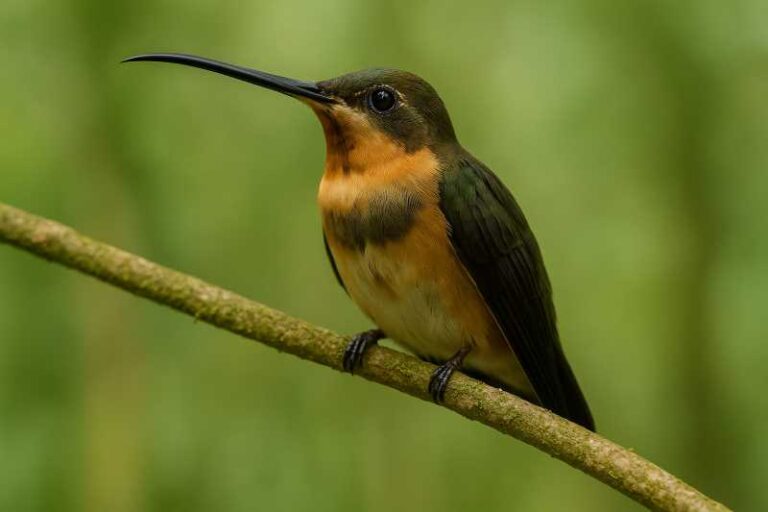
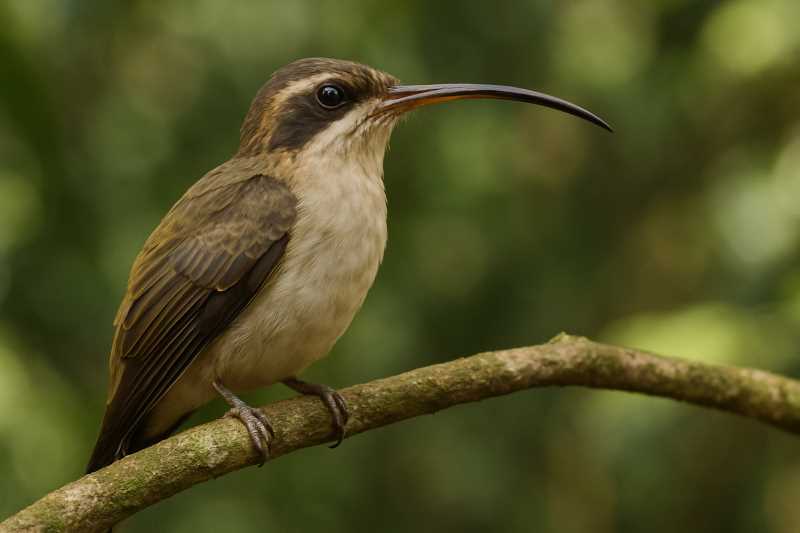
The Pale-bellied Hermit is about 13 centimetres long. It has green to olive-green upperparts, paler greyish or buff-tinged underparts, and a distinctive dark facial mask bordered by pale lines above and below the eye. The throat is generally pale, while the flanks and undertail may show warmer buff or cinnamon tones.
Its bill is moderately long and slightly curved, although bill shape can vary between sexes and geographic forms. The tail is relatively long, with pale or whitish tips that are especially noticeable when the bird is perched or hovering. The sexes are broadly similar in plumage, and reliable age-related differences are not usually obvious in the field. The proposed form P. a. fuscicapillus has sometimes been treated separately from the nominate population, so geographic variation should be interpreted cautiously.
Range and Habitat
The species is found in Panama, Colombia and Venezuela. In Panama, its distribution includes eastern and central areas and the Pearl Islands. In Colombia, it occurs mainly in the northern lowlands, the Magdalena Valley and regions east of the Andes. Its Venezuelan range includes western and northern areas and extends eastwards along parts of the coastal and foothill regions.
The Pale-bellied Hermit is primarily a lowland and lower-foothill bird, with records generally reaching to about 900 metres. It uses semi-deciduous and humid forest, gallery forest, secondary growth, plantations, woodland, scrub and other habitats with dense vegetation and flowering plants. It is resident rather than a long-distance migrant, although local movements may occur as birds respond to flowering and changes in food availability.
Geographic variation
Two subspecies are commonly recognised: the nominate Phaethornis anthophilus anthophilus, found across most of the mainland range, and P. a. hyalinus, associated with the Pearl Islands of Panama. A further form, P. a. fuscicapillus, has been proposed for populations east of the Andes, but its taxonomic treatment is not consistent among authorities.
Where to See This Species
Tayrona National Natural Park, Magdalena, Colombia
The Pale-bellied Hermit has been recorded in and around Tayrona National Natural Park, particularly in the lower-elevation forest and woodland of the Santa Marta region. Nearby Minca is also a recognised birding base where the species has been reported at hummingbird feeders and in suitable forest-edge habitat. Look along shaded trails, forest edges and flowering vegetation, especially during the morning.
Nearby accommodation: Santa Marta and Minca offer hotels, guest houses, eco-lodges and self-catering accommodation.
Catatumbo Barí National Natural Park, Norte de Santander, Colombia
The species is documented from Catatumbo Barí, where humid lowland forest, transitional woodland and riverine vegetation provide suitable habitat. The park is remote and comparatively little visited, so sightings are more realistic for birders travelling with local support and allowing time for quiet observation along forest and river corridors.
Nearby accommodation: El Tarra and nearby communities provide the most practical local base, with basic guest houses and small-scale accommodation; arrangements should be made locally before travelling.
Darién National Park, Darién Province, Panama
Darién National Park lies within the species’ Panamanian range and supports lowland forest, secondary growth and forest-edge habitats used by the Pale-bellied Hermit. The park is remote, and access commonly requires careful logistical planning, local guidance and attention to current entry arrangements. Yaviza and nearby settlements are useful gateways for organised wildlife trips.
Nearby accommodation: Yaviza and surrounding gateway communities offer basic guest houses, small lodges and camping options, while organised expeditions may use forest camps.
Behaviour and Diet
The Pale-bellied Hermit is active during the day and usually forages alone. Like other hermits, it may follow a regular route between dependable flowering plants rather than defend a single feeding patch. It hovers while taking nectar and may also feed from flowers while perched.
Nectar provides most of its energy. The long bill and extendible tongue allow the bird to exploit tubular flowers that are difficult for shorter-billed pollinators to reach. Small insects and spiders are also taken, particularly when birds need additional protein for growth, maintenance or breeding.
Males may defend feeding areas or display sites through chases and vocal activity. The female is responsible for most nest construction and incubation. Hermit hummingbird nests are typically small structures made from plant fibres, moss and spider silk, attached beneath a leaf or to a slender support in shaded vegetation. Detailed information on the breeding schedule and incubation period of this species is limited, so precise timings should not be assumed without locality-specific evidence.
Identification Tips
- Look for a medium-sized hermit with olive-green upperparts, pale underparts and a dark facial mask.
- The pale belly and throat contrast with the darker face and back.
- Pale or whitish tail tips and a relatively long tail are useful at close range.
- The bill is long and slightly curved, but usually appears less extremely elongated than that of some long-billed hermits.
- In Panama and northern Colombia, compare it carefully with the Long-billed Hermit and other Phaethornis species. Bill length, facial pattern, belly colour, tail-tip colour and habitat are more reliable together than any single feature.
- Because hermits often move quickly through shaded vegetation, calls, repeated flight paths and several field marks should be assessed before confirming an identification.
Conservation Status
The Pale-bellied Hermit is currently assessed as Least Concern. Its broad distribution and ability to use secondary forest, woodland, plantations and other modified habitats reduce its immediate global extinction risk. Nevertheless, clearance and fragmentation of semi-deciduous forest, gallery forest and scrub can reduce feeding and nesting opportunities, particularly where agricultural expansion removes dense vegetation along waterways and forest margins.
Maintaining connected lowland forest, protecting riparian vegetation and retaining structurally diverse secondary growth are important conservation measures. The species’ overall population trend should be treated cautiously because detailed population estimates and consistent monitoring are limited.
Frequently Asked Questions
Where is the Pale-bellied Hermit found?
It is found in Panama, Colombia and Venezuela, mainly in lowland and lower-foothill habitats. Its range includes the Pearl Islands of Panama, the Magdalena Valley and northern Colombia, and parts of western and northern Venezuela.
What does the Pale-bellied Hermit look like?
It is a medium-sized hermit hummingbird with olive-green upperparts, pale greyish or buff-tinged underparts, a dark facial mask, a slightly curved bill and a long tail with pale tips.
What does the Pale-bellied Hermit eat?
It feeds mainly on nectar from flowering plants and supplements this diet with small insects and spiders.
Is the Pale-bellied Hermit migratory?
It is generally considered resident. Local movements may occur when birds follow changes in flowering, water availability or habitat conditions, but it is not known for regular long-distance migration.
Where is the best place to see this species?
Documented viewing locations include Tayrona National Natural Park in Colombia, Catatumbo Barí National Natural Park in Colombia and Darién National Park in Panama. Quiet observation in lowland forest, woodland edges and flowering vegetation offers the best chance of an encounter.
Is the Pale-bellied Hermit endangered?
No. It is currently assessed as Least Concern, although habitat loss, forest fragmentation and the degradation of gallery forest remain ongoing concerns.
References
- BirdLife International
- IUCN Red List of Threatened Species
- Birds of the World
Related posts