Introduction
The Ashy Wood Pigeon, Columba pulchricollis, is a medium-sized forest pigeon of the Himalayas and surrounding highlands of South and Southeast Asia. It is generally associated with wooded mountain landscapes, where its subdued plumage and quiet habits can make it difficult to detect.
Physical Description
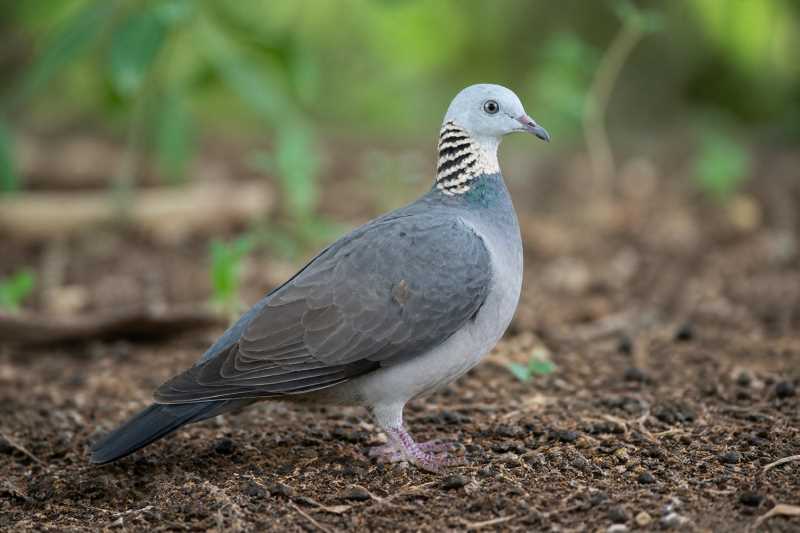
The Ashy Wood Pigeon measures approximately 31–36 cm in length. Adults have a bluish-grey head, a pale throat and breast, and darker grey upperparts. A distinctive pale, black-speckled collar across the hindneck is often the most useful field mark. The wings are darker than the body, while the tail is broadly squared with darker tips. The bill and legs are generally pale grey to pinkish-grey.
Males and females are broadly similar in appearance, with no consistently obvious sexual dimorphism reported in standard field descriptions. Reliable information on juvenile plumage is limited, but young birds may appear duller and less sharply marked than adults.
Range and Habitat
The species occurs from the Himalayan region of northern India, Nepal and Bhutan eastwards through Myanmar, northern Thailand, northern Laos and southern China, including Taiwan. It is also recorded in several forested parts of northeastern India. The Ashy Wood Pigeon is not endemic to a single country and is generally regarded as resident, with local or altitudinal movements in some areas.
It favours temperate, subtropical and montane forests, including evergreen and mixed woodland. Records commonly come from elevations of about 1,200–3,200 metres, although birds may move to lower elevations when local conditions or food availability change. Dense forest, mature trees and fruiting vegetation are important habitat features.
Where to See This Species
Neora Valley National Park, West Bengal, India
Ashy Wood Pigeons are included on the bird checklist for Neora Valley National Park. The park’s semi-evergreen and montane forests, particularly at middle and higher elevations, provide suitable habitat for this forest-dependent species. Look and listen quietly along forest tracks and in areas with fruiting trees, especially during periods of good bird activity.
Nearby accommodation: Lava and Loleygaon are practical gateway settlements with guest houses, homestays and small hotels. Kalimpong provides a wider range of hotels and other accommodation.
Chitwan National Park, Bagmati Province, Nepal
The Ashy Wood Pigeon is listed in the Chitwan National Park bird inventories. Although the species is likely to be local and less conspicuous here than in the park’s hill forests, forest edges, wooded river corridors and other areas with mature trees may offer opportunities for observation. Visits with an experienced local bird guide are advisable because the species is quiet and easily overlooked.
Nearby accommodation: Sauraha is the principal visitor gateway, with lodges, guest houses, hotels and other wildlife-tourism accommodation. Bharatpur is another practical base for access to the wider Chitwan area.
Behaviour and Diet
The Ashy Wood Pigeon is generally shy, quiet and difficult to approach. It is usually encountered alone, in pairs or in small groups rather than in large flocks. Its deep, subdued call may be heard before the bird is seen, particularly in dense woodland.
The diet is primarily plant-based and includes wild fruits, berries, seeds and other forest vegetation. Acorns and small invertebrates such as snails have also been reported in dietary accounts. By eating fruit and later moving through the forest, the species may contribute to the dispersal of plant seeds, although its precise ecological role has not been studied in detail across its range.
Breeding information is limited. The nest is a simple platform of twigs placed in a tree, and the usual clutch is one white egg, although two-egg clutches have been recorded. Incubation lasts approximately 21–23 days, and young birds may fledge at about four weeks of age. Breeding dates vary geographically, with records extending through parts of spring and summer.
Identification Tips
- Look for a medium-sized, stocky pigeon with an overall bluish-grey appearance.
- Check for the pale throat and the contrasting black-speckled collar on the hindneck.
- The dark wings and broad, squared tail help separate it from smaller forest pigeons and doves.
- Its deep, low call can reveal its presence before the bird appears.
- The species may be confused with other Columba pigeons, especially the Speckled Wood Pigeon, but the Ashy Wood Pigeon lacks the latter’s prominent dark-and-pale wing pattern and chestnut tones.
- The best approach is to combine the collar pattern, overall grey coloration, habitat and elevation rather than relying on a single feature.
Conservation Status
The Ashy Wood Pigeon is currently assessed as Least Concern on the global IUCN Red List. However, the species depends substantially on forest habitat, and forest clearance, degradation, logging, agricultural expansion and infrastructure development may affect local populations.
Reliable population estimates are not available, and recent trend data are insufficient in parts of its range. Protected forests, careful management of montane woodland and the retention of mature fruiting trees are important conservation measures. Further surveys would help clarify its distribution, population trend and habitat requirements.
Frequently Asked Questions
Where can the Ashy Wood Pigeon be found?
It occurs in the Himalayan region and parts of South and Southeast Asia, including northern India, Nepal, Bhutan, Myanmar, northern Thailand, northern Laos, southern China and Taiwan.
What habitat does the Ashy Wood Pigeon prefer?
It mainly inhabits temperate, subtropical and montane forests, often between about 1,200 and 3,200 metres. It is associated with mature woodland and areas containing fruiting trees.
What does the Ashy Wood Pigeon eat?
Its diet consists mainly of fruits, berries, seeds and other plant material. Acorns and small invertebrates such as snails have also been reported.
Is the Ashy Wood Pigeon migratory?
It is generally considered resident, but some populations make local or altitudinal movements. Birds may move to different elevations in response to food availability and seasonal conditions.
How can the Ashy Wood Pigeon be identified?
Look for its bluish-grey body, pale throat and distinctive black-speckled collar on the hindneck. Its deep call, forest habitat and broad, squared tail are also useful clues.
Is the Ashy Wood Pigeon endangered?
No. It is currently classified globally as Least Concern. Nevertheless, habitat loss and degradation remain potential local threats, and population trends are not sufficiently known across its range.
References
- IOC World Bird List
- State of India’s Birds
- IUCN Red List of Threatened Species
Related posts