Allen’s Hummingbird: A Jewel of the Western Skies
In the diverse and vibrant tapestry of avian life, Allen’s Hummingbird (Selasphorus sasin) stands out as a true gem. With its iridescent plumage and agile flight, this small bird captures the imagination of birdwatchers and ornithologists alike. Native to the coastal regions of California and parts of southern Oregon, Allen’s Hummingbird is a fascinating species that offers insights into the complexities of avian migration, adaptation, and ecology.
Physical Description
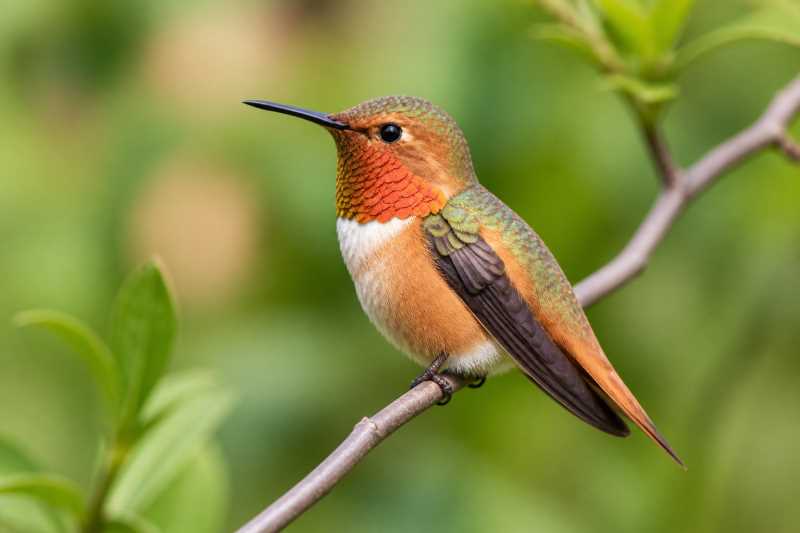
Allen’s Hummingbird is a small bird, measuring about 3 to 3.5 inches in length with a wingspan of approximately 4.3 inches. Despite its diminutive size, it is renowned for its vibrant coloring. The male Allen’s Hummingbird is particularly striking, with a brilliant orange-red throat, known as a gorget, and a shimmering green back and crown. The females and juveniles, while less flamboyant, are nonetheless beautiful with their greenish backs and rust-colored flanks.
Habitat and Distribution
The habitat preferences of Allen’s Hummingbird are closely tied to the coastal chaparral and scrub environments found along the Pacific Coast. These birds are predominantly found in coastal California, with a range extending from southern Oregon to the Los Angeles area. During the breeding season, they are particularly fond of areas with abundant flowering plants, which provide their primary food source—nectar.
Unlike many other hummingbird species, Allen’s Hummingbird is partially migratory. The nominate subspecies, S. s. sasin, migrates to central Mexico during the winter months, while the S. s. sedentarius subspecies is largely non-migratory, residing year-round in southern California.
Breeding and Behavior
The breeding behavior of Allen’s Hummingbird is a captivating spectacle. Males establish territories and perform elaborate aerial displays to attract females. These displays include rapid ascents followed by dramatic dives, during which the male produces a distinctive whistle-like sound. Once a female chooses a mate, she takes on the responsibility of nest building and rearing the young.
Nests are typically constructed in shrubs or trees, made from plant fibers, spider silk, and lichen, providing both camouflage and flexibility. The female lays two tiny, white eggs, which she incubates for about 15 to 17 days. Once hatched, the chicks are fed a diet of regurgitated insects and nectar until they fledge after approximately three weeks.
Feeding Habits
Allen’s Hummingbirds are primarily nectarivorous, relying heavily on the nectar of flowering plants for sustenance. Their long, specialized bills and extendable tongues enable them to extract nectar efficiently. In addition to nectar, they consume small insects and spiders, which provide essential proteins and nutrients.
These birds are known for their territorial behavior, often aggressively defending their feeding grounds from other hummingbirds and insects. This territoriality ensures a steady supply of food, crucial for their energy-intensive lifestyle.
Conservation Status
Currently, Allen’s Hummingbird is listed as "Least Concern" by the International Union for Conservation of Nature (IUCN). However, their population is subject to pressures from habitat loss and climate change. Urban development along the California coast and changes in flowering plant availability due to climate shifts pose significant threats to their habitats.
Conservation efforts for Allen’s Hummingbird focus on habitat preservation and restoration, particularly in breeding areas. Public awareness campaigns and citizen science initiatives, such as community-driven planting of native flowering plants, play a critical role in supporting local populations.
Conclusion
Allen’s Hummingbird is a testament to the incredible diversity and adaptability of avian species. Its vibrant presence along the Pacific Coast is not only a delight to those who encounter it but also a reminder of the intricate connections within our ecosystems. As we continue to study and protect these remarkable birds, they remain a vibrant symbol of the natural beauty and resilience of the western skies.
Related posts