Introduction
The Thick-billed Cuckoo (Pachycoccyx audeberti) is a large, elusive African cuckoo of woodland, forest edge and gallery forest. It is a specialised brood parasite, laying its eggs mainly in the nests of helmetshrikes. The species is patchily distributed and may be difficult to locate, even where it is recorded regularly.
Physical Description
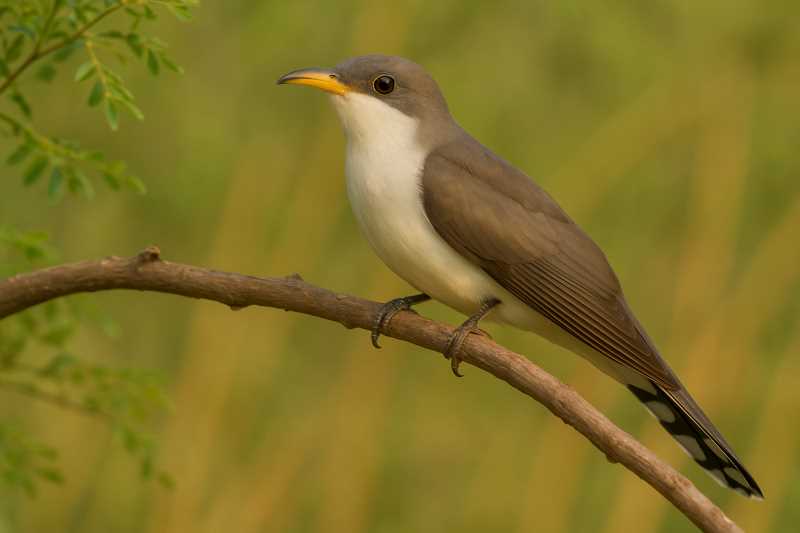
The Thick-billed Cuckoo is a large cuckoo measuring approximately 33–36 centimetres in length. Adults have grey to greyish-brown upperparts, white underparts, dark wings and a barred tail. The white lores, narrow yellow eye-ring and exceptionally deep, heavy bill are useful identification features. The bill is usually blackish, although the lower mandible can show yellowish or greenish tones.
The sexes are similar in appearance. Juveniles are more strongly marked, with dark brown upperparts, broad white spotting on the back and wings, and a contrasting black-and-white face. Plumage can appear browner and less sharply marked in worn adults.
Range and Habitat
The species is distributed patchily across sub-Saharan Africa, with records from parts of West and Central Africa and from eastern and southern Africa, including Tanzania, Zambia, Malawi, Mozambique, Zimbabwe, South Africa and Namibia. Madagascar has also been associated with distinct regional forms in taxonomic treatments, although the status and distribution of these populations require careful interpretation.
Thick-billed Cuckoos are generally associated with humid or subhumid woodland, miombo, mopane woodland, gallery forest, forest edge and other well-developed wooded habitats. In southern Africa, they are often recorded in woodland containing suitable helmetshrike hosts. They may occur near rivers and other areas where woodland remains relatively dense.
The species is uncommon to rare across much of its range. Some populations are migratory or seasonally mobile, while others may be nomadic in response to rainfall, food availability and breeding conditions. Its movements are not fully understood, and records can be irregular from year to year.
Where to See This Species
Kruger National Park, Limpopo and Mpumalanga, South Africa
Kruger National Park includes the Thick-billed Cuckoo on its official bird checklist. BirdLife South Africa also identifies the northern part of the park, particularly the Punda Maria area, as a place where the species may be encountered in summer. Look in mature woodland and along wooded river courses, especially during the warmer and wetter months.
Nearby accommodation: Kruger has a wide range of official rest camps, campsites and safari lodges. Phalaborwa, Hoedspruit and towns near the park’s southern and western boundaries provide additional hotels, guest houses and self-catering accommodation.
Mapungubwe National Park, Limpopo, South Africa
Mapungubwe National Park includes the Thick-billed Cuckoo on its official bird checklist. The park’s riverine woodland, mopane woodland and mixed savanna provide suitable habitat, although the species remains an irregular and specialised sighting. Concentrate on wooded areas and listen for calls during the warmer season.
Nearby accommodation: Accommodation is available in the park through official camps and self-catering facilities. Musina is the nearest practical gateway town for additional hotels, guest houses and other accommodation.
Mana Pools National Park, Mashonaland West, Zimbabwe
The Thick-billed Cuckoo is included on the Mana Pools bird checklist, and the park has also produced records suggesting local breeding activity. The Zambezi Valley’s mature riverine woodland and surrounding mopane and mixed woodland are suitable places to search, particularly during the wetter part of the year.
Nearby accommodation: Mana Pools offers park campsites, lodges and safari camps, while Chirundu is the nearest recognised gateway settlement with further accommodation options.
Behaviour and Diet
The Thick-billed Cuckoo is usually solitary and unobtrusive, often remaining still in leafy cover. It may forage in the canopy and middle layers of woodland, taking caterpillars, grasshoppers, mantids and other large insects. Its powerful bill is well suited to seizing sizeable invertebrate prey.
The species is a specialised brood parasite. It does not build a nest or raise its own young. Instead, the female lays an egg in the nest of another bird, most often a helmetshrike. Retz’s Helmetshrike is the best-documented host in southern Africa, while other helmetshrikes, including Red-billed, Chestnut-fronted and Chestnut-bellied Helmetshrikes, have also been recorded or considered as hosts in different parts of the range.
Breeding is associated with the availability of active host nests. The female may approach aggressively, displace the incubating host and remove or damage eggs before laying her own. The cuckoo chick normally develops rapidly and can dominate the host nest.
Calls are often described as a repeated, clear whistle such as “wheet-it”. Calling may be accompanied by a conspicuous flight display, and vocal activity is particularly useful for locating birds that remain hidden in woodland foliage.
Identification Tips
- Look for a large, heavy-bodied cuckoo with a noticeably thick bill.
- Adults show grey or grey-brown upperparts, white underparts, dark wings and a barred tail.
- The white lores and narrow yellow eye-ring are useful at close range.
- In flight, the bird can appear powerful and somewhat raptor-like because of its broad wings and substantial body.
- Juveniles are browner and more heavily spotted above than adults.
- The species lacks the crest of the Great Spotted Cuckoo and differs from that species in its heavier bill and cleaner white underparts.
- The absence of a prominent crest and the white lores help separate it from some other large African cuckoos, although lighting and worn plumage can make field identification difficult.
- In suitable habitat, the repeated whistled call may be easier to detect than the bird itself.
Conservation Status
The Thick-billed Cuckoo is currently assessed as Least Concern. Its global population has not been reliably quantified, and detailed population trends are poorly documented because the species is uncommon, patchily distributed and difficult to study.
The principal conservation concern is the loss and fragmentation of mature woodland and forest habitat, including miombo and riverine woodland. Declines in suitable habitat could also affect the helmetshrikes on which the cuckoo depends for breeding. Protecting extensive woodland, maintaining habitat corridors and conserving healthy populations of host species are important measures for the species.
Frequently Asked Questions
Where does the Thick-billed Cuckoo live?
It occurs patchily across sub-Saharan Africa in humid or subhumid woodland, miombo, mopane woodland, gallery forest and forest edge. Some taxonomic treatments also recognise regional populations in Madagascar.
Is the Thick-billed Cuckoo migratory?
Some populations are migratory or seasonally mobile, particularly in eastern and southern Africa. Other birds may move nomadically in response to rainfall, food availability and breeding conditions, so its movements are not uniform across the range.
What does the Thick-billed Cuckoo eat?
Its diet consists mainly of large insects and other invertebrates, including caterpillars, grasshoppers and mantids. It commonly searches for prey in the canopy and middle layers of woodland.
Which birds host the Thick-billed Cuckoo?
The species is a specialised brood parasite of helmetshrikes. Retz’s Helmetshrike is the best-documented host, while Red-billed, Chestnut-fronted and Chestnut-bellied Helmetshrikes have also been associated with it in different regions.
How can the Thick-billed Cuckoo be identified?
Look for a large cuckoo with a very thick bill, grey or grey-brown upperparts, white underparts, dark wings, a barred tail, white lores and a narrow yellow eye-ring. Its repeated whistled call is also useful.
Is the Thick-billed Cuckoo threatened?
It is currently classified as Least Concern, but habitat loss and fragmentation remain important concerns. Conservation of mature woodland and the cuckoo’s helmetshrike hosts is central to its long-term protection.
References
- IOC World Bird List
- BirdLife International
- SANParks
Related posts