Hidden within the lush, mist-shrouded rainforests of southeastern Queensland and far northeastern New South Wales, Albert’s Lyrebird (Menura alberti) reigns as one of Australia’s most elusive and fascinating songbirds. A close relative of the more widely known Superb Lyrebird, Albert’s Lyrebird is a lesser-known, more localized species with a captivating song and ornate tail feathers. Though secretive by nature, this bird is a gem of the Gondwana Rainforests and a living testament to the power of evolutionary adaptation through sound and spectacle.
Identification and Physical Description
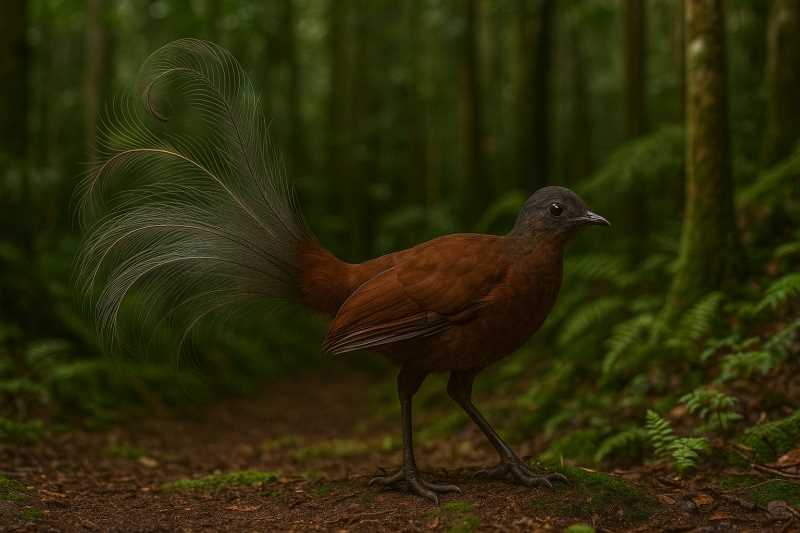
Albert’s Lyrebird is a large, ground-dwelling passerine, measuring up to 90 cm in length, with the male significantly larger than the female. Males possess a spectacular tail, which they display during courtship rituals. The tail consists of 16 feathers: two lyrate outer feathers that curve gracefully, two filamentary median feathers, and twelve broader rectrices with a delicate, lace-like pattern. Unlike the Superb Lyrebird’s silver-tinged plumes, Albert’s Lyrebird’s tail is rich brown and fawn with more subdued coloration.
The bird’s body is primarily chocolate brown with rufous flanks, a greyish throat, and a short, curved bill. It has powerful legs and feet adapted for scratching through leaf litter in search of insects, spiders, and other invertebrates, its primary diet.
Vocal Mastery and Mimicry
The most celebrated feature of Albert’s Lyrebird is its extraordinary vocal ability. Males, particularly during the breeding season (May to August), produce a remarkable array of calls, incorporating both their own vocalizations and an astounding variety of imitated sounds. These include the calls of other rainforest birds such as whipbirds, catbirds, and bowerbirds, as well as mechanical noises like camera shutters or chainsaws when exposed to human influence.
The male’s song is not just a showcase of mimicry—it is a carefully structured performance. Perched on a display mound, he sings for hours each day, repeating complex sequences to attract females and ward off rival males. Recent research suggests individual males have unique repertoires, passed down and elaborated across generations.
Habitat and Range
Albert’s Lyrebird is endemic to Australia and has one of the most restricted ranges of any Australian bird species. It occurs only in the subtropical rainforests of the Macpherson, Border, and Tweed Ranges, spanning parts of Lamington National Park, Springbrook, Mount Warning, and surrounding areas. These forests, remnants of ancient Gondwanan rainforest, provide dense undergrowth, high humidity, and abundant leaf litter—ideal conditions for foraging and nesting.
The bird’s preference for dense, undisturbed rainforest makes it particularly sensitive to habitat fragmentation and human disturbance. It avoids open areas and is rarely seen except by patient birdwatchers willing to wait quietly along forest trails.
Courtship and Breeding
Breeding takes place in winter, when males build one or more display platforms—cleared patches of forest floor or raised mounds of soil and leaves. Here, they fan out their tails over their heads and sing elaborate songs to impress visiting females.
Females are solely responsible for nest construction, incubation, and chick rearing. The nest is a large dome of sticks, ferns, and moss, usually placed in a tree stump, hollow, or bank. Only one egg is laid, and the chick is raised without any assistance from the male.
This breeding strategy, with its heavy reliance on female care and extended development, reflects the lyrebird’s slow life cycle. Chicks remain dependent for many months, and individuals can live for over 20 years in the wild.
Conservation Status
Albert’s Lyrebird is listed as Near Threatened by the IUCN and as Vulnerable in Queensland due to its small range and specific habitat requirements. Habitat loss through logging, agriculture, and development has historically reduced its distribution, although much of its core habitat is now protected within national parks and World Heritage-listed areas.
Climate change poses a looming threat, with shifting rainfall patterns and increased temperatures potentially altering the rainforest microclimates that this species depends on. Conservation efforts focus on protecting remaining habitat, monitoring populations, and mitigating the impacts of tourism and fire.
Observing Albert’s Lyrebird
For birdwatchers, seeing an Albert’s Lyrebird in the wild is a rare and rewarding experience. Lamington National Park offers some of the best opportunities, especially in the early morning during the breeding season. The bird’s incredible song often gives away its presence long before it is seen.
To improve your chances, move quietly along well-vegetated trails, listen carefully for the bird’s complex song, and remain still if you hear rustling in the undergrowth. A fleeting glimpse of a fanned tail or a burst of mimicked birdcalls might just reveal one of Australia’s most remarkable avian performers.
Related posts