Introduction
The Green-breasted Mountaingem (Lampornis sybillae) is a medium-sized hummingbird of the highlands of eastern Honduras and north-central Nicaragua. It is a resident of montane evergreen forest, pine-oak woodland and forest edges, where it feeds on nectar and small invertebrates.
Physical Description
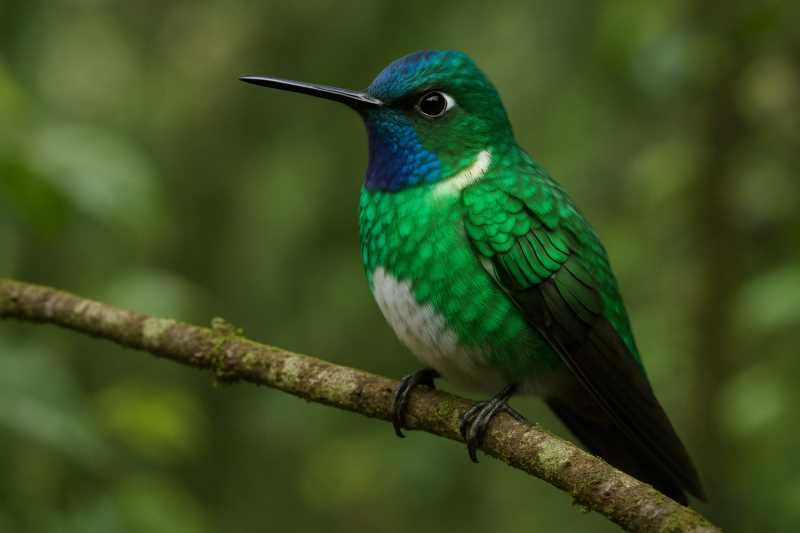
The Green-breasted Mountaingem is approximately 10–12 cm long and has a straight, medium-length black bill. Both sexes have metallic green upperparts, a white stripe curving behind the eye and conspicuous pale outer tail feathers.
Adult males are predominantly metallic green below, with paler feather margins and white on the lower belly, vent and leg tufts. Adult females are duller underneath, with greyish-white underparts, green on the sides of the breast and a buff chin and throat. Males are generally slightly larger than females.
Juveniles and immature birds are less clearly marked. Young birds may show mottling on the throat and buff or cinnamon edges to the upperpart feathers before acquiring adult plumage.
Range and Habitat
The species occurs in the highlands of eastern Honduras, particularly east of the Sula Valley, and in north-central and western Nicaragua. It is not native to Costa Rica or Panama, as stated in the original article.
It is associated with montane evergreen forest, humid pine-oak woodland, cloud forest and forest edges. Recorded elevations generally range from about 1,000 to 2,400 metres, with many observations concentrated between approximately 1,400 and 2,200 metres. It is considered resident, although local movements to lower elevations may occur outside the breeding period.
Where to See This Species
La Tigra National Park, Francisco Morazán, Honduras
La Tigra protects humid montane forest near Tegucigalpa and is one of the better-known accessible localities for Green-breasted Mountaingem. Look along forest trails, edges and flowering plants, especially in suitable middle- and upper-elevation habitat.
Nearby accommodation: Tegucigalpa is the main practical base, with hotels, guest houses and self-catering accommodation. Basic lodging may also be available near park access points.
Uyuca Biological Reserve, Francisco Morazán, Honduras
The reserve’s pine-oak and cloud-forest habitats support documented records of Green-breasted Mountaingem around 1,600 metres. Access may require prior permission because the reserve is associated with a research and education institution.
Nearby accommodation: The Zamorano and Valle de Yeguare area provides practical options including institutional lodging, guest houses and small hotels, subject to availability and access arrangements.
La Muralla National Park, Olancho, Honduras
La Muralla contains well-preserved cloud forest and transitional pine forest, habitats in which the species has been recorded during birding visits. Forest edges and roads through suitable highland habitat are reasonable places to search, although sightings are not guaranteed.
Nearby accommodation: La Unión is the nearest recognised gateway settlement, with basic hotels, guest houses and locally arranged accommodation.
Behaviour and Diet
The Green-breasted Mountaingem usually forages alone and may defend productive feeding areas from other hummingbirds. It visits flowering plants for nectar and also takes small insects and spiders, which provide protein and other nutrients.
Like other hummingbirds, it can hover while feeding and makes rapid movements between flowers and perches. Territorial chases and aerial disputes are most likely where flowering plants are concentrated. The species is also capable of making local altitudinal movements when food availability changes.
Breeding information is limited compared with that of better-studied hummingbirds. Observations from Honduras indicate territorial activity, courtship and nesting in the highlands, but a single nationwide breeding season should not be assumed for the whole range.
Identification Tips
- Look for a medium-sized hummingbird with a straight black bill, metallic green upperparts and a bold white stripe behind the eye.
- The pale outer tail feathers can produce a noticeable white flash when the bird fans or opens its tail.
- Adult males are largely green below, whereas females have greyish-white underparts and a buff chin and throat.
- The closely related Green-throated Mountaingem (Lampornis viridipallens) is the main potential comparison. Green-breasted Mountaingem males are more extensively green below, and the female usually has a buffier throat. The two species are largely separated geographically, with L. viridipallens occurring mainly west of the Sula Valley and L. sybillae to the east.
- The Amethyst-throated Mountaingem has a more noticeably downcurved bill and a different throat pattern, while Rivoli’s Hummingbird is larger with a longer bill and a different white facial marking.
Conservation Status
The Green-breasted Mountaingem is currently assessed as Least Concern. Its total population has not been reliably quantified, and some assessments indicate that the population may be declining.
The principal concerns are the loss and degradation of montane forest through agriculture, logging, fire and other land-use changes. Climate change may also alter the distribution and quality of cloud-forest habitat. Protecting remaining forest, maintaining connected habitat and managing protected areas effectively are important conservation measures.
Frequently Asked Questions
Where is the Green-breasted Mountaingem found?
It is found in the highlands of eastern Honduras and north-central Nicaragua. It is not a Costa Rican or Panamanian species.
What habitat does the Green-breasted Mountaingem prefer?
It mainly uses humid montane evergreen forest, cloud forest, pine-oak woodland and forest edges, usually at middle to high elevations.
How can male and female Green-breasted Mountaingems be distinguished?
Adult males are mostly metallic green below. Females have paler greyish-white underparts, green on the sides of the breast and a buff chin and throat.
What does the Green-breasted Mountaingem eat?
Its diet consists mainly of flower nectar, supplemented by small insects and spiders.
Is the Green-breasted Mountaingem migratory?
It is generally regarded as a resident species. Local altitudinal movements may occur, particularly when flowering conditions and food availability change.
Is the Green-breasted Mountaingem endangered?
No. It is currently classified as Least Concern, although habitat loss and possible population decline remain conservation concerns.
References
- IOC World Bird List
- IUCN Red List of Threatened Species
- Birds of the World, Cornell Lab of Ornithology
Related posts