Introduction
The African Black Duck, Anas sparsa, is a medium-sized African waterfowl species also known as the Black River Duck. It is a mainly resident duck associated especially with wooded rivers and streams in sub-Saharan Africa. Its dark plumage, orange legs and preference for fast-flowing freshwater distinguish it from many other African ducks. (birdlife.org.za)
Physical Description
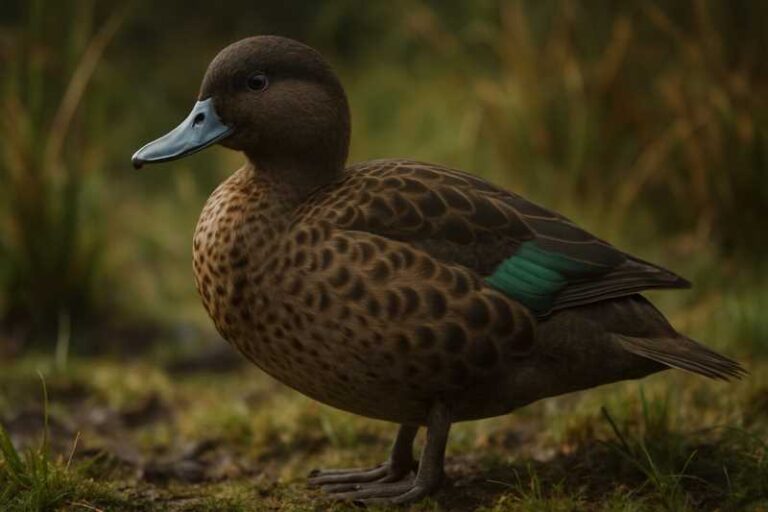
The African Black Duck measures approximately 48–57 cm in length and weighs about 0.915–1.090 kg. Adults are predominantly dark chocolate-brown to blackish, with irregular white markings on the back, wings and tail. The iridescent green or purple speculum is most conspicuous in flight. The legs and feet are orange to yellow, while the eyes are dark brown.
Males and females have broadly similar plumage, although males are generally larger. Bill colour varies geographically. Birds of southern Africa commonly have a dark blue-grey or blackish bill, whereas northern populations may show more pink on the bill. Juveniles are browner, with buff markings and paler underparts. (birdlife.org.za)
Range and Habitat
The species is endemic to Africa south of the Sahara. Its main range extends through eastern and southern Africa, from South Africa northwards through Zimbabwe, Zambia, Malawi, Tanzania, Kenya, Ethiopia and Sudan. Disjunct populations also occur in parts of west equatorial Africa, including south-eastern Nigeria, Cameroon and Gabon. The original range should not be extended to Senegal without supporting evidence.
Two subspecies are generally recognised: the nominate South African Black Duck, A. s. sparsa, and the Pink-billed Black Duck, A. s. leucostigma. The latter occupies much of the northern and western part of the range, while A. s. sparsa occurs mainly in southern Africa. Taxonomic treatments may differ in their handling of subspecies.
African Black Ducks favour clear, well-vegetated rivers, streams and smaller waterways, particularly in wooded, mountainous or highland landscapes. They may also use lakes, ponds, reservoirs and other freshwater habitats, but running water is a notable preference. The species is considered resident rather than long-distance migratory, although local movements may occur in response to rainfall, water levels, food availability and breeding conditions. (birdlife.org.za)
Behaviour and Diet
African Black Ducks are generally secretive and territorial. They are most often encountered singly, in pairs or in small groups rather than in large flocks. They commonly forage at dawn and dusk and may swim, dabble, up-end or dive briefly in running water.
The diet is omnivorous and varies with habitat and season. Recorded food includes aquatic insects and their larvae, crustaceans, molluscs, larval amphibians, fish spawn, waterweeds, other aquatic vegetation, seeds, agricultural grain, fallen acorns and fruits from plants growing near water. The species’ ability to forage in swift streams helps explain its close association with riverine habitats. (ebird.org)
Breeding information remains less comprehensive than for many widespread ducks. Breeding can occur during much of the year, but timing varies geographically and is often linked to local seasonal conditions. The female usually places the nest on or near the ground, concealed in dense vegetation close to water. Nests are lined with plant material and down. Clutches commonly contain four to eight eggs, and incubation lasts approximately 28–30 days. The female is primarily responsible for incubation and care of the precocial ducklings, which leave the nest soon after hatching. (birdlife.org.za)
Identification Tips
Look for the following combination of features:
- A medium-sized duck with overall dark chocolate-brown or blackish plumage.
- Irregular white spots or rough barring across the back, rump, wings and tail.
- A green or purple speculum that is particularly visible in flight.
- Orange to yellow legs and feet.
- A dark blue-grey, blackish or partly pinkish bill, depending on geographic region.
- A preference for wooded, fast-flowing rivers and streams.
The African Black Duck can be confused with the Yellow-billed Duck, Anas undulata. The African Black Duck is generally darker, has a shorter-looking neck and lacks the Yellow-billed Duck’s conspicuously bright yellow bill. Its white back markings and association with wooded running water are also useful field clues. (ebird.org)
Conservation Status
The African Black Duck is currently assessed as Least Concern on the IUCN Red List. This category does not mean that all populations are secure. Regional declines and local pressures have been reported, while reliable information on population size and long-term trends remains limited in some parts of the range.
Important pressures include the loss and degradation of riparian vegetation, pollution, changes to river flow, dam construction, agricultural expansion and disturbance of freshwater habitats. Conservation measures should focus on protecting riverine and wetland habitats, maintaining environmental flows, reducing pollution, retaining dense bankside vegetation and improving monitoring of regional populations. (birdlife.org.za)
Frequently Asked Questions
Where does the African Black Duck live?
It occurs in sub-Saharan Africa, mainly in eastern and southern Africa, with additional isolated populations in parts of west equatorial Africa. It is most strongly associated with wooded rivers, streams and other freshwater habitats.
Is the African Black Duck migratory?
It is generally regarded as a resident species rather than a long-distance migrant. Local or seasonal movements may occur when rainfall, water levels or food availability change.
What does the African Black Duck eat?
It eats both plant and animal material, including aquatic vegetation, seeds, grain, fruits, insects, crustaceans, molluscs, amphibian larvae and fish spawn.
How can the African Black Duck be identified?
It is a dark duck with irregular white markings on the back and wings, orange legs, a variable-coloured bill and a green or purple speculum. It is often found on fast-flowing, wooded waterways.
How many eggs does it lay?
A clutch usually contains four to eight eggs. Incubation lasts about 28–30 days, and the female normally incubates the eggs and leads the ducklings after hatching.
Is the African Black Duck endangered?
It is currently classified as Least Concern globally. Nevertheless, habitat degradation, pollution, altered river flows and other local pressures can affect populations, so protection of freshwater and riparian habitats remains important.
References
- BirdLife South Africa. 2024. “African Black Duck Anas sparsa.” In Red Data Book and Red List. BirdLife South Africa. Available at: https://www.birdlife.org.za/red-data-book/red-list/african-black-duck/ (accessed 8 September 2026).
- BirdLife International. 2024. “Species factsheet: African Black Duck Anas sparsa.” BirdLife DataZone. Available at: https://datazone.birdlife.org/species/factsheet/african-black-duck-anas-sparsa (accessed 8 September 2026).
- Carboneras, C. and Kirwan, G. M. 2020. “African Black Duck Anas sparsa, version 1.0.” In: del Hoyo, J., Elliott, A., Sargatal, J., Christie, D. A. and de Juana, E. (eds), Birds of the World. Cornell Lab of Ornithology. https://doi.org/10.2173/bow.afbduc1.01.
- Gill, F., Donsker, D. and Rasmussen, P. (eds). 2026. IOC World Bird List, version 15.2. International Ornithologists’ Union. Available at: https://www.worldbirdnames.org/ (accessed 8 September 2026).
- Lavretsky, P., Russell, R., Gonzalez, S., Musni, V. M., Díaz, A. and Brown, J. I. 2025. “Evolution, population structure and morphology of the African Black Duck Anas sparsa and Yellow-billed Duck A. undulata.” Ostrich 96(2). https://doi.org/10.2989/00306525.2025.2509215.
- Siegfried, W. R. 1968. “The Black Duck in the south-western Cape.” Ostrich 39(2): 61–75. https://doi.org/10.1080/00306525.1968.9634279.
- South African National Biodiversity Institute and Animal Demography Unit. 2000. “Anatidae: ducks, geese and swans.” In The Southern African Bird Atlas Project. Available at: https://sabap2.birdmap.africa/docs/sabap1/105.pdf (accessed 8 September 2026).
Related posts