Introduction
The Yucatan Nightjar (Antrostomus badius) is a medium-sized member of the nightjar family, Caprimulgidae. It is associated mainly with the Yucatán Peninsula and nearby parts of northern Central America. Its nocturnal activity, cryptic plumage and habit of calling from concealed perches make it easier to detect by sound than by sight.
Physical Description
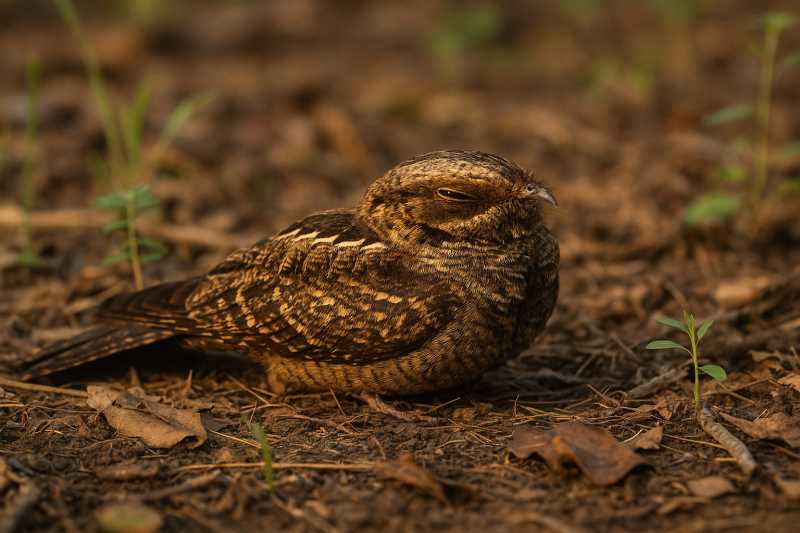
The Yucatan Nightjar is approximately 25 cm long. It has a relatively large head, long pointed wings and soft, mottled plumage in dark brown, grey, buff and cinnamon tones. A broad tawny or buff collar across the hindneck is a useful identifying feature. The breast and belly are dark with coarse pale spotting, while the underparts and upperparts are strongly patterned to blend with leaf litter, bark and shaded ground.
The sexes are similar, but the male has broad white tips on the outer tail feathers. In the female, these tips are narrower and buff or buff-white. The species has the large eyes, short bill and conspicuous rictal bristles typical of nightjars. Reliable information on age-related plumage differences is limited.
Range and Habitat
The species breeds on the Yucatán Peninsula of Mexico, including Cozumel Island. Outside the breeding season, it is recorded in northern Belize, northern Guatemala and north-western Honduras. It is therefore not strictly confined to the peninsula throughout the year, although the Yucatán region is the centre of its distribution.
It is associated with dry and semi-humid broadleaf woodland, scrub, brushy woodland, forest edge, second-growth vegetation and nearby clearings. It may use open or lightly wooded sites for foraging and shaded ground or low vegetation for daytime roosting. Most records are from lowland areas, and it is not considered a montane species. Seasonal movements appear to be short-distance, with some birds moving south from the peninsula during the non-breeding season.
Behaviour and Diet
The Yucatan Nightjar is primarily nocturnal and is most active after dusk and before dawn. It commonly rests lengthwise on a branch or on the ground during daylight, where its plumage provides effective camouflage. Birds may call from concealed bushes or trees and can be difficult to locate even when nearby.
It feeds on flying insects, probably including moths, beetles and other nocturnal insects. Like other nightjars, it may hunt by making short aerial sallies from a perch, and it may also forage close to the ground. Its wide gape and rictal bristles help it take insects in flight.
The song is a clear, repeated, slightly downslurred phrase often transcribed approximately as “puc ree-u-reeeu” or “preeeo”. Calls have historically been confused with those of the Yucatan Poorwill, so identification by sound should be based on a recording or a careful comparison of the full vocal pattern. The song is reported mainly during the breeding period, but the precise timing can vary geographically.
The breeding season has not been defined with certainty. As in many nightjars, the eggs are believed to be laid directly on the ground without a constructed nest. A clutch of two eggs has been reported, but detailed information on incubation, parental care and chick development remains limited.
Identification Tips
Look and listen for the following combination of features:
- A relatively large-headed, dark and grey-brown nightjar with heavy pale spotting below.
- A broad tawny or buff hindneck collar.
- Broad white outer-tail tips in the male, contrasting with narrower buff-white tips in the female.
- Absence of a prominent white wing band, which helps distinguish it from some other nightjars.
- A clear, repeated call given from a concealed perch.
- Preference for woodland edges, scrub and lightly wooded clearings rather than dense, continuous rainforest.
The Yucatan Nightjar can be confused with the smaller Yucatan Poorwill (Nyctiphrynus yucatanicus). The nightjar is generally larger and more heavily built, with a more conspicuous tawny hindneck collar, coarser pale spotting on the underparts and more extensive white in the male’s outer tail. Their voices are also different, although confusion has occurred in published and field accounts.
Conservation Status
The Yucatan Nightjar is currently assessed as Least Concern on the IUCN Red List. The global assessment does not identify an immediate species-level threat, but local habitat loss and degradation from agricultural expansion, development and the clearance of woodland may affect suitable habitat, especially where scrub and forest edges are converted or heavily disturbed. The population trend has been reported as decreasing in some global summaries, although precise population estimates and detailed monitoring remain limited.
Important conservation measures include retaining dry and semi-humid woodland, scrub and forest-edge habitat across the Yucatán Peninsula and northern Central America, protecting connected areas within reserves, and improving knowledge of seasonal movements and breeding biology. Further field surveys and sound-recording work would help clarify the species’ distribution and population trend.
Frequently Asked Questions
Where does the Yucatan Nightjar live?
It breeds mainly on Mexico’s Yucatán Peninsula, including Cozumel Island. During the non-breeding season it may occur in northern Belize, northern Guatemala and north-western Honduras.
Is the Yucatan Nightjar migratory?
It is not a long-distance migrant. Some birds appear to make short seasonal movements from the Yucatán Peninsula into northern Central America, while other individuals may remain resident in or near the breeding range.
What does the Yucatan Nightjar eat?
It feeds on flying insects, including moths, beetles and other nocturnal insects. It usually captures prey during short flights from a perch or while hunting near the ground.
What does the Yucatan Nightjar sound like?
Its song is a clear, repeated phrase commonly transcribed approximately as “puc ree-u-reeeu” or “preeeo”. It is usually delivered from a concealed perch at night.
How can the Yucatan Nightjar be identified?
Useful field marks include its dark mottled plumage, broad tawny hindneck collar, heavily spotted underparts and extensive white tips on the male’s outer tail feathers. It is also larger and more strongly marked than the Yucatan Poorwill.
Is the Yucatan Nightjar threatened?
The species is currently classified as Least Concern. Nevertheless, the loss and degradation of woodland, scrub and forest-edge habitat may reduce local populations, and more monitoring is needed to determine the significance of reported declines.
References
- American Ornithologists’ Union. 1998. Check-list of North American Birds, 7th edition. American Ornithologists’ Union, Washington, DC. Species treatment for Antrostomus badius available in the Caprimulgidae section: https://americanornithology.org/wp-content/uploads/2019/07/AOSChecklistPter-Apod.pdf. Accessed 8 September 2026.
- Fagan, J. and Komar, O. 2016. Field Guide to the Birds of Northern Central America. Houghton Mifflin Harcourt, New York.
- Gill, F., Donsker, D. and Rasmussen, P., eds. 2026. IOC World Bird List, version 15.2. International Ornithological Community. https://www.worldbirdnames.org/. Accessed 8 September 2026.
- Hardy, J. W. and Straneck, R. 1989. The Silky-tailed Nightjar and other neotropical caprimulgids: unraveling some mysteries. The Condor, 91(1), 193–197. https://digitalcommons.usf.edu/condor/vol91/iss1/21/.
- Howell, S. N. G. and Webb, S. 1995. A Guide to the Birds of Mexico and Northern Central America. Oxford University Press, Oxford.
- IUCN. 2020. Antrostomus badius. The IUCN Red List of Threatened Species 2020: e.T22689795A163506971. https://doi.org/10.2305/IUCN.UK.2020-3.RLTS.T22689795A163506971.en. Accessed 8 September 2026.
- Schulenberg, T. S., Arizmendi, M. d. C., Rodríguez-Flores, C. I., Soberanes-González, C. A., Behrstock, R. A. and Van Tatenhove, A. 2020. Yucatan Nightjar (Antrostomus badius), version 1.0. In T. S. Schulenberg, ed., Birds of the World. Cornell Lab of Ornithology, Ithaca, New York. https://doi.org/10.2173/bow.yucnig1.01.
Related posts