Introduction
The Andaman Teal (Anas albogularis) is a small, endemic dabbling duck of the Andaman Islands in the Bay of Bengal. It was formerly treated by some authorities as a subspecies of the Sunda Teal, but is now generally recognised as a separate, monotypic species. Its restricted range and dependence on coastal and inland wetlands make it an important conservation priority. (worldbirdnames.org)
Physical Description
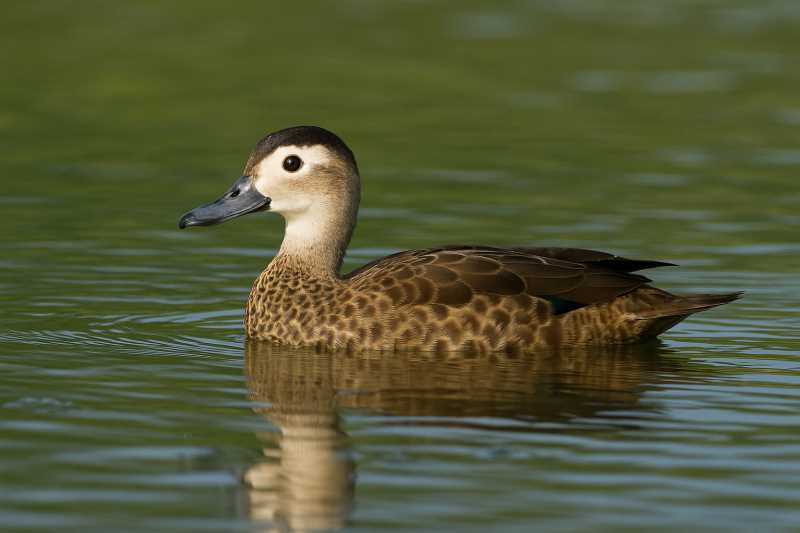
The Andaman Teal is a medium-sized duck with predominantly dark brown to greyish-brown plumage, often marked with fine buff or pale edging. The face and throat are noticeably paler than the crown and upperparts, and a contrasting white eye-ring is one of its most useful field marks. The bill is generally dark grey, while the iris may appear reddish or red-brown.
In flight, the wing shows a dark, glossy speculum with a conspicuous white border or leading edge. Males and females are broadly similar in appearance, although individual variation and age can affect the amount of pale colouring on the head and underparts. Juveniles tend to be duller and less clearly marked, with a less distinct eye-ring.
Reliable modern sources do not support the original article’s precise length estimate of 48–52 cm, so no exact body measurement is given here. (scribd.com)
Range and Habitat
The Andaman Teal is endemic to the Andaman archipelago of India and is not a long-distance migrant. It occurs in sheltered wetlands, including freshwater pools, marshes, lagoons, mangrove margins, brackish waterbodies and flooded rice fields. Shallow water with emergent or marginal vegetation provides feeding areas, cover and suitable nesting habitat.
Historical records concentrated on South Andaman, but surveys have also recorded the species in parts of North and Middle Andaman. New wetlands formed or altered by the 2004 earthquake and tsunami created additional habitat in some areas and were associated with a documented range expansion within the islands. The species is generally found at low elevations, close to wetlands and coastal habitats. (threatenedtaxa.org)
Behaviour and Diet
Andaman Teals are usually seen singly, in pairs or in small groups, although larger gatherings may form where suitable wetlands provide abundant food. They are wary and may retreat into dense vegetation when disturbed. The species is considered resident, although local movements between wetlands may occur.
Feeding commonly takes place in shallow water, muddy margins, flooded fields and wetland vegetation. The diet includes aquatic invertebrates, such as insects and molluscs, together with seeds and other plant material. Feeding activity may increase around dusk or at night, particularly in rice fields and other open wetlands.
Breeding records from South Andaman indicate a breeding season broadly extending from July to October. Nests have been reported in concealed vegetation, including reed or grass cover near water. Clutch size and nesting behaviour remain relatively poorly documented, and older accounts of regular nesting in tree cavities should be treated cautiously. A published field note recorded a clutch of approximately seven eggs, while broader summaries report clutches of about seven to nine eggs and an incubation period of roughly 25–26 days. (biodiversitylibrary.org)
Identification Tips
Look for the following combination of features:
- Dark brown or greyish-brown overall plumage.
- A pale face and throat contrasting with a darker crown and nape.
- A conspicuous white eye-ring.
- A dark bill and generally dark legs.
- A dark, glossy wing speculum with a noticeable white border in flight.
- A preference for shallow, vegetated wetlands, mangrove edges and flooded fields.
The white eye-ring and pale throat help separate the Andaman Teal from the more numerous Lesser Whistling-Duck in Andaman wetlands. Identification can be more difficult when comparing it with other brown teals, particularly the Sunda Teal, because the two were historically treated as closely related forms. Range, the strong facial pattern and the Andaman Teal’s distinctive wing markings are useful supporting characters. (birdwatching.asia)
Conservation Status
The Andaman Teal is currently classified as Near Threatened on the IUCN Red List. The species was previously assessed as Vulnerable, but its status was revised to Near Threatened in the 2024 Red List review. (forums.birdlife.org)
The principal conservation concerns are the loss, alteration and fragmentation of wetlands, including drainage, land reclamation, changes to coastal habitats and disturbance around feeding and breeding sites. The species’ restricted island range makes it particularly sensitive to environmental changes, even where local numbers appear stable or have increased following the creation of new wetlands.
Important conservation measures include protecting mangroves, lagoons, marshes, rice-field wetlands and other shallow water habitats; maintaining natural water regimes; limiting damaging reclamation and drainage; and continuing systematic surveys of population size, distribution and breeding success. Conservation planning should also account for the effects of coastal development, pollution and future changes in sea level and storm intensity. (threatenedtaxa.org)
Frequently Asked Questions
Where is the Andaman Teal found?
The species is endemic to the Andaman Islands of India, where it occurs in freshwater and brackish wetlands, lagoons, mangrove margins, marshes and flooded rice fields.
Is the Andaman Teal migratory?
No. It is regarded as a resident species, although individuals may move locally between wetlands as water levels, food availability and habitat conditions change.
What does the Andaman Teal eat?
Its diet includes aquatic insects, molluscs, other small invertebrates, seeds and aquatic plant material. It feeds mainly in shallow water, muddy margins and flooded fields.
How can the Andaman Teal be identified?
The most useful field marks are its dark brown plumage, pale face and throat, conspicuous white eye-ring and dark wing speculum with a contrasting white border.
When does the Andaman Teal breed?
Breeding has been recorded mainly during the monsoon and post-monsoon period, broadly from July to October. Nests are usually concealed in dense grass or reed-like vegetation near water.
What is the conservation status of the Andaman Teal?
The Andaman Teal is classified as Near Threatened. Wetland loss, coastal habitat alteration, drainage, reclamation and disturbance are among the main conservation concerns.
References
- BirdLife International. 2024. Species factsheet: Andaman Teal Anas albogularis. BirdLife International Data Zone. Accessed 8 September 2026. https://datazone.birdlife.org/species/factsheet/andaman-teal-anas-albogularis
- BirdLife International. 2024. Red List status changes 2024.1. BirdLife International. Accessed 8 September 2026. https://forums.birdlife.org/wp-content/uploads/2024/03/Red_List_status_changes_2024.1.pdf
- Gill, F., D. Donsker and P. Rasmussen, eds. 2026. IOC World Bird List, version 15.2. International Ornithologists’ Committee. Accessed 8 September 2026. https://www.worldbirdnames.org/
- Kulkarni, S. and M. Chandi. 2003. “Note on Breeding of Andaman Teal Anas gibberifrons in South Andaman Islands, India.” Journal of the Bombay Natural History Society 100: 112–113. Biodiversity Heritage Library. https://www.biodiversitylibrary.org/part/155807
- Singh, A. R., G. Sirola, S. Kumar and N. Prabakaran. 2024. “Post-tsunami status, distribution, and way forward for the conservation of Andaman Teal Anas albogularis Hume, 1873 (Aves: Anatidae) in the Andaman Islands.” Journal of Threatened Taxa 16(5): 25256–25260. https://doi.org/10.11609/jott.8938.16.5.25256-25260
- Vijayan, L. 1996. “Status and conservation of the Andaman teal Anas gibberifrons albogularis.” Gibier Faune Sauvage, Game Wildlife 13(1): 831–842.
- Vijayan, L. 2007. “Ecology and conservation of the Andaman teal.” Journal of the Bombay Natural History Society 103(2–3): 231–238.
- Vijayan, L., R. Sankaran, K. Sivakumar and V. Murugan. 2000. A Study on the Ecology, Status and Conservation Perspectives of Certain Rare Endemic Avifauna of the Andaman and Nicobar Islands. Salim Ali Centre for Ornithology and Natural History, Coimbatore.
- Winkler, D. W., S. M. Billerman and I. J. Lovette. 2020. “Ducks, Geese, & Waterfowl (Anatidae), version 1.0.” In Birds of the World, Cornell Lab of Ornithology. https://doi.org/10.2173/bow.anatid1.01
Related posts