The White-throated Bee-eater: A Jewel of the Avian World
The White-throated Bee-eater, scientifically known as *Merops albicollis*, is a vibrant and fascinating bird species that captures the attention of ornithologists and bird enthusiasts alike. This striking bird is part of the family Meropidae, known for its vivid colors and agile flight. Native to sub-Saharan Africa, the White-throated Bee-eater is a migratory species that showcases a unique blend of beauty and adaptability.
Appearance and Identification
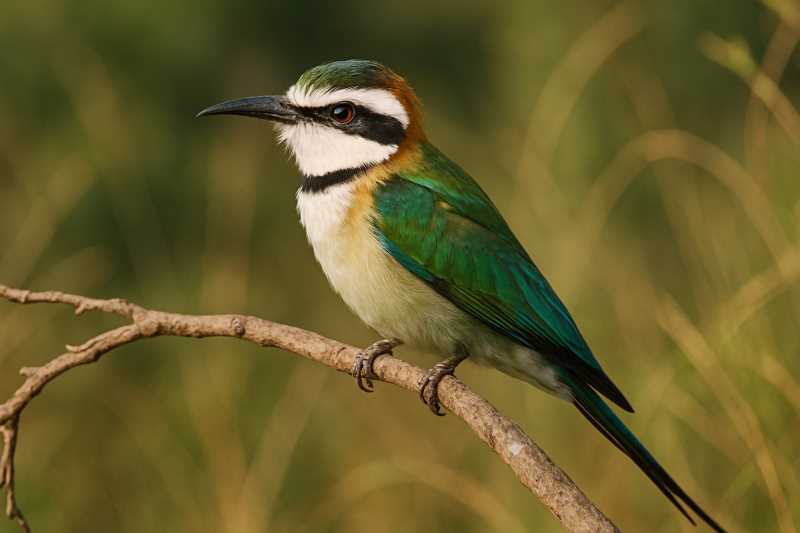
The White-throated Bee-eater is renowned for its exquisite plumage, which combines vivid hues of green, blue, and black with its distinctive white throat patch. Measuring about 20-23 cm in length, including its elongated tail feathers, this bird is a sight to behold. The upperparts feature a rich green color, providing a stark contrast against its bright blue underparts. Its wings are adorned with black margins, adding to its striking appearance.
One of the most distinguishing features of the White-throated Bee-eater is its long, curved bill, perfectly adapted for catching its primary prey: bees and other flying insects. The bird’s iridescent green crown and nape, together with its blue-green upper body and black eye mask, make it easily identifiable.
Habitat and Distribution
The White-throated Bee-eater is predominantly found across the savannas and open woodlands of sub-Saharan Africa. Its distribution spans from Senegal and Gambia in the west to Ethiopia and Kenya in the east, extending southwards to Uganda and northern Tanzania. During the breeding season, these birds migrate to the Sahel region, where they inhabit dry, open areas with sparse vegetation, such as acacia woodlands and semi-desert regions.
Outside the breeding season, the White-throated Bee-eater can be found in more wooded regions and is often seen near water bodies, which provide ample insect prey. The bird’s migratory patterns are closely linked to the seasonal availability of food, particularly the abundance of flying insects.
Behavior and Diet
True to its name, the White-throated Bee-eater has a diet that predominantly consists of bees, wasps, and other flying insects. This skilled aerial hunter is known for its remarkable agility in flight, capable of catching insects mid-air with precision. The bird’s hunting technique involves perching on a vantage point and launching into the air to snatch its prey in swift, acrobatic maneuvers.
Interestingly, the White-throated Bee-eater has developed a strategy to handle stinging insects. Before consuming its catch, the bird will remove the sting by repeatedly hitting the insect against a hard surface, thereby neutralizing the threat of a sting.
Breeding and Reproduction
Breeding typically occurs during the rainy season, which varies depending on the region. The White-throated Bee-eater is a colonial breeder, often nesting in large colonies in sandy banks or flat terrain. They excavate burrows in the sand, where they lay their eggs and rear their young. These burrows can be up to 1 meter in length, providing a safe haven from predators.
A typical clutch consists of 3 to 5 white eggs, which are incubated by both parents. The eggs hatch after about 21 days, and the chicks are fed by both parents until they are ready to fledge, approximately 30 days later. The communal nature of their nesting sites provides additional protection and increases the chances of survival for the young.
Conservation Status
Currently, the White-throated Bee-eater is not considered to be at risk, classified as “Least Concern” by the International Union for Conservation of Nature (IUCN). However, like many species, it faces threats from habitat loss and environmental changes. The destruction of nesting sites and the use of pesticides, which reduce insect prey availability, pose potential risks to their populations.
Conservation efforts are vital to ensure the continued survival of this species, which plays a crucial role in controlling insect populations and maintaining ecological balance in its habitat.
Conclusion
The White-throated Bee-eater is a remarkable bird that exemplifies the beauty and complexity of avian life. Its vibrant colors, agile flight, and intriguing behaviors make it a favorite among birdwatchers and researchers. As we continue to study and appreciate these magnificent creatures, it is essential to prioritize their conservation, ensuring that future generations can enjoy the sight of these stunning birds gracing the skies.
The White-throated Bee-eater is more than just a pretty face; it is an integral part of the ecosystems it inhabits. By understanding and protecting this species, we contribute to the broader effort of preserving biodiversity across the globe.
Related posts