Introduction
The Harlequin Quail, Coturnix delegorguei, is a small ground-dwelling quail in the family Phasianidae. It occurs mainly in open grassland and savanna habitats across sub-Saharan Africa, with additional populations on Madagascar and parts of the Arabian Peninsula. It is generally secretive and is often detected by its distinctive call or by the sudden, direct flight it makes when flushed. (animaldiversity.org)
Physical Description
The Harlequin Quail is a compact bird measuring approximately 16–20 cm in length and weighing about 57–71 g, although published measurements vary between regions and sources. (animaldiversity.org)
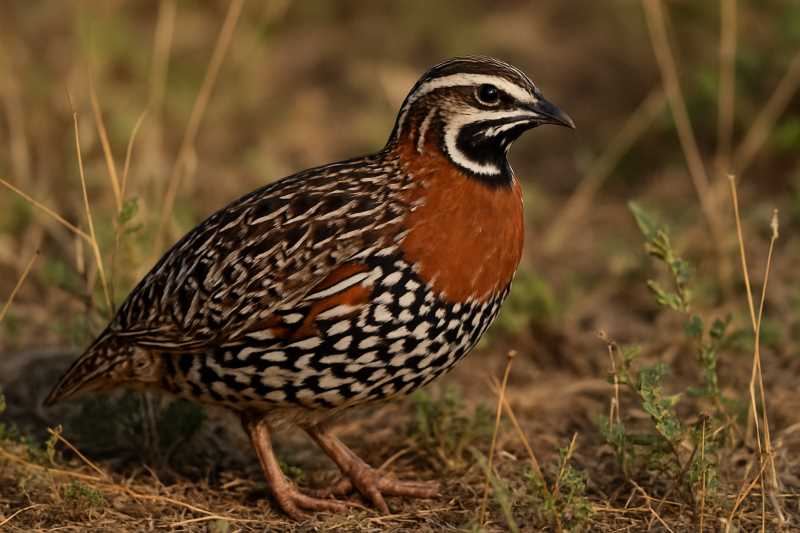
Adult males are strikingly patterned. They have a contrasting black-and-white facial mask, a dark chest edged with rufous feathers, a blackish abdomen and rufous flanks. Females are much less conspicuous, with predominantly brown plumage, a faint dark necklace, a brown-spotted underbody and lightly rufous flanks. This strong sexual dimorphism is one of the species’ most useful identification features.
Young birds are less boldly marked than adult males and are chiefly brown and buff, providing camouflage in grassland vegetation. Chicks are yellowish-buff with heavy dark-brown stripes soon after hatching. (animaldiversity.org)
Range and Habitat
The Harlequin Quail has a broad but discontinuous distribution across sub-Saharan Africa, extending from parts of West Africa eastwards through Ethiopia and Kenya, and southwards through eastern and southern Africa. It also occurs in much of Madagascar. Some taxonomic treatments recognise geographically distinct forms, including populations associated with the Arabian Peninsula and the Gulf of Guinea islands, although subspecies treatment can vary between authorities. (animaldiversity.org)
It favours open grasslands, savannas, lightly vegetated river margins and cultivated areas with suitable grass or herbaceous cover. Dense forest is generally avoided. The species is terrestrial and relies on vegetation for concealment, nesting and access to seeds and invertebrates.
Harlequin Quails are not uniformly migratory throughout their range. Seasonal movements have been reported, particularly near the northern and southern limits of the distribution, and local abundance can change with rainfall and the resulting availability of food and cover. (animaldiversity.org)
Behaviour and Diet
Harlequin Quails spend most of their time on the ground, walking or running through grass and low vegetation. They are secretive and may remain hidden until approached closely, when they usually flush with rapid wingbeats and a powerful, direct flight. They may occur singly, in pairs or in small groups, with social groupings changing according to season and local conditions.
The diet is varied. Grass and weed seeds form an important part of it, supplemented by shoots, leaves, insects, insect larvae, worms and small land molluscs. Invertebrate food is likely to be particularly important when adults are breeding and when chicks are growing. (animaldiversity.org)
Breeding is closely associated with seasonal rainfall. In southern Africa, breeding has been recorded mainly from October to March, with the timing varying according to local conditions. The nest is a shallow scrape on the ground, lined with plant material and concealed in grass or other dense vegetation.
Clutches usually contain three to nine eggs. The eggs range from pale buff or cream to olive-brown and are heavily marked with reddish-brown, chestnut or purplish-brown spots. Incubation lasts approximately 17–18 days. The chicks are precocial, leaving the nest soon after hatching and becoming capable of feeding themselves at an early age. Available accounts describe the female as the principal caregiver. (animaldiversity.org)
Courtship may include the male presenting an insect to the female, raising his wings slightly and following or chasing her. Males can become aggressive towards one another before breeding. The species is generally described as forming strong pair bonds. (animaldiversity.org)
Identification Tips
- Look for a small, short-tailed, ground-dwelling bird in open grassland, savanna or cultivated fields with good cover.
- An adult male is distinctive, with a bold black-and-white facial pattern, dark chest and belly, and rufous flanks.
- The female is more difficult to identify. She is generally darker and more uniformly brown than a female Common Quail, Coturnix coturnix, with less obvious pale underparts and less strongly marked upperparts. (ebird.org)
- The species is often detected by voice rather than sight. The male’s call has been rendered as a repeated, three-part whistle, while other calls include short contact notes and a squeaky call when the bird is flushed. (animaldiversity.org)
- When disturbed, the Harlequin Quail usually makes a strong, direct flight from dense cover before dropping back into vegetation.
Conservation Status
The Harlequin Quail is assessed as Least Concern on the IUCN Red List framework used by BirdLife International. Its broad distribution is an important factor in this assessment, but a global population estimate should not be inferred from the category. BirdLife’s current species account does not provide a reliable global population total. (datazone.birdlife.org)
The species is not considered globally threatened, but local populations may be affected by the conversion and fragmentation of grassland, changes in agricultural practices, loss of dense ground cover and hunting. A Kenyan study documented traditional hunting of wild Harlequin Quails and noted the need for improved monitoring of distribution, population structure and effective population size. These findings indicate that local pressures may be significant even though the species remains of global Least Concern. (onlinelibrary.wiley.com)
Conservation measures should include maintaining open grassland and savanna mosaics, retaining patches of tall grass and other nesting cover, applying sustainable agricultural practices and monitoring local populations where hunting or habitat conversion is increasing.
Frequently Asked Questions
Where does the Harlequin Quail live?
It occurs in open grasslands, savannas, lightly vegetated river margins and some cultivated areas across parts of sub-Saharan Africa. It also occurs on Madagascar and in parts of the Arabian Peninsula, depending on the taxonomic treatment used.
How can a male Harlequin Quail be identified?
The male has a conspicuous black-and-white facial mask, a dark chest and abdomen, and rufous feathers on the flanks. This pattern is much more striking than the mainly brown plumage of the female.
What does the Harlequin Quail eat?
Its diet includes grass and weed seeds, plant shoots and leaves, insects, insect larvae, worms and small land molluscs. The balance of plant and animal food varies with local availability and season.
Does the Harlequin Quail migrate?
Not all populations are migratory. Seasonal movements have been reported at the northern and southern edges of the range, and local movements may follow rainfall and changes in food and vegetation cover.
Where does the Harlequin Quail build its nest?
It nests on the ground in a shallow scrape lined with plant material. The nest is usually concealed in grass or other dense low vegetation.
How many eggs does it lay?
Reported clutch sizes range from three to nine eggs. Incubation lasts approximately 17–18 days, and the chicks are precocial, leaving the nest soon after hatching.
References
- BirdLife International. 2026. “Harlequin Quail Coturnix delegorguei Species Factsheet.” BirdLife DataZone. Accessed 8 September 2026. https://datazone.birdlife.org/species/factsheet/harlequin-quail-coturnix-delegorguei
- Gill, F., D. Donsker and P. Rasmussen, eds. 2026. IOC World Bird List, version 15.2. International Ornithologists’ Committee. Accessed 8 September 2026. https://www.worldbirdnames.org/
- Ogada, S., N. O. Otecko, G. Moraa Kennedy, J. Musina, B. Agwanda, V. Obanda, J. Lichoti, M.-S. Peng and S. Ommeh. 2021. “Demographic history and genetic diversity of wild African harlequin quail (Coturnix delegorguei delegorguei) populations of Kenya.” Ecology and Evolution 11(24): 18562–18574. https://doi.org/10.1002/ece3.8458
- Pappas, J. 2001. “Coturnix delegorguei.” Animal Diversity Web, University of Michigan Museum of Zoology. Accessed 8 September 2026. https://animaldiversity.org/accounts/Coturnix_delegorguei/
- Cornell Lab of Ornithology. n.d. “Harlequin Quail Coturnix delegorguei.” eBird species account. Accessed 8 September 2026. https://ebird.org/species/harqua1
Related posts