Introduction
The Moluccan Swiftlet (Aerodramus infuscatus) is a small, fast-flying swift of Indonesia’s Sulawesi and Maluku regions. It is associated with forested landscapes, cliffs and cave systems, and feeds almost entirely on insects captured in flight. Current international checklists generally treat the Sulawesi and Seram forms as part of the same species, although the taxonomy of this group has changed over time.
Physical Description
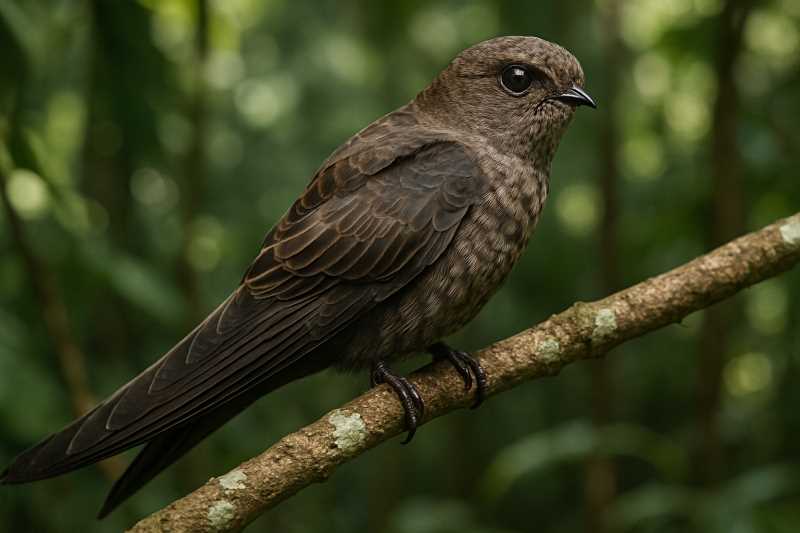
The Moluccan Swiftlet is a small swiftlet, approximately 10 cm long, with a compact body, long narrow wings and a slightly forked tail. Its upperparts are generally blackish-brown to dark brown, while the underparts are paler brown. A narrow, pale grey or whitish rump band is an important feature, although its width and contrast vary between geographic forms.
The sexes are alike in appearance. Juveniles and poorly seen adults can be difficult to distinguish from other small swiftlets because the plumage is subdued and the birds spend most of their time in rapid flight. There are no well-established field measurements or plumage differences that reliably separate males from females.
Range and Habitat
The Moluccan Swiftlet is resident in Indonesia. Its range includes Sulawesi and several islands of the Maluku region, including Seram and Halmahera. It is endemic to this part of the Indonesian archipelago and is not considered a long-distance migrant.
It occurs over forest, woodland, cultivated areas and other open landscapes where flying insects are available. The species is also recorded around cliffs, limestone formations and caves, which may provide roosting or nesting sites. It has been recorded from lowlands into upland and montane habitats, but available information is not detailed enough to define a single strict elevation range for the whole species.
Geographic variation is reflected in the appearance of the rump band and other subtle plumage features. Forms formerly treated as the Sulawesi Swiftlet and Seram Swiftlet have been included within A. infuscatus by current IOC taxonomy.
Where to See This Species
The Moluccan Swiftlet is usually seen in flight, often high above forest edges, valleys and open areas. Identification is easiest when the birds are close enough to show the pale rump band and overall brown coloration.
Tangkoko Nature Reserve, North Sulawesi, Indonesia
Tangkoko is a recognised wildlife-viewing area on northern Sulawesi, and local bird checklists document the Moluccan Swiftlet among its avifauna. Look for swiftlets over forest edges, clearings and surrounding lowland habitat, particularly during periods of active insect movement.
Nearby accommodation: Bitung is the practical gateway, with guest houses, small hotels and other visitor accommodation serving the reserve.
Lore Lindu National Park, Central Sulawesi, Indonesia
The Moluccan Swiftlet is documented in bird lists for Lore Lindu National Park. Its mixture of forest, valleys and upland habitats provides suitable areas for watching swiftlets feeding above the canopy and open sections of the park.
Nearby accommodation: Palu is the main gateway, while settlements near the park, including areas around Lake Lindu, provide simpler guest-house and homestay accommodation.
Aketajawe-Lolobata National Park, North Maluku, Indonesia
Aketajawe-Lolobata has a documented record of the Moluccan Swiftlet and protects extensive forest on Halmahera. The species may be encountered over forest clearings, roads and river valleys, although access to different parts of the park can be difficult and local guidance is advisable.
Nearby accommodation: Sofifi and other settlements on Halmahera provide the most practical base, with basic guest houses and small hotels available in the wider gateway area.
Behaviour and Diet
The Moluccan Swiftlet spends most of its life in the air. It is an agile flier that may travel alone or in small groups, although larger feeding groups can form where flying insects are abundant. It captures prey during continuous flight, often making rapid turns and changes of direction above forest, clearings and waterways.
Its diet consists mainly of small flying insects, including flies, beetles, moths and other aerial invertebrates. Like other swiftlets in the genus Aerodramus, it is associated with cave environments and is capable of using echolocation, particularly in dark roosting or nesting sites. Detailed species-specific studies of its feeding and breeding behaviour remain limited.
Swiftlets generally nest colonially on cave walls, cliffs or sheltered rock surfaces. Their nests are built with saliva, sometimes combined with small plant materials depending on the species. The Moluccan Swiftlet’s breeding season and clutch size are not sufficiently documented across its full range to support precise generalisations, but both adults are expected to contribute to incubation and care of the young, as in other closely related swiftlets.
Identification Tips
- Look for a small, dark brown swiftlet with long, narrow wings and a slightly forked tail.
- The pale grey or whitish rump band is the most useful field feature when it can be seen clearly.
- The underparts are usually paler brown than the upperparts, but lighting and distance can make the bird appear almost uniformly dark.
- The species is often identified by its fast, direct flight and frequent association with forest edges, valleys and open airspace.
- Glossy Swiftlet is generally darker and more glossy, with less obvious contrast at the rump. Uniform Swiftlet may have a less distinct rump band and can be very difficult to separate in poor views.
- Calls, flight behaviour, location and habitat can all help, but close views or recordings may be needed for confident identification.
Conservation Status
The Moluccan Swiftlet is currently assessed as Least Concern. It has a relatively broad distribution across Sulawesi and the Maluku region, and it occurs in several protected areas.
The available assessment does not provide a reliable global population estimate, and the overall population trend is not sufficiently documented for a confident direction of change. Potential local pressures include forest clearance, degradation of cave and cliff habitats, disturbance at nesting sites and, where it occurs, unregulated collection of swiftlet nests. Protecting remaining forest, maintaining cave and karst habitats and improving monitoring of local populations are appropriate conservation measures.
Frequently Asked Questions
Where is the Moluccan Swiftlet found?
It is found in Indonesia, particularly on Sulawesi and islands in the Maluku region, including Seram and Halmahera.
What does the Moluccan Swiftlet eat?
It feeds mainly on small flying insects such as flies, beetles, moths and other aerial invertebrates caught during flight.
Can the Moluccan Swiftlet use echolocation?
Yes. As a member of the cave-associated swiftlet genus Aerodramus, it is capable of echolocation, which helps swiftlets navigate in dark roosting and nesting places.
How can the Moluccan Swiftlet be identified?
Look for a small dark brown swiftlet with a slightly forked tail, paler brown underparts and a narrow pale rump band. It is often difficult to identify in poor light or at long range.
Is the Moluccan Swiftlet endangered?
No. It is currently classified as Least Concern, although local populations may still be affected by habitat loss, disturbance and nest collection.
Where can I see a Moluccan Swiftlet?
Documented wildlife-viewing locations include Tangkoko Nature Reserve and Lore Lindu National Park on Sulawesi, and Aketajawe-Lolobata National Park on Halmahera.
References
- BirdLife International
- IOC World Bird List
- Cornell Lab of Ornithology, Birds of the World
Related posts