Introduction
Wallace’s Owlet-nightjar (Aegotheles wallacii) is a small, elusive nocturnal bird in the owlet-nightjar family, Aegothelidae. Named after the British naturalist Alfred Russel Wallace, it is associated with New Guinea and nearby islands, where it inhabits forested landscapes and is usually detected by careful night searching or by locating a daytime roost.
Physical Description
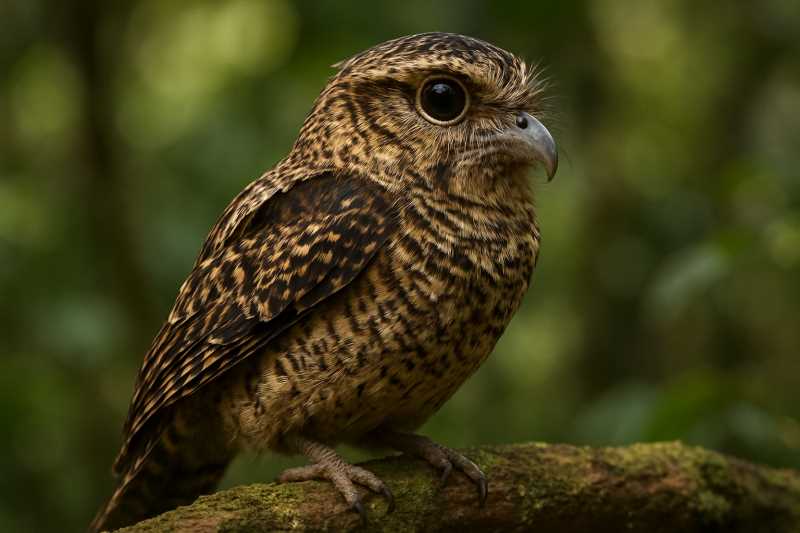
Wallace’s Owlet-nightjar is approximately 20–23 cm long. It has a large head, prominent forward-facing eyes, rounded wings, a relatively long tail and small feet with long toes and claws. The plumage is cryptic, combining dark grey, brown, rufous, buff and blackish markings that help the bird disappear against bark, shadowed foliage and tree hollows.
In the Mimika region of Indonesian Papua, it has been described as dark grey to blackish, with a pale throat and chin and no distinct pale collar. Reliable information on sexual dimorphism, juvenile plumage and age-related variation is limited, so these features should not be used confidently for field identification.
Range and Habitat
Wallace’s Owlet-nightjar occurs in New Guinea, including western New Guinea in Indonesia and Papua New Guinea, as well as the Aru Islands and Waigeo in the Raja Ampat region. The species is locally distributed and has been recorded only patchily across its range.
It is associated mainly with humid lowland, hill and lower-montane forest, although it may also occur in woodland, scrub and other well-vegetated habitats. Records extend from lowland areas to about 1,500 metres, with some sources giving a maximum near 1,540 metres. The species is regarded as non-migratory or probably sedentary, but its movements are poorly documented.
The species was formerly discussed using several named forms, including A. w. gigas and A. w. manni. Modern taxonomic treatments vary in how these forms are handled, and the species is often treated as monotypic pending further study.
Where to See This Species
Wallace’s Owlet-nightjar is difficult to observe, and confirmed birding locations are limited. Night surveys should be undertaken with experienced local guides, with care taken not to disturb roosting birds.
Kampung Kwau, West Papua, Indonesia
Kampung Kwau is a recognised birdwatching and ecotourism destination in the Arfak Mountains of West Papua. Wallace’s Owlet-nightjar has been recorded in the wider Kwau area, including a roosting bird located by visiting birdwatchers. The forested slopes and local guiding network provide a realistic opportunity to search for the species, although sightings are far from guaranteed. The site’s elevation, generally around 1,000–2,000 metres, overlaps the species’ documented upper range in some areas.
Nearby accommodation: Kampung Kwau has local homestays and simple forest guest accommodation. Manokwari is the nearest larger town and a practical base for arranging transport and local guiding.
Behaviour and Diet
Wallace’s Owlet-nightjar is nocturnal and normally remains concealed during daylight. It may roost in a tree hollow or among dense vegetation, where its cryptic plumage makes it extremely difficult to detect. At night it is likely to use exposed perches and short flights to search for prey, although detailed observations of its hunting behaviour remain scarce.
The diet is believed to consist mainly of invertebrates, including insects and other small arthropods such as spiders and millipedes. Its call is poorly known, and available descriptions are insufficient to provide a dependable vocal identification guide.
Breeding information is limited. The species is reported to nest in holes, presumably using natural tree cavities or similar sheltered sites, but details of clutch size, incubation, parental care and breeding season remain poorly documented.
Identification Tips
- Look for a small, large-headed nocturnal bird with rounded wings and a longish tail.
- The overall impression is dark grey, brown and blackish rather than brightly coloured.
- A pale throat and chin and the absence of a strong pale collar are useful features in the field.
- Search tree hollows, shaded trunks and dense vegetation during the day, but expect the bird to remain almost invisible unless it is flushed or occupying the entrance of a cavity.
- At night, listen and watch from quiet forest tracks or clearings, preferably with a local guide familiar with the species.
- Do not confuse it with the Moluccan Owlet-nightjar, which occurs in the northern Moluccas, outside the main range described for Wallace’s Owlet-nightjar. Other owlet-nightjars in New Guinea can be difficult to separate without close views, photographs or reliable location information.
Conservation Status
Wallace’s Owlet-nightjar is currently listed as Least Concern on the IUCN Red List. Nevertheless, it is poorly known, has a patchy distribution and is seldom recorded, so its population size and trend are difficult to assess.
The main conservation priority is the protection of remaining forest across New Guinea and nearby islands. Logging, agricultural expansion, infrastructure development and forest fragmentation may affect suitable habitat, although the scale of their impact on this species has not been quantified. More field surveys, acoustic monitoring and records from local observers would improve understanding of its distribution and conservation needs.
Frequently Asked Questions
Where is Wallace’s Owlet-nightjar found?
It is found in New Guinea, including Indonesian Papua and Papua New Guinea, as well as the Aru Islands and Waigeo in the Raja Ampat region.
Is Wallace’s Owlet-nightjar found in the Maluku Islands?
The species should not be confused with the Moluccan Owlet-nightjar, Aegotheles crinifrons, which occurs on Halmahera and Bacan. Wallace’s Owlet-nightjar is primarily a New Guinea and nearby-island species.
How large is Wallace’s Owlet-nightjar?
It is approximately 20–23 cm long. It has a large head, rounded wings, a relatively long tail and strongly cryptic plumage.
What does Wallace’s Owlet-nightjar eat?
It is believed to feed mainly on insects and other small invertebrates, including spiders and millipedes.
Is Wallace’s Owlet-nightjar difficult to see?
Yes. It is nocturnal, secretive and well camouflaged. It often remains hidden in tree hollows or dense vegetation during the day, and confirmed sightings are uncommon.
What is its conservation status?
Wallace’s Owlet-nightjar is listed as Least Concern, although limited observations mean that its population size and long-term trend are not well known.
References
- IOC World Bird List
- IUCN Red List of Threatened Species
- Ministry of Tourism and Creative Economy of the Republic of Indonesia
Related posts