Introduction
The Marbled Frogmouth (Podargus ocellatus) is a nocturnal frogmouth in the family Podargidae. It occurs mainly in rainforest habitats in eastern Australia, New Guinea, the Aru Islands and nearby islands. Despite its owl-like appearance, it is not an owl or a nightjar. Frogmouths are a distinct group of nocturnal birds, currently placed in the order Podargiformes. (ww.worldbirdnames.org)
Physical Description
The Marbled Frogmouth is a medium-sized frogmouth, generally measuring about 30–45 cm in length, with a wingspan of approximately 62–75 cm and a reported weight range of about 130–290 g. It has a broad, flattened head, a very wide frog-like bill, large forward-facing eyes and relatively short, weak feet typical of frogmouths. (threatenedspecies.bionet.nsw.gov.au)
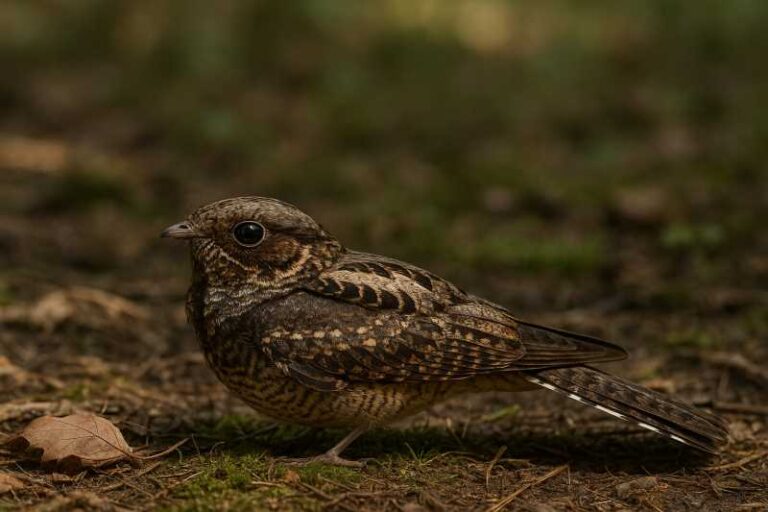
Its plumage is highly variable, ranging from pale grey and brown to darker brown or rich rufous-brown. The upperparts are densely mottled, streaked and spotted with blackish, cream and brown markings, while the underparts are generally paler and may show barred or marbled patterning. This cryptic colouring helps the bird blend with bark, lianas, branches and dense rainforest vegetation.
Females are usually slightly smaller than males and may differ subtly in bill size and plumage tone, although sexing a bird in the field is difficult. Geographic forms also vary in appearance. The southern Queensland and northern New South Wales form is often known as the Plumed Frogmouth because of its distinctive plumage features. (mli.org.au)
Range and Habitat
The Marbled Frogmouth is a resident species of eastern Australia, New Guinea, the Aru Islands and several nearby islands. In Australia, it occurs in parts of Cape York Peninsula and in subtropical rainforest and associated wet forest in south-eastern Queensland and north-eastern New South Wales. It is not regarded as a long-distance migrant. (featherbase.info)
It is strongly associated with tropical and subtropical rainforest, including lowland rainforest, vine forest, wet eucalypt forest adjoining rainforest and, in some regions, moist montane forest. Australian records commonly come from low elevations to approximately 800 m, although the precise elevational range varies between geographic forms. The species generally uses the understorey and lower canopy, where dense vegetation provides roosting cover and suitable hunting perches. (en.wikipedia.org)
Geographic variation is considerable, and several regional forms have been recognised in taxonomic treatments. These forms occupy separated areas across Australia, New Guinea and neighbouring islands, so their conservation circumstances can differ substantially even though they are treated here as one species. (worldbirdnames.org)
Behaviour and Diet
The Marbled Frogmouth is nocturnal. It usually roosts motionless during the day in dense vegetation, where its mottled plumage makes it difficult to detect. At night it becomes active, typically hunting from a prominent perch such as a low branch, stump or other suitable vantage point. It may make short sallies to capture prey from the ground, foliage, trunks or nearby airspace. (threatenedspecies.bionet.nsw.gov.au)
Its diet consists mainly of large nocturnal insects and other arthropods. Recorded prey includes beetles, cockroaches, grasshoppers, moth larvae and spiders. Some accounts also report occasional small vertebrate prey, but detailed dietary information remains limited, particularly for the less frequently studied populations outside Australia. (birdsqueensland.org.au)
The species is generally encountered singly or in pairs, although family groups may sometimes be seen. Pairs defend territories with vocalisations and bill-snapping. The call has been described as a low, unusual or descending gobble, sometimes followed by a sharp snap of the bill. (ebird.org)
Breeding information is best documented for Australian populations. In eastern Australia, breeding generally occurs from about August to December. The nest is a small platform or cup-like structure placed on a branch or in a tree fork. The usual clutch is one egg, although two eggs may occasionally be laid. Both parents participate in incubation and care of the young, with males known to incubate or brood during the day. (threatenedspecies.bionet.nsw.gov.au)
Identification Tips
Look for the following combination of features:
- A large nocturnal bird with a very broad, frog-like bill.
- Strongly mottled or marbled brown, grey, cream and rufous plumage.
- A broad, flattened head and large orange to deep orange eyes.
- A relatively long tail and a slenderer overall build than the Tawny Frogmouth.
- A preference for rainforest, vine forest and wet forest rather than open woodland or suburban habitats.
- An unusual nocturnal call that may include a descending gobble and bill-snapping.
The Tawny Frogmouth (Podargus strigoides) is the most likely species to cause confusion in Australia. The Marbled Frogmouth is generally smaller and slimmer, more strongly associated with rainforest, and often has a more irregularly marbled pattern on the underparts. It also tends to have a proportionally longer tail and more prominent barred feathering above the bill. (ebird.org)
Conservation Status
The Marbled Frogmouth is listed globally as Least Concern on the IUCN Red List. This global category does not mean that all populations are secure. Some regional forms, particularly the southern Australian populations, are uncommon and subject to state or regional conservation concern. (datazone.birdlife.org)
The principal threats in parts of Australia are the clearing, fragmentation and isolation of rainforest and associated wet forest for agriculture, forestry and development. Disturbance can also open the canopy, alter understorey structure, encourage invasive weeds and increase the isolation of remaining habitat patches. (threatenedspecies.bionet.nsw.gov.au)
Important conservation measures include protecting remaining rainforest and wet-forest habitat, retaining connections between habitat patches, limiting destructive clearing and forestry practices, controlling invasive weeds and managing fire to reduce the isolation of suitable forest. More information is needed on population size, trends and breeding ecology in several parts of the species’ range.
Frequently Asked Questions
Where does the Marbled Frogmouth live?
It occurs in eastern Australia, New Guinea, the Aru Islands and nearby islands. It is mainly associated with tropical and subtropical rainforest, vine forest and adjoining wet forest.
Is the Marbled Frogmouth an owl?
No. Its owl-like appearance results from its large eyes, broad head and nocturnal habits, but it belongs to the frogmouth family, Podargidae, not the owl family.
What does the Marbled Frogmouth eat?
It feeds mainly on large nocturnal insects and other arthropods, including beetles, cockroaches, grasshoppers, moth larvae and spiders. It usually hunts from a perch and makes short sallies to take prey from vegetation, trunks or the ground.
When is the Marbled Frogmouth active?
It is nocturnal. During the day it usually roosts motionless in dense vegetation, becoming active after dark to feed, call and defend its territory.
How can the Marbled Frogmouth be distinguished from a Tawny Frogmouth?
The Marbled Frogmouth is generally smaller and slimmer, has a more marbled pattern, a proportionally longer tail and a stronger preference for rainforest and wet forest. The Tawny Frogmouth is more widespread in open woodland, farmland, parks and suburban areas.
Is the Marbled Frogmouth endangered?
The species is globally classified as Least Concern, but some regional populations are locally uncommon and threatened by habitat clearing, fragmentation, weeds, forestry disturbance and inappropriate fire regimes.
References
- BirdLife International. 2026. “Marbled Frogmouth Podargus ocellatus Species Factsheet.” BirdLife DataZone. Accessed 8 September 2026. https://datazone.birdlife.org/species/factsheet/marbled-frogmouth-podargus-ocellatus
- Gill, F., D. Donsker and P. Rasmussen, eds. 2026. IOC World Bird List, version 15.2. International Ornithologists’ Union. Accessed 8 September 2026. https://www.worldbirdnames.org/
- International Union for Conservation of Nature. 2025. The IUCN Red List of Threatened Species. Version 2025-1. IUCN, Gland, Switzerland. Accessed 8 September 2026. https://www.iucnredlist.org/
- New South Wales Department of Planning and Environment. n.d. “Marbled Frogmouth: Profile.” NSW Environment, Energy and Science. Accessed 8 September 2026. https://threatenedspecies.bionet.nsw.gov.au/profile?id=10640
- Beruldsen, G. R. 2003. “Breeding Biology of the Plumed Frogmouth Podargus ocellatus plumiferus and Marbled Frogmouth P. o. marmoratus.” Australian Field Ornithology 20: 126–138. https://afo.birdlife.org.au/afo/index.php/afo/article/download/517/501
- Smith, G. C., M. de Baar, J. Kehl, D. Milledge and R. Schodde. 1994. “Notes on the Foods of the Plumed Frogmouth Podargus ocellatus plumiferus.” The Sunbird 24(4): 91–97. https://birdsqueensland.org.au/sunbird_issues/Sunbird_Vol24_No4.pdf
- Atherton, R. G., P. A. Matthew and J. W. Winter. 1980. “Notes on the Crop Contents and Locality Records of the Marbled Frogmouth Podargus ocellatus marmoratus Gould from Cape York Peninsula.” The Sunbird 11(3–4): 71–75. https://birdsqueensland.org.au/sunbird_issues/Sunbird_Vol11_No3-4.pdf
- Australian Bird Study Association. 2020. “Marbled Frogmouth Podargus ocellatus.” Bird in the Hand, second edition. Accessed 8 September 2026. https://absa.asn.au/wp-content/uploads/2020/06/Marbled-Frogmouth.pdf
- Australian Museum. 2025. “Tawny Frogmouth Podargus strigoides.” Australian Museum. Accessed 8 September 2026. https://australian.museum/learn/animals/birds/tawny-frogmouth/
Related posts