Introduction
The Pirre Hummingbird (Goldmania bella) is a small, range-restricted hummingbird of eastern Panama and the adjacent Chocó region of north-western Colombia. It was formerly placed in the genus Goethalsia, a name that remains in use as a synonym in some sources. The species inhabits humid foothill and lower montane forests, particularly on isolated ridges in the Darién highlands.
Physical Description
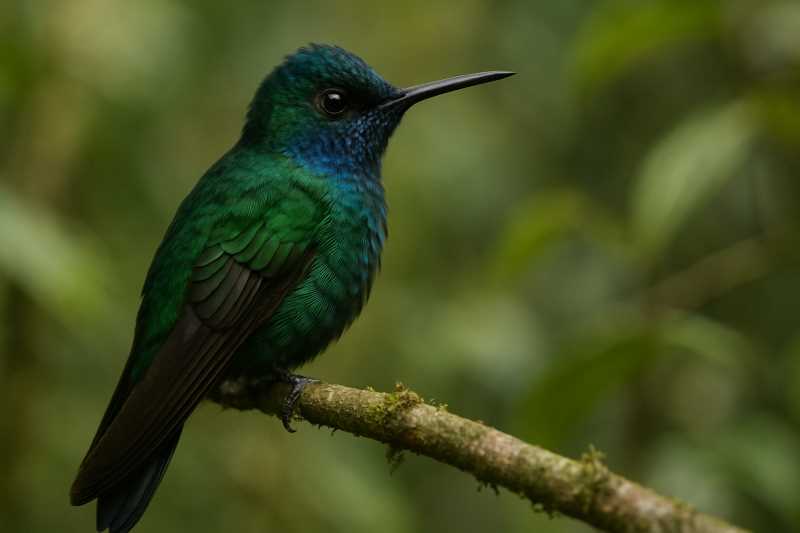
The Pirre Hummingbird is approximately 9 cm long. Both sexes have a slender, slightly downcurved bill, green upperparts and distinctive cinnamon-buff feathers in the wings and tail. The central tail feathers are bronze-green at the base and black-tipped, while the outer tail feathers are largely cinnamon-buff with dark tips.
The adult male has a chestnut forehead, lores and chin. Its throat, breast and belly are shining bluish-green, with white undertail coverts. The female lacks the male’s chestnut forehead and has paler, cinnamon-buff underparts. Both sexes have elongated central undertail coverts, an unusual feature that can help confirm identification at close range.
The original article’s description of a violet throat patch is not a reliable diagnostic feature. The male’s most useful head markings are the chestnut forehead and lores, while the cinnamon-buff wing and tail markings are prominent in both sexes.
Range and Habitat
The Pirre Hummingbird occurs in a small, fragmented range in eastern Panama and adjacent north-western Colombia. In Panama, it has been recorded from the Pirre Massif, Cerro Sapo and the Serranía de Jungurudó. In Colombia, records come from the Darién highlands in Chocó Department.
It is a non-migratory forest species associated with humid foothill and lower montane forest, forest edges and other dense, naturally vegetated habitats. It has been recorded from approximately 600 to 1,650 metres, although it is most often associated with elevations above about 1,000 metres in the Cerro Pirre area. Its restricted distribution and dependence on forested mountain habitats make it vulnerable to habitat degradation.
Where to See This Species
Darién National Park, Darién Province, Panama
Darién National Park includes the Cerro Pirre area, one of the best-known localities for the species and part of its documented Panamanian range. The park contains humid foothill, montane and cloud-forest habitats suitable for the Pirre Hummingbird. The Cana area and Pirre Station provide recognised access points for birdwatching, but the park is extremely remote. Visits should be arranged with experienced local guides and in accordance with current park access and safety requirements.
Nearby accommodation: Yaviza and El Real are the principal gateway settlements, with basic guesthouses and small hotels. Remote park facilities such as the basic dormitory at Pirre Station require visitors to bring suitable camping and personal equipment.
Behaviour and Diet
The Pirre Hummingbird is generally encountered alone while feeding in the lower and middle levels of humid forest and along forest edges. It feeds on nectar from flowering shrubs and small trees, and, like other hummingbirds, is expected to take small insects and spiders as an additional source of protein, although detailed dietary studies are limited.
Its flight includes hovering and short, rapid movements between flowers. Territorial behaviour may occur around productive feeding sites, but the species is poorly known and detailed information about social behaviour is limited.
The breeding season, nest, clutch size and parental care of the Pirre Hummingbird have not been adequately documented. Claims that breeding is confined to the wet season should therefore be treated cautiously.
Identification Tips
- Look for a small hummingbird with green upperparts and conspicuous cinnamon-buff wing and tail feathers.
- In males, check for a chestnut forehead, chestnut lores and chestnut chin, together with shining bluish-green underparts.
- Females are duller below, with pale cinnamon-buff underparts and no chestnut forehead.
- The cinnamon-buff outer tail and wing feathers are more useful field marks than a supposed violet throat patch.
- Within its restricted range, the combination of green plumage, chestnut facial markings in males and cinnamon-buff wing and tail markings makes it distinctive. The related Violet-capped Hummingbird (Goldmania violiceps) has a violet crown in the male and does not show the Pirre Hummingbird’s strongly cinnamon-buff tail pattern.
Conservation Status
The Pirre Hummingbird is currently classified as Near Threatened on the IUCN Red List. Its principal conservation concern is the loss and degradation of humid montane forest through deforestation, agricultural expansion and other land-use changes.
Darién National Park protects important habitat, including the Pirre highlands, but the species remains difficult to study because of its remote range and limited number of confirmed localities. Continued protection of forested ridges, careful monitoring and further field research are important for assessing its population trend and ecological requirements.
Frequently Asked Questions
Where is the Pirre Hummingbird found?
It occurs in eastern Panama and adjacent north-western Colombia, especially in isolated mountain ranges of the Darién highlands.
Is the Pirre Hummingbird endemic to Panama?
No. Although much of its known range is in Panama, it also occurs in the neighbouring Chocó region of Colombia.
What habitat does the Pirre Hummingbird use?
It uses humid foothill and lower montane forest, forest edges and dense natural vegetation, generally between about 600 and 1,650 metres.
What does the Pirre Hummingbird eat?
Its main food is nectar from flowering shrubs and small trees. It also likely takes small insects and spiders, although detailed studies of its diet are limited.
How can the Pirre Hummingbird be identified?
Look for green plumage combined with cinnamon-buff wing and tail feathers. Males have a chestnut forehead, lores and chin, while females have paler underparts and lack the chestnut forehead.
Is the Pirre Hummingbird threatened?
Yes. It is classified as Near Threatened because its small, fragmented range is vulnerable to the loss and degradation of humid montane forest.
References
- BirdLife International
- Cornell Lab of Ornithology, Birds of the World
- Autoridad de Turismo de Panamá
Related posts