Introduction
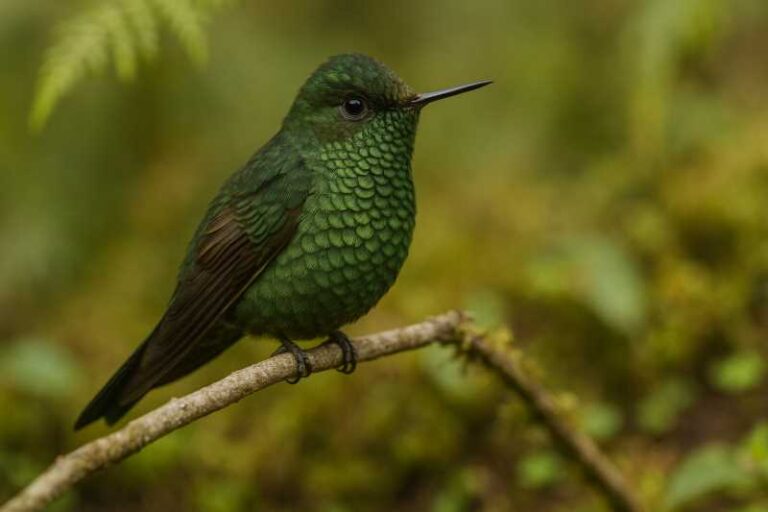
The Mexican Woodnymph, Eupherusa ridgwayi, is a small hummingbird endemic to western Mexico. It has a restricted distribution in the Pacific-slope foothills of Nayarit, Jalisco and Colima, where it inhabits humid woodland, riparian areas and shade-grown coffee plantations. The species is locally uncommon and is currently listed as Vulnerable because of continuing habitat loss.
Physical Description
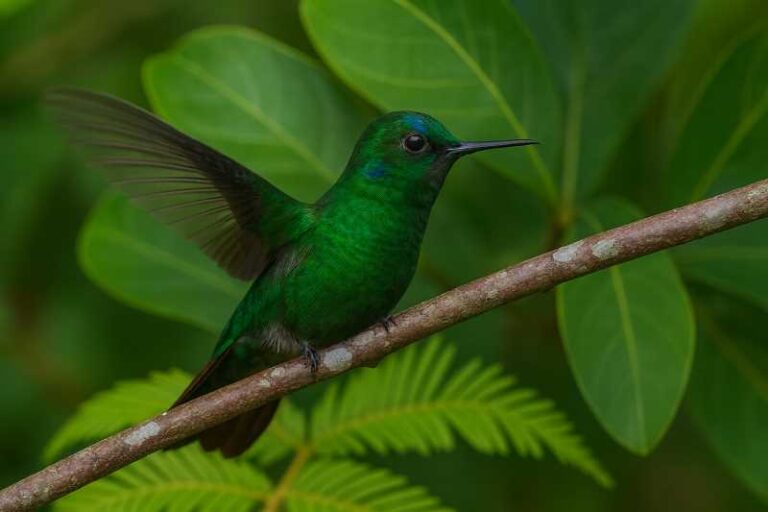
The Mexican Woodnymph is a small hummingbird measuring approximately 9–10 centimetres in length. It has a straight black bill and a slightly forked, bluish-black tail.
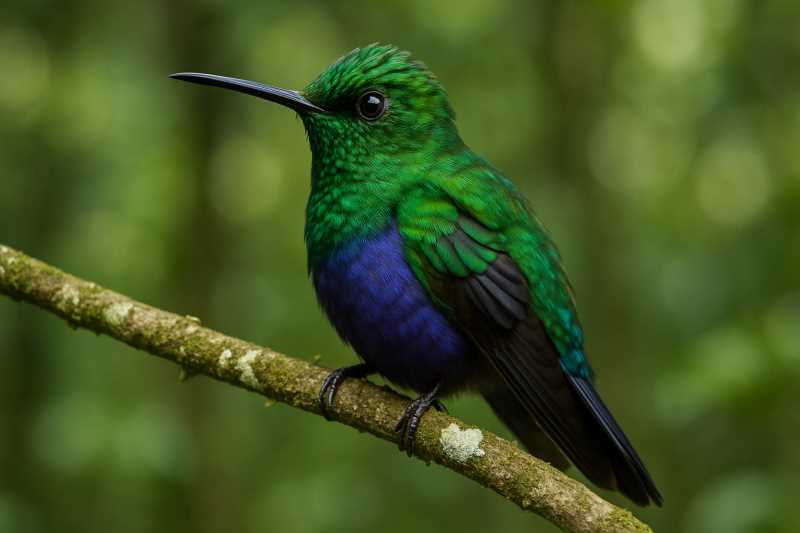
The male is mainly deep green and can appear almost black in poor light. The crown and forehead show iridescent violet-blue or deep blue, while the throat has a brilliant emerald-green gorget. The upperparts, belly and undertail coverts are predominantly green, although the colours can change noticeably with the angle of the light.
The female is much plainer. She has dark green upperparts, a greyish face and pale greyish underparts, sometimes with green markings on the sides of the chest. A small white post-ocular spot may be visible in both sexes, but it is not always conspicuous. Juvenile plumage is less well documented and is likely to be duller than adult plumage.
Range and Habitat
The Mexican Woodnymph is endemic to western Mexico. Its known range is patchy and includes southern Nayarit, western and southern Jalisco, and parts of Colima. It is a resident species rather than a long-distance migrant.
BirdLife International gives a typical elevational range of approximately 250–1,200 metres, although recent observations in protected forest habitats have extended the recorded range locally to higher elevations. The species occurs in humid semi-deciduous woodland, cloud forest, riparian forest, humid shrubland and shade coffee plantations. It generally prefers relatively undisturbed vegetation and is associated with forested gullies, streams and areas containing flowering plants.
The species is not restricted to old-growth forest, but it appears to avoid exposed forest edges. This makes the retention of connected woodland and shaded agricultural habitats particularly important.
Where to See This Species
Reserva Ecológica Sierra de San Juan, Nayarit, Mexico
The Sierra de San Juan is one of the recognised Important Bird and Biodiversity Areas associated with the Mexican Woodnymph. The reserve’s humid forest and foothill habitats provide suitable conditions, and documented records include the El Cuarenteño area near Xalisco. The bird is most likely to be encountered in shaded woodland, forest edges with good cover and flowering areas, although it is not guaranteed on any visit.
Nearby accommodation: Xalisco and Tepic are the most practical bases, with hotels, guest houses and other town-based accommodation. Rural accommodation may also be available in communities near the reserve.
Sierra de Manantlán Biosphere Reserve, Jalisco and Colima, Mexico
The Mexican Woodnymph is documented from the Sierra de Manantlán, one of the most important protected areas for the species. Surveys have recorded it in cloud forest, riparian forest, subdeciduous tropical forest and humid shrubland, including areas around Los Mazos. The reserve has a broad elevational gradient, so local guidance is useful when selecting forest trails and access points.
Nearby accommodation: Autlán de Navarro and El Grullo are practical gateway towns with hotels and guest houses. Some communities around the reserve may offer rural cabins or locally managed accommodation, subject to availability and access arrangements.
Behaviour and Diet
The Mexican Woodnymph is generally observed alone and may defend feeding areas from other hummingbirds. It is agile and fast-flying, usually moving through shaded vegetation and forest gullies rather than remaining in exposed open areas for long periods.
Its diet consists mainly of flower nectar. It also takes small insects and spiders, which provide protein and other nutrients. By visiting flowers, it contributes to pollination within the forest and shade-coffee habitats where it occurs.
The species is resident, so seasonal movements are not expected to resemble the long-distance migrations of some other hummingbirds. Breeding behaviour remains incompletely known, but a study in Jalisco documented a female constructing a nest and raising nestlings in cloud forest. The nest was built from plant material and placed in forest vegetation, although detailed information on breeding timing and nest success is still limited.
Identification Tips
- Look for a small hummingbird with a straight black bill and a slightly forked dark tail.
- Adult males show a deep blue or violet crown and a bright emerald-green throat. They can look nearly black when the iridescent feathers are not catching the light.
- Females are considerably duller, with dark green upperparts, a greyish face and pale greyish underparts.
- A small white spot behind the eye can help, but it may be subtle and should not be treated as the only identification feature.
- Search shaded forest, riparian vegetation, humid gullies and shade coffee plantations rather than open, exposed habitat.
- The species should not be confused with the more widespread Crowned Woodnymph complex outside western Mexico. Range, the dark bill, the male’s deep blue crown and emerald gorget, and the female’s plain greyish underparts are useful when assessing a sighting.
Conservation Status
The Mexican Woodnymph is classified as Vulnerable on the IUCN Red List, with a decreasing population trend. BirdLife International estimates the number of mature individuals at approximately 6,000–15,000, although the estimate is considered uncertain.
The principal threat is continuing habitat loss, especially the clearance of forest for agriculture and sun-grown coffee plantations. The species also appears sensitive to habitat edges and fragmentation. Important conservation measures include protecting remaining forest, maintaining shaded agricultural systems, improving habitat connectivity and carrying out further surveys to clarify its distribution, population size and ecological requirements.
The species is recorded from protected areas including the Sierra de San Juan, Sierra de Manantlán and Nevado de Colima National Park. Protection within these sites is valuable, but continued management and monitoring are needed because suitable habitat also occurs outside formal reserves.
Frequently Asked Questions
Where is the Mexican Woodnymph found?
The Mexican Woodnymph is endemic to western Mexico, with its known range extending through southern Nayarit, Jalisco and Colima. It occurs mainly in humid foothill and montane woodland.
What habitat does the Mexican Woodnymph prefer?
It favours humid semi-deciduous woodland, cloud forest, riparian vegetation, humid shrubland and shade coffee plantations. It is usually associated with shaded, relatively undisturbed habitat and often occurs near streams or flowering plants.
How can the Mexican Woodnymph be identified?
The male has a deep blue or violet crown, an emerald-green throat, green upperparts and a dark, slightly forked tail. The female is plainer, with a greyish face and pale greyish underparts. Both sexes have a black bill.
What does the Mexican Woodnymph eat?
It feeds mainly on nectar from flowers and supplements this diet with small insects and spiders.
Is the Mexican Woodnymph migratory?
No. It is regarded as a resident species and is not known for long-distance migration.
Why is the Mexican Woodnymph threatened?
Its restricted range and dependence on forested habitat make it vulnerable to deforestation, agricultural conversion and habitat fragmentation. The loss of shaded forest and coffee-growing systems can reduce feeding and breeding habitat.
References
- BirdLife International
- Comisión Nacional de Áreas Naturales Protegidas
- The American Midland Naturalist
Related posts