Introduction
The Zebra Dove, Geopelia striata, is a small, slender member of the dove family, Columbidae. It is recognised by its finely barred plumage, long graduated tail and soft, rhythmic call. The species is native to parts of Southeast Asia and has also established introduced populations in several regions, including the Hawaiian Islands.
Physical Description
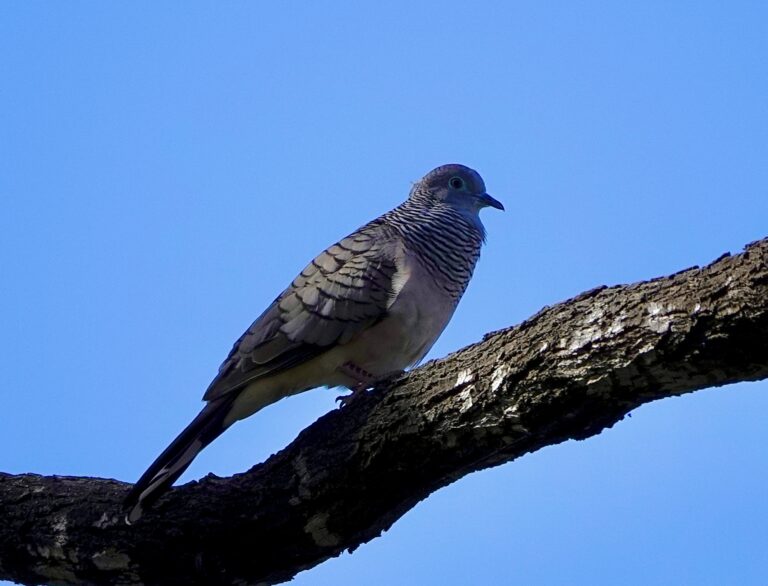
The Zebra Dove is approximately 20–23 centimetres long. It has a slim body, a relatively small head and a long, narrow, graduated tail with pale tips. The upperparts are brownish-grey with extensive dark barring, while the face and throat are paler grey. Fine black-and-white barring is especially noticeable across the sides of the neck, breast and flanks. The breast may show a soft pinkish wash, and the eye-ring and facial skin are bluish. The bill is pale grey and the feet are pinkish-brown or reddish.
Males and females are very similar, and sex is not usually reliable from appearance alone. Subtle differences in the extent of breast barring may occur, but courtship behaviour is generally a more dependable guide. Juveniles resemble adults but usually have softer, less sharply defined barring and a more subdued overall appearance.
Range and Habitat
The Zebra Dove is primarily associated with Southeast Asia. Its native distribution is centred on the Thai-Malay Peninsula, Sumatra and Java, while populations also occur elsewhere in the region through natural spread, releases or introduction. Introduced populations are established in places including the Hawaiian Islands.
It is mainly a resident species rather than a long-distance migrant. The dove favours open and semi-open habitats, including scrub, plantations, farmland, village edges, gardens, parks, roadsides and urban areas. It is particularly successful where short grass, bare ground and scattered shrubs or trees provide feeding and nesting opportunities. Most records are from lowlands and foothills, although the species can occur at higher elevations in suitable tropical habitats.
Where to See This Species
Kranji Marshes, Singapore
National Parks Board records list the Zebra Dove as a common resident breeder at Kranji Marshes. The species is most likely to be found around open paths, grassland margins, scrub and other lightly vegetated areas where it can feed on the ground.
Nearby accommodation: Kranji and the wider northern Singapore area provide hotels, guest houses and other urban accommodation.
Pulau Ubin, Singapore
The official Pulau Ubin bird checklist includes the Zebra Dove, and National Parks Board describes it as a resident of parks, gardens, urban areas and other open habitats. Look along village tracks, grass verges, clearings and cultivated areas, especially during the morning when ground-feeding birds are active.
Nearby accommodation: Changi Village and eastern Singapore provide hotels, guest houses and other accommodation, with Pulau Ubin reached by local boat services from Changi Point.
Coney Island Park, Singapore
National Parks Board identifies the Zebra Dove among the birds recorded at Coney Island Park. The park’s open tracks, grassed areas, gardens and scattered vegetation provide suitable feeding habitat, and birds may be seen alone or in pairs on or beside the paths.
Nearby accommodation: Punggol and the north-eastern Singapore area provide hotels, guest houses and serviced accommodation.
Behaviour and Diet
Zebra Doves are active during the day and are usually encountered alone, in pairs or in small groups. They spend much of their feeding time walking over bare ground, short grass and paths, and may gather where food or water is plentiful. When disturbed, they generally make a rapid, low flight to nearby cover.
The diet consists mainly of small seeds, including grass and weed seeds, rice and other cultivated grains. Small invertebrates may also be taken, although seeds form the main part of the diet. The species commonly feeds in the early morning and roosts in trees or shrubs at night.
Courtship includes repeated cooing, bowing movements and displays by the male. The nest is a loose platform of twigs and stems, usually placed in a tree, shrub or palm, although ground nesting may occur in locations where predators are limited. The usual clutch is two white eggs, and both parents participate in incubation and care of the young. Pair bonds are associated with breeding and should not automatically be described as lifelong.
Identification Tips
- Look for a small, slim dove with a long, narrow tail.
- The extensive fine barring on the neck, breast, flanks and upperparts is the key field mark.
- Note the pale face, bluish eye-ring and pinkish or reddish feet.
- Listen for a soft, repetitive and generally soothing cooing call.
- The Zebra Dove is smaller and sleeker than the Spotted Dove, Spilopelia chinensis. The Zebra Dove has a barred collar and breast, whereas the Spotted Dove has a larger body and a spotted, rather than barred, neck pattern.
- The similar-looking Peaceful Dove and Barred Dove are treated as separate species by many modern checklists. Their identification and distribution should therefore be assessed using a current regional field guide or checklist.
Conservation Status
The Zebra Dove is listed as Least Concern on the IUCN Red List. The available global assessment describes the population trend as stable, although a precise global population estimate is not available.
The species remains common and adaptable across much of its range, but local pressures can still be important. Habitat loss, capture for the cage-bird trade and persecution or trapping may affect some populations. Maintaining open green spaces, protecting suitable breeding habitat and enforcing regulations against illegal trapping are practical conservation measures. Introduced populations should also be monitored where they may interact with native species or carry avian diseases.
Frequently Asked Questions
Where is the Zebra Dove found?
The Zebra Dove is native to parts of Southeast Asia, with its distribution centred on the Thai-Malay Peninsula, Sumatra and Java. It has also been introduced to other regions, including the Hawaiian Islands.
What does a Zebra Dove eat?
It feeds mainly on small seeds, including grass and weed seeds, rice and other grains. It may occasionally take small invertebrates, but it is primarily a ground-feeding seed eater.
How can a Zebra Dove be identified?
Identify it by its small, slender shape, long graduated tail, bluish eye-ring and extensive fine barring across the neck, breast, flanks and upperparts. Its soft, repetitive call is also distinctive.
What is the difference between a Zebra Dove and a Spotted Dove?
The Zebra Dove is smaller and slimmer, with fine barred markings. The Spotted Dove is larger and bulkier, with a spotted collar pattern rather than the Zebra Dove’s barred collar.
Where does the Zebra Dove build its nest?
It usually builds a loose platform of twigs and stems in a tree, shrub or palm. In some low-predator locations, it may nest on or close to the ground.
Is the Zebra Dove endangered?
No. The species is currently assessed as Least Concern by the IUCN. Nevertheless, local populations may be affected by habitat change and trapping for the cage-bird trade.
References
- IUCN Red List of Threatened Species
- Cornell Lab of Ornithology, Birds of the World
- National Parks Board Singapore
Related posts