Namaqua Dove: The Graceful Wanderer of Africa’s Arid Landscapes
The Namaqua Dove (Oena capensis) is a small and elegant bird species that enchants birdwatchers and ornithologists alike with its distinctive appearance and remarkable adaptability. Named after the Namaqualand region of southern Africa, this dove is a true testament to survival in some of the continent’s most challenging environments. With its unique plumage and intriguing behaviors, the Namaqua Dove deserves a closer look.
Physical Characteristics
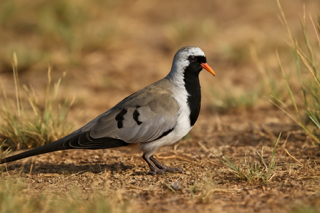
The Namaqua Dove is easily recognizable by its small size and striking sexual dimorphism. The male is particularly distinctive with a black face, throat, and upper breast, which contrasts sharply with its pale grey body. The long, narrow tail feathers and white wing patches add to its elegant appearance. In contrast, the female is less flamboyant, exhibiting a more uniform brown plumage with a slight pinkish tinge. Both sexes share a slender, down-curved bill that is orange at the base, transitioning to black at the tip.
This species measures approximately 22 cm in length, with a wingspan of about 28 cm. Despite their small stature, Namaqua Doves are notable for their long tails, which make up a significant portion of their overall length.
Habitat and Distribution
Namaqua Doves are predominantly found in sub-Saharan Africa, with their range extending from Mauritania and Senegal in the west, across to Ethiopia and Somalia in the east, and southwards to South Africa. Their habitat preferences are closely tied to arid and semi-arid regions, where they thrive in environments such as savannas, scrublands, and lightly wooded areas.
These doves are particularly adapted to dry conditions, often inhabiting regions where other bird species struggle to survive. They can also be found near water sources such as rivers and lakes, particularly during the breeding season.
Behavior and Diet
Namaqua Doves are primarily ground feeders, foraging for seeds, grains, and small insects. Their diet is diverse and opportunistic, allowing them to exploit a variety of food sources depending on availability. This adaptability is one of the keys to their success in arid regions.
The birds are generally solitary or seen in pairs, although they may form small flocks outside the breeding season. Their flight is rapid and direct, characterized by swift wingbeats and occasional glides.
Breeding and Reproduction
The breeding season for Namaqua Doves varies across their range, often coinciding with the rainy season when food resources are more abundant. Males attract females with a distinctive courtship display, involving cooing calls and a bobbing motion of the head and tail.
Nests are typically constructed in low shrubs or trees, made from twigs and lined with softer materials. The female lays one to two eggs, which are incubated by both parents for about two weeks. The chicks are altricial, hatching helpless and requiring extensive parental care. They fledge approximately two weeks after hatching, during which time they are fed a regurgitated ‘crop milk’ produced by both parents.
Conservation Status
Currently, the Namaqua Dove is classified as a species of Least Concern by the International Union for Conservation of Nature (IUCN). This status is largely due to its wide distribution and stable population numbers. The species’ adaptability to a range of habitats and conditions contributes significantly to its resilience.
However, like many wildlife species, Namaqua Doves face threats from habitat destruction and climate change. The expansion of agriculture and human settlements can lead to habitat fragmentation, while changes in climate patterns may alter the availability of water and food resources.
Cultural Significance
Beyond its ecological role, the Namaqua Dove holds cultural significance in various African societies. In some cultures, doves are seen as symbols of peace and love, with the Namaqua Dove being no exception. Its presence in folklore and local traditions highlights its importance beyond just an avian species.
Conclusion
The Namaqua Dove is a remarkable bird that embodies the spirit of adaptability and survival. Its ability to thrive in some of Africa’s most challenging environments is a testament to its resilience and evolutionary success. As we continue to study and appreciate this species, it is crucial to ensure that its habitats are preserved, allowing future generations to witness the grace and beauty of the Namaqua Dove in the wild.
Through a combination of conservation efforts and ecological awareness, we can help secure a future for this elegant wanderer of Africa’s arid landscapes.
Related posts