Introduction
The Black-hooded Sunbeam (Aglaeactis pamela) is a small hummingbird in the family Trochilidae. Endemic to Bolivia, it occurs in high Andean valleys, humid montane scrub and woodland near the upper tree line. Its predominantly dark plumage, iridescent green back and rufous tail make it one of the most distinctive hummingbirds of the Bolivian Andes.
Physical Description
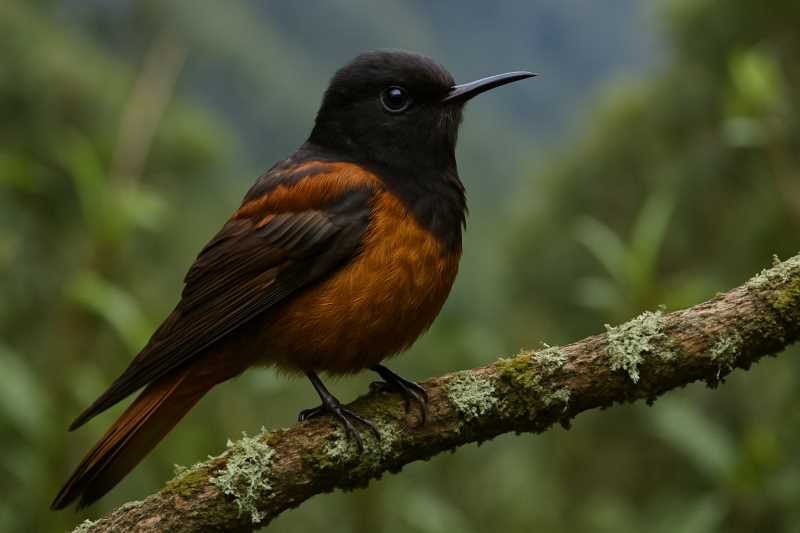
The Black-hooded Sunbeam is approximately 12–13 cm long and has a short, straight black bill. The adult male is mostly velvety black or purplish-black, with a brilliant bluish-green to golden-green lower back and rump. A small white tuft at the centre of the breast is particularly diagnostic, although it can be difficult to see on a fast-moving bird. The tail is rufous, with darker edges and tips.
Females resemble males but are generally duller, with less intense iridescence and a less conspicuous breast tuft. Juveniles are browner overall and usually show reduced iridescent colouring and a less developed breast tuft. The species is monotypic, with no currently recognised subspecies.
Range and Habitat
The Black-hooded Sunbeam is endemic to Bolivia. Its known range is concentrated in the departments of La Paz and Cochabamba, particularly along the eastern slopes of the Andes and in the Yungas region.
It is associated with humid montane forest, high-elevation shrubland, woodland edges and vegetation around the upper tree line. It is most often reported at approximately 2,500–4,000 metres above sea level, although records from lower elevations have also been documented. Its distribution is localised and can be fragmented, so it may be absent from apparently suitable habitat.
Where to See This Species
Cotapata National Park and Integrated Management Area, La Paz Department, Bolivia
The Black-hooded Sunbeam is listed among the endemic birds of Cotapata National Park. The park protects steep Andean landscapes, Yungas forest and high-elevation queñua woodland, providing suitable habitat across the species’ elevational range. Birdwatchers should concentrate on montane scrub, woodland edges and high-elevation trails, especially where flowering plants are present.
Nearby accommodation: La Paz and the settlements along the Cotapata and Yungas access routes provide practical options, including hotels, guest houses, lodges and small rural accommodation.
Tunari National Park, Cochabamba Department, Bolivia
The species is included in bird records and conservation information for Tunari National Park. The park contains high-elevation valleys, montane scrub and transitional Yungas habitats. It is most realistic to look for the Black-hooded Sunbeam in suitable upper-montane vegetation rather than in the heavily settled parts of the Cochabamba valley.
Nearby accommodation: Cochabamba is the main practical base, with hotels, guest houses and self-catering accommodation, while smaller rural lodging may be available near park access points.
Apolobamba National Integrated Management Area, La Paz Department, Bolivia
Apolobamba lies within the high Andes and includes humid montane habitats, shrubland and areas near the upper limit of tree growth. The Black-hooded Sunbeam is documented in conservation and bird records for the protected-area landscape. Local guidance is advisable because access can be difficult and sightings are likely to be localised.
Nearby accommodation: Charazani and nearby villages are the most practical local bases, with basic guest houses, community accommodation and camping options where arrangements are available.
Behaviour and Diet
Like other hummingbirds, the Black-hooded Sunbeam feeds mainly on nectar from flowering plants. Its bill and extensible tongue allow it to exploit tubular flowers, while visits to different plant species may contribute to pollination. It also takes small insects and spiders, which provide protein and other nutrients.
The species is generally encountered alone while feeding or defending access to productive flowers. It may perch conspicuously in shrubs or small trees between feeding flights. Information about its breeding season, nest, eggs and parental care remains limited, so detailed claims about nesting dates and incubation should be treated cautiously.
Identification Tips
- Look for a small, dark hummingbird with a striking blue-green or golden-green rump.
- The white central breast tuft is a useful feature when visible.
- The rufous tail contrasts with the otherwise dark body.
- The bill is short, straight and black, rather than long and strongly curved.
- Iridescent colours are most obvious in direct light and may appear dull or almost black in shade.
- Distinguish it from other sunbeams by its combination of predominantly black plumage, bright green rump, rufous tail and central white breast tuft.
Conservation Status
The Black-hooded Sunbeam is currently assessed as Least Concern on the IUCN Red List. It is nevertheless a restricted-range endemic, and its local populations may be affected by the loss and fragmentation of humid montane forest, high-elevation woodland and shrubland through agricultural expansion, burning, road development and other land-use changes.
A comprehensive population estimate and reliable long-term population trend are not available. Protecting high-elevation forests and shrublands, maintaining habitat connectivity and managing development in the Bolivian Andes are important conservation measures.
Frequently Asked Questions
Where is the Black-hooded Sunbeam found?
It is endemic to Bolivia, mainly in the Andean departments of La Paz and Cochabamba, including parts of the Yungas and adjacent high-elevation valleys.
What habitat does the Black-hooded Sunbeam use?
It uses humid montane forest, high-elevation shrubland, woodland edges and vegetation near the upper tree line, generally at elevations above about 2,500 metres.
What does the Black-hooded Sunbeam eat?
Its diet consists mainly of nectar, supplemented by small insects and spiders. It is often associated with flowering shrubs and other nectar-producing plants.
How can the Black-hooded Sunbeam be identified?
The best field marks are its mostly black plumage, iridescent blue-green rump, rufous tail and small white tuft at the centre of the breast.
Is the Black-hooded Sunbeam endangered?
No. The species is currently classified as Least Concern, although its restricted Bolivian range means that habitat loss and fragmentation remain important local concerns.
Where is the best place to look for this hummingbird?
Protected high-elevation habitats in Cotapata, Tunari and Apolobamba provide documented opportunities. Local guides and recent bird records are valuable because the species is localised and may be uncommon at any particular site.
References
- BirdLife International
- IUCN Red List of Threatened Species
- Servicio Nacional de Áreas Protegidas de Bolivia
Related posts