Introduction
The Buff-winged Starfrontlet (Coeligena lutetiae) is a medium-sized hummingbird of the northern and central Andes. It inhabits cool, humid mountain forests, forest edges and high-elevation shrublands from Colombia through Ecuador to north-western Peru. Its most distinctive field mark is the conspicuous buff or cinnamon-buff patch on the wing, visible in flight and present in both sexes.
Physical Description
The Buff-winged Starfrontlet is approximately 14 centimetres long, with a long, black bill, a slightly forked tail and a small pale spot behind the eye. The species shows clear sexual dimorphism.
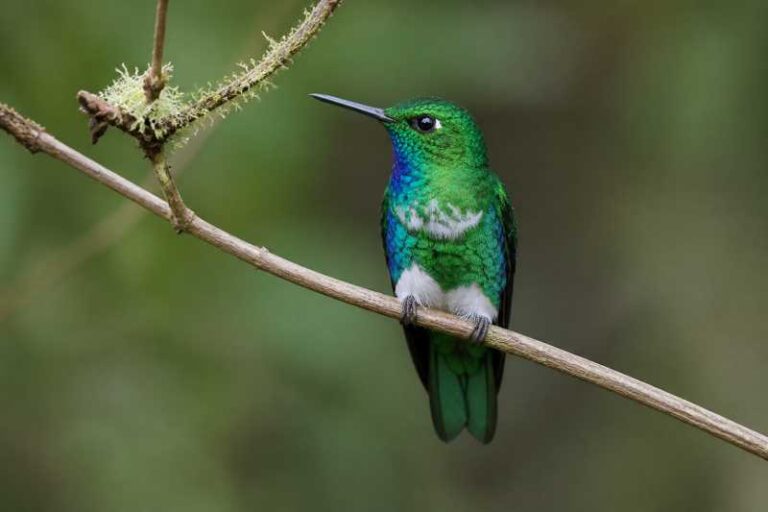
Adult males have dark, velvety upperparts, a glittering green forehead and an iridescent violet or violet-blue throat patch. The underparts are mainly dark green. The wings are dark, with a large cinnamon-buff patch, while the tail is bronzy black.
Females are less strongly iridescent. They have shining green upperparts, a cinnamon-buff throat and golden-green underparts with pale feather edges that can create a subtly scaled appearance. Their wings also show the characteristic buff patch, but the tail is generally bronzy green and less deeply forked than the male’s.
The western Ecuadorian subspecies C. l. albimaculata is paler in the wing, with patches that may appear whitish rather than cinnamon-buff. Immature birds can resemble females and may show less developed iridescent colouring.
Range and Habitat
The species occurs in the Andes of Colombia, Ecuador and north-western Peru. In Colombia, it is found in the central Andes. In Ecuador, it occurs on both the eastern Andean slope and parts of the north-western Andes. In Peru, its range reaches the northern Andes west and north of the Marañón Valley, including parts of Cajamarca and adjacent Piura.
The Buff-winged Starfrontlet is associated with humid montane forest, cloud forest, forest edges, elfin woodland and high-elevation Polylepis habitats. It is generally recorded from about 2,400 to 3,900 metres, although the precise elevation varies geographically and it is most often encountered around the upper montane and sub-páramo zones. It is resident rather than a long-distance migrant, but local movements may occur as birds follow flowering plants and changing conditions across elevational zones.
Two subspecies are commonly recognised: the nominate C. l. lutetiae and C. l. albimaculata, which occurs on the western slope of the northern Ecuadorian Andes.
Where to See This Species
Yanacocha Biological Reserve, Pichincha, Ecuador
Yanacocha protects high-elevation Andean forest and páramo on the slopes west of Quito. The reserve’s bird checklist documents the Buff-winged Starfrontlet, and its humid montane vegetation, trails and hummingbird feeding areas provide realistic opportunities to search for the species. Look along forest edges, flowering shrubs and sheltered sections of trail, particularly in the cool upper elevations.
Nearby accommodation: Quito and the nearby settlement of Nono provide the most practical bases, with hotels, guest houses and small rural accommodation available in the wider area.
Guango Lodge Reserve, Napo, Ecuador
Guango Lodge lies on the eastern slope of the Andes near Papallacta, in cool, wet upper montane forest at roughly 2,700 to 2,900 metres. The reserve’s bird checklist includes the Buff-winged Starfrontlet, and its trails, forest edge and hummingbird-feeding areas make it a practical venue for visitors seeking high-elevation hummingbirds.
Nearby accommodation: Papallacta is the nearest recognised gateway settlement, with hotels, lodges, guest houses and thermal-resort accommodation.
Behaviour and Diet
Buff-winged Starfrontlets are usually encountered singly. Like many hummingbirds, they may defend productive flowers or feeding areas from other hummingbirds, although the intensity of territorial behaviour can vary with food availability.
Their diet consists mainly of nectar from tubular or otherwise suitable mountain flowers. They also take small insects and other arthropods, either by making short sallies from a perch or by gleaning among vegetation. Nectar provides energy for hovering flight, while arthropods supply protein and other nutrients.
By carrying pollen between flowers, the species contributes to pollination in high-Andean plant communities. Detailed information on its breeding season, nest placement and courtship remains limited compared with that available for better-studied hummingbirds.
Identification Tips
- Look for a medium-sized, long-billed hummingbird in high-elevation Andean forest or páramo-edge habitat.
- The large buff or cinnamon-buff wing patch is the most useful feature and is often easiest to see when the bird turns or flies.
- Males show a glittering green forehead, dark upperparts and a distinct violet or violet-blue throat patch.
- Females have a buff throat, greener overall plumage and a less deeply forked, bronzy-green tail.
- The small pale spot behind the eye, black bill and forked tail help confirm the identification.
- Take care when comparing it with other Coeligena species. The combination of a buff wing patch, green forehead in the male and violet throat patch is more reliable than overall colour alone, especially in poor light.
Conservation Status
The Buff-winged Starfrontlet is currently assessed as Least Concern by BirdLife International and the IUCN Red List framework. Its broad Andean distribution means that it is not presently considered close to the global thresholds for a threatened category.
Nevertheless, suitable habitat is fragmented in parts of its range. Agricultural expansion, forest clearance, road and infrastructure development, and the degradation of high-elevation forest can reduce feeding and nesting habitat. Climate change may also alter flowering patterns and the distribution of suitable montane habitats. Protecting connected cloud-forest remnants, páramo edges and Polylepis woodland, together with restoring degraded corridors, remains important for the species and the wider Andean bird community.
Frequently Asked Questions
Where can the Buff-winged Starfrontlet be found?
It is found in the Andes of Colombia, Ecuador and north-western Peru, mainly in humid montane forests, cloud forests, forest edges and high-elevation woodland.
What does the Buff-winged Starfrontlet look like?
It is a medium-sized hummingbird with a long black bill, a forked tail and a distinctive buff or cinnamon-buff patch on both wings. Males have a green forehead and violet throat patch, while females have a buff throat and duller green plumage.
What does the Buff-winged Starfrontlet eat?
It feeds mainly on nectar from mountain flowers and supplements its diet with small insects and other arthropods.
Is the Buff-winged Starfrontlet migratory?
It is considered resident rather than a long-distance migrant. Local or altitudinal movements may occur as birds respond to flowering conditions and changes in food availability.
Where is the best place to see this species?
Documented viewing locations include Yanacocha Biological Reserve west of Quito and Guango Lodge Reserve near Papallacta in Ecuador. It is most likely in cool, humid forest, forest edges and flowering areas at high elevation.
Is the Buff-winged Starfrontlet endangered?
No. It is currently classified as Least Concern, although habitat loss and fragmentation remain important conservation concerns in parts of its Andean range.
References
- BirdLife International
- IOC World Bird List
- Fundación Jocotoco
Related posts