Introduction
The Hainan Peacock-Pheasant (Polyplectron katsumatae) is an endemic pheasant of Hainan Island, China. It occurs mainly in remaining tropical and subtropical evergreen forests in the island’s central and southern mountain ranges. Although it is secretive and difficult to observe, the species is recognised by the contrasting plumage and metallic eye-like spots, or ocelli, on the male’s wings and tail. The IOC World Bird List and current conservation references treat it as a distinct species rather than as a subspecies of the Grey Peacock-Pheasant.
Physical Description
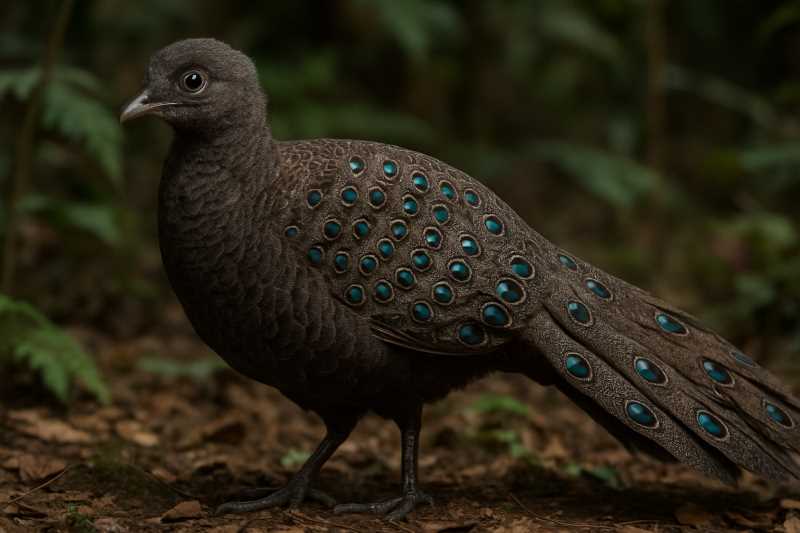
The Hainan Peacock-Pheasant is a relatively small, ground-dwelling member of the pheasant family, Phasianidae. The male has dark brown to grey-brown plumage, a short crest and ruff, and conspicuous blue-green ocelli bordered with paler markings on the wings and elongated tail feathers. The bare facial skin is reddish, a feature that helps distinguish it from the Grey Peacock-Pheasant, which generally has differently coloured facial skin.
Males are more ornate than females. The female is duller brown overall, with less prominent markings and stronger camouflage for foraging and nesting on the forest floor. Juveniles are less distinctive than adults and are likely to resemble the cryptic female plumage during their early development. Reliable published measurements are limited, so no single standard length or weight is given here.
Range and Habitat
The Hainan Peacock-Pheasant is endemic to Hainan Island and is not migratory. Its known distribution is concentrated in mountainous areas of central and southwestern Hainan, including forest landscapes associated with Jianfengling and other protected areas. Published studies describe it mainly from tropical montane and evergreen broadleaf forests, particularly habitats with dense but not impenetrable understorey and suitable leaf-litter cover.
Recent camera-trap research in Jianfengling recorded the species in forest at approximately 500–1,200 metres above sea level, with use of mid-elevation habitats and proximity to water being especially important during the dry season. Suitable habitat is fragmented, and the species avoids areas with high levels of human disturbance. Roads, forest clearance, plantation expansion and other changes to the forest landscape can reduce habitat quality and connectivity.
Behaviour and Diet
The Hainan Peacock-Pheasant is secretive and primarily terrestrial. It is usually encountered alone or in pairs, although direct observations are uncommon because the bird moves through dense understorey and leaf litter. Camera-trap research indicates pronounced activity around dawn and dusk, with seasonal changes in the timing and strength of these activity peaks.
Its diet is considered omnivorous and includes insects and other small invertebrates, seeds and fallen fruits. By feeding on both animal and plant material, it occupies a generalist ground-foraging niche within the forest ecosystem. Detailed information about its breeding behaviour, nesting sites, incubation and chick development remains limited, and further field research is needed before more specific claims can be made.
The male’s patterned tail and wing feathers are associated with display behaviour. However, the precise sequence and frequency of courtship displays in wild birds are not yet sufficiently documented to describe them in detail.
Identification Tips
Look for the following combination of features:
- A small, dark, ground-dwelling pheasant in humid evergreen or montane forest.
- A relatively short crest and ruff compared with the Grey Peacock-Pheasant.
- Blue-green, eye-like ocelli on the male’s wings and tail, often visible when the bird turns or displays.
- Reddish bare facial skin in adults.
- A strongly camouflaged female, mainly brown and less boldly patterned than the male.
- Secretive behaviour, with the bird often slipping into dense vegetation rather than flying immediately.
The most relevant comparison is the Grey Peacock-Pheasant (Polyplectron bicalcaratum), from which the Hainan species was formerly separated as a subspecies. The Hainan Peacock-Pheasant is smaller and has a shorter crest and ruff, while the colour of the bare facial skin and other plumage details also differ. Geographic location is important, because the Hainan species is restricted to Hainan Island.
Conservation Status
The Hainan Peacock-Pheasant is currently classified as Endangered on the IUCN Red List. It has a restricted island range, a fragmented population and a continuing dependence on remaining forest habitat. It is also listed as a nationally protected species in China.
The principal threats are loss, degradation and fragmentation of evergreen forest through agricultural and plantation expansion, infrastructure development and other forms of land conversion. Hunting and the historical consumption of peacock-pheasant meat have also been documented as conservation concerns. Because the species has little opportunity to expand beyond Hainan’s remaining forest blocks, local habitat loss can have a disproportionate effect.
Important conservation measures include protecting remaining forest, maintaining connections between habitat patches, reducing disturbance around core areas, preventing illegal hunting and conducting long-term monitoring. Hainan Tropical Rainforest National Park and other protected areas provide an important framework for these actions. Recent habitat-modelling and camera-trap studies have recommended stronger protection of suitable forest in the eastern and southern parts of the Jianfengling landscape, together with regular surveys and control of roads and other disturbance sources.
Frequently Asked Questions
Where does the Hainan Peacock-Pheasant live?
It lives only on Hainan Island, China. Its known range is concentrated in mountainous evergreen and tropical montane forests in central and southern parts of the island.
Is the Hainan Peacock-Pheasant endangered?
Yes. The species is classified as Endangered on the IUCN Red List because of its restricted range, fragmented population and continuing threats to its forest habitat.
What does the Hainan Peacock-Pheasant eat?
It is an omnivorous ground-forager that feeds on insects and other small invertebrates, seeds and fallen fruits.
How can the species be identified?
The male is identified by its dark plumage, short crest and ruff, reddish facial skin and blue-green eye-like ocelli on the wings and tail. Females are browner and more cryptic.
Is the Hainan Peacock-Pheasant migratory?
No. It is a resident island endemic and is not known to undertake regular long-distance migration.
What conservation work is needed?
Priority actions include protecting and restoring evergreen forest, maintaining habitat connectivity, limiting roads and other disturbance, preventing hunting and improving long-term camera-trap and field monitoring.
References
- BirdLife International. n.d. Hainan Peacock-pheasant Polyplectron katsumatae Species Factsheet. BirdLife DataZone. Accessed 8 September 2026. https://datazone.birdlife.org/species/factsheet/hainan-peacock-pheasant-polyplectron-katsumatae
- Gill, F., Donsker, D. and Rasmussen, P. (eds). 2026. IOC World Bird List, version 15.2. International Ornithologists’ Committee. Accessed 8 September 2026. https://www.worldbirdnames.org/
- Liang, W. and Zhang, Z. 2011. Hainan Peacock Pheasant (Polyplectron katsumatae): an endangered and rare tropical forest bird. Avian Research, 2(2), 111–116. https://doi.org/10.5122/cbirds.2011.0017
- Wang, Y. W., Leader-Williams, N. and Turvey, S. T. 2021. Exploitation histories of pangolins and endemic pheasants on Hainan Island, China: baselines and shifting social norms. Frontiers in Ecology and Evolution, 9, 608057. https://doi.org/10.3389/fevo.2021.608057
- Yao, W., Ma, Y., Long, A., Liu, L., Shang, E., Zhang, S., Yang, J. and Gao, T. 2025. Assessment of suitable habitats and identification of key protection areas for Polyplectron katsumatae in Jianfengling, Hainan Province, China. Life, 15(5), 826. https://doi.org/10.3390/life15050826
- Lu, X., Yan, W., Wang, Q. et al. 2026. Niche partitioning and facilitative coexistence of two sympatric pheasants across a gradient of human disturbance. Ecology and Evolution. https://doi.org/10.1002/ece3.73929
- World Bird Names. n.d. Hainan Peacock-Pheasant / Polyplectron katsumatae. Accessed 8 September 2026. https://www.worldbirdnames.com/bird/hainan-peacock-pheasant/1200.html
Related posts