Introduction
The Bearded Mountaineer (Oreonympha nobilis) is a distinctive hummingbird endemic to the Peruvian Andes. It inhabits dry intermontane valleys and open montane vegetation, where its long, deeply forked tail and iridescent throat make it one of the region’s most memorable hummingbirds. Some taxonomic authorities refer to this taxon as the Eastern Mountaineer and treat the Western Mountaineer as a separate species.
Physical Description
The Bearded Mountaineer is a medium-sized hummingbird measuring approximately 14–16.5 centimetres in length, including its bill, and weighing about 7–9 grams.
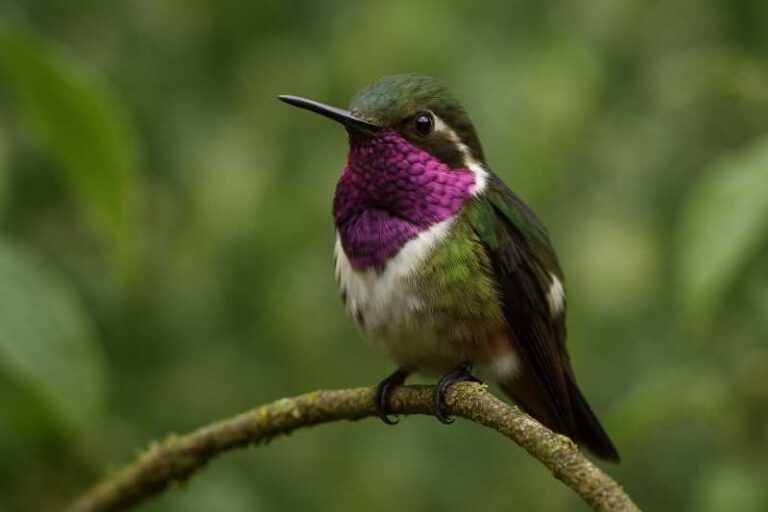
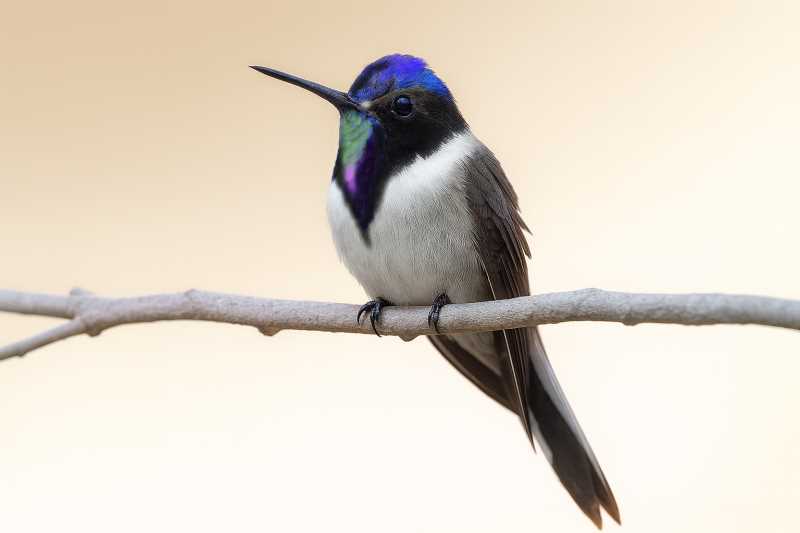
Adult males have a deep purplish-blue crown, a bronzy-black face, a narrow white band behind the head and a long, narrow gorget, or throat patch. The gorget is emerald green beneath the chin and becomes purplish with a bluish sheen towards the lower edge. The back and rump are bronzy to bronzy-brown, while the centre of the breast is white and the flanks are brownish. The long tail is strongly forked and bronzy, with increasing amounts of white towards the outer feathers.
Females are duller overall, with a smaller gorget that is mainly white, a less deeply forked tail and less contrasting underparts. Juveniles are duller still, with a scaly green crown, a brownish throat and a yellowish lower mandible. Both sexes have black bills and legs.
Range and Habitat
The Bearded Mountaineer is endemic to Peru. The nominate form occurs mainly in the departments of Cusco and Apurímac, particularly in the drainages of the Urubamba and upper Apurímac rivers. It is generally resident rather than a long-distance migrant.
It occupies dry Andean valleys, rocky and scrub-covered hillsides, open woodland and other semi-open montane habitats. It has been recorded from approximately 2,500 to 3,900 metres above sea level. Although it uses native plant communities, it may also visit flowering tree tobacco (Nicotiana), agaves, cacti and eucalyptus, including plants growing beside roads and around settlements.
Geographic variation is reflected in the treatment of O. n. albolimbata, which some authorities recognise as the separate Western Mountaineer, Oreonympha albolimbata. This article follows the species name Oreonympha nobilis requested for the Bearded Mountaineer.
Where to See This Species
Humedal Lucre–Huacarpay, Cusco, Peru
This Ramsar-listed high-Andean wetland near Cusco is one of the most reliable and accessible places to look for the Bearded Mountaineer. The species is documented there in the dry hillsides, scrub and flowering vegetation surrounding the lagoons, at about 3,020 metres. Early morning visits are usually most productive, particularly when flowering tree tobacco is available.
Nearby accommodation: Cusco is the most practical base, with hotels, guest houses, hostels and self-catering accommodation. Basic guest-house accommodation may also be available in nearby Lucre.
Upper Manu Road and Manu Biosphere Reserve, Cusco, Peru
The high-elevation approaches to Manu are recognised birdwatching areas for the Bearded Mountaineer, especially in dry scrub and open vegetation around the Cusco side of the route. The species is a regular target on birding journeys travelling from Cusco towards Manu, although sightings can be local and conditions vary with flowering and access.
Nearby accommodation: Paucartambo is the main practical gateway settlement for the upper route and offers basic hotels, guest houses and simple lodging. Further along the route, guided trips may use mountain lodges, research-station accommodation or campsites, depending on access and current arrangements.
Abra Málaga, Cusco, Peru
Abra Málaga is a recognised high-Andean birdwatching area on the route between the Sacred Valley and the eastern slopes of the Andes. The Bearded Mountaineer has been documented in local bird lists and birding records from the pass and surrounding slopes. Look in open scrub, flowering vegetation and sheltered areas along accessible roads, while also checking higher-elevation habitats for other Andean hummingbirds.
Nearby accommodation: Ollantaytambo is the most practical base, with hotels, guest houses, hostels and self-catering accommodation. Accommodation is also available in other Sacred Valley settlements, although travel times to the pass vary.
Behaviour and Diet
The Bearded Mountaineer is active during daylight and may defend flowering plants or move between scattered patches of nectar-producing vegetation. It is resident throughout its known range, although local movements may occur as birds track changes in flowering conditions.
Its diet consists mainly of nectar from plants including agaves, cacti, tree tobacco and eucalyptus. It can feed while hovering in a near-vertical posture, often flicking its tail, and may also cling to flowers with its wings open. Small arthropods, including insects and spiders, provide additional protein and nutrients.
The species is not usually dominant at flowers and may be displaced by more aggressive hummingbirds. Detailed information about courtship, nesting sites, clutch size and incubation remains limited, and its breeding biology has not been fully documented. Earlier accounts suggested possible nesting in caves above rivers, but this has not been adequately confirmed.
Identification Tips
Look for a relatively large hummingbird with a long, deeply forked tail and a conspicuous, elongated throat patch. Adult males are especially distinctive when the light catches the purplish-blue crown and green-and-violet gorget.
Useful field marks include:
- a long, strongly forked bronzy tail with pale outer feathers;
- a white central breast contrasting with darker flanks;
- a bronzy-brown back and rump;
- a narrow white band behind the head in adult males; and
- a long, iridescent throat patch that may appear green, violet or blue depending on the light.
Females and juveniles are more subdued and can be overlooked among other Andean hummingbirds. The combination of size, deeply forked tail, pale central breast and elongated gorget is usually more useful than colour alone.
Conservation Status
The Bearded Mountaineer is assessed as Least Concern. Its population size is not known, but available assessments describe the population as stable. Nevertheless, it has a restricted Peruvian range and depends on fragmented dry-valley and montane habitats.
Potential pressures include the conversion of native vegetation for agriculture, overgrazing, burning, road development and other changes to dry Andean valleys. The loss of flowering plants may reduce feeding opportunities, although planted tree tobacco and eucalyptus can sometimes provide alternative nectar sources. Protecting native scrub, open woodland, flowering plants and wetland margins remains important, particularly around heavily visited sites such as Huacarpay.
Frequently Asked Questions
Where does the Bearded Mountaineer live?
It is endemic to Peru, where it occurs mainly in dry Andean valleys and montane scrub in the Cusco and Apurímac region, generally between about 2,500 and 3,900 metres.
Is the Bearded Mountaineer migratory?
No. It is considered resident throughout its range, although individuals may make local movements in response to flowering and food availability.
What does the Bearded Mountaineer eat?
It feeds mainly on nectar from agaves, cacti, tree tobacco and eucalyptus. It also takes small arthropods such as insects and spiders.
Where is the best place to see this hummingbird?
Humedal Lucre–Huacarpay near Cusco is one of the best-known and most accessible sites. Other documented birdwatching areas include the upper Manu Road and Abra Málaga.
How can the species be identified in the field?
Adult males are recognised by their long, iridescent throat patch, purplish-blue crown, bronzy back, white central breast and deeply forked tail. Females and juveniles are duller but retain the distinctive tail shape and overall structure.
Is the Bearded Mountaineer endangered?
It is currently classified as Least Concern. However, its restricted range means that habitat loss, degradation of dry Andean valleys and declines in flowering resources should continue to be monitored.
References
- BirdLife International
- Birds of the World
- Ramsar Sites Information Service
Related posts