Introduction
The New Caledonian Owlet-nightjar (Aegotheles savesi) is an endemic bird of New Caledonia and one of the least-known species in the world. It is known from very few specimens and a small number of uncertain or historical observations. Although it has not been conclusively confirmed in recent surveys, it remains listed as Critically Endangered rather than officially extinct.
Physical Description
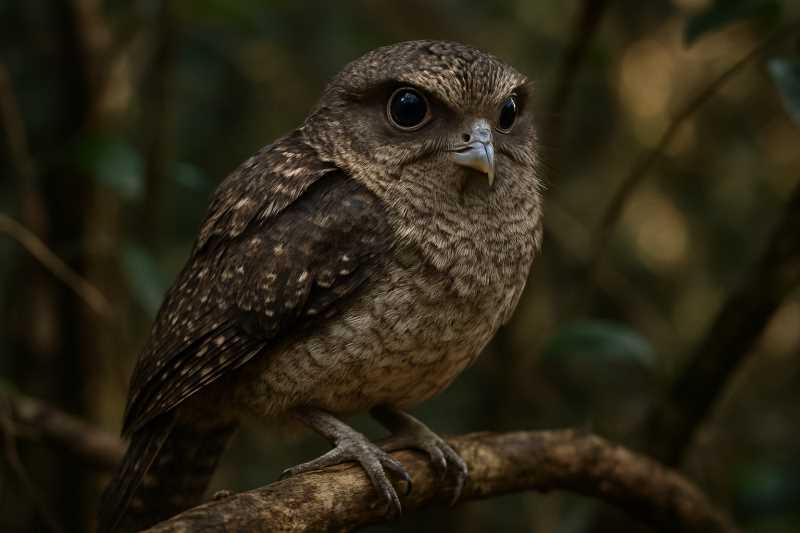
The New Caledonian Owlet-nightjar is a relatively large owlet-nightjar with grey-brown and black, finely patterned plumage that provides camouflage in forest vegetation. It has a long, slightly rounded tail, short rounded wings and unusually long, stout legs. These features distinguish it from the smaller Australian Owlet-nightjar and may indicate that it spent more time moving or feeding close to the ground.
Reliable information on body measurements, sexual dimorphism, juvenile plumage and age-related variation is unavailable. No confirmed field photographs or modern specimens provide enough evidence for a detailed description of variation within the species.
Range and Habitat
The species is endemic to Grande Terre, the main island of New Caledonia. The type specimen was collected near Nouméa, and another specimen was obtained in the early twentieth century. A reported observation in 1998 came from the Rivière Ni Valley in the Kouakoué massif of southern New Caledonia, where a large owlet-nightjar was seen foraging at dusk.
Historical accounts associate the species with humid evergreen forest, riparian forest and other native forest habitats. Its precise elevation range and current distribution are unknown. The available evidence suggests that it is resident rather than migratory, but this cannot be confirmed from the limited records.
Where to See This Species
No regularly accessible public wildlife-viewing venue can currently be recommended with confidence for the New Caledonian Owlet-nightjar. The most recent reported observation was associated with the remote Rivière Ni Valley in the Kouakoué massif, but subsequent searches did not produce confirmed records, and the area is not an established site for observing the species.
The best available approach is to follow conservation surveys and approved research carried out in suitable forest reserves. Any attempt to search for the bird should respect local access rules, protected-area regulations and the need to avoid disturbance to a potentially surviving population.
Behaviour and Diet
Very little is known about the species’ behaviour. It is presumed to be nocturnal or crepuscular, as the most recent reported observation occurred at dusk. During that observation, the bird was seen apparently searching for insects.
The diet has not been studied directly, but insects are considered the most likely food based on the observation of foraging behaviour and the ecology of related owlet-nightjars. Whether it captures prey from perches, in flight or on the ground is uncertain.
Breeding behaviour, nest sites, clutch size, vocalisations and parental care have not been reliably documented. Roosting in tree hollows and other habits reported for related species should not be treated as confirmed characteristics of the New Caledonian Owlet-nightjar.
Identification Tips
A suspected New Caledonian Owlet-nightjar would be expected to show the following combination of features:
- A relatively large owlet-nightjar with grey-brown and black, vermiculated plumage.
- Short, rounded wings and a long, slightly rounded tail.
- Noticeably long, strong legs.
- Nocturnal or dusk activity in native forest, particularly near forest edges or watercourses.
The species should not be confused with the New Caledonian Nightjar (Eurostopodus exul), which belongs to a different family and has a different body shape and flight profile. Because the New Caledonian Owlet-nightjar has not been reliably documented in recent decades, any sighting would require careful verification through photographs, sound recordings or detailed field notes.
Conservation Status
The New Caledonian Owlet-nightjar is classified as Critically Endangered. Some modern bird lists also identify it as possibly extinct because there has been no widely accepted confirmed record since the late twentieth century. The total population is unknown, and no reliable population estimate should be given.
Potential threats include the loss and degradation of native forest through logging, mining and other land-use pressures. Introduced predators, particularly rats and feral cats, may also pose a serious risk to any surviving birds, nests or eggs. The species’ extreme rarity makes assessment difficult, and protecting remaining forest while continuing carefully managed surveys is a conservation priority.
Frequently Asked Questions
Where is the New Caledonian Owlet-nightjar found?
It is endemic to Grande Terre, New Caledonia. Historical records come from areas near Nouméa and from the Kouakoué massif in the south of the island.
Is the New Caledonian Owlet-nightjar extinct?
Its survival has not been conclusively demonstrated in recent years. It remains classified as Critically Endangered, although some bird lists describe it as possibly extinct because confirmed records are exceptionally old and scarce.
What does the New Caledonian Owlet-nightjar look like?
It is a relatively large owlet-nightjar with grey-brown and black patterned plumage, a long slightly rounded tail, short rounded wings and long, stout legs.
What does the New Caledonian Owlet-nightjar eat?
Its diet is poorly known. Insects are considered the most likely food, and a reported 1998 observation described a bird apparently foraging for insects at dusk.
Can visitors see this species in New Caledonia?
There is currently no established public birdwatching site where the species can be reliably seen. Its known locations are remote, and later searches have not confirmed a surviving population.
What are the main threats to this bird?
Likely threats include habitat loss and degradation, together with predation by introduced rats and feral cats. The lack of reliable recent records also makes it difficult to identify the species’ precise conservation needs.
References
- BirdLife International
- IUCN Red List of Threatened Species
- IOC World Bird List
Related posts