Introduction
The Garnet-throated Hummingbird (Lamprolaima rhami) is a medium-sized hummingbird of the highlands of southern Mexico and northern Central America. It is closely associated with cloud forest, humid montane woodland and pine-oak forest, where its iridescent plumage can be difficult to see clearly in the dim, filtered light.
Physical Description
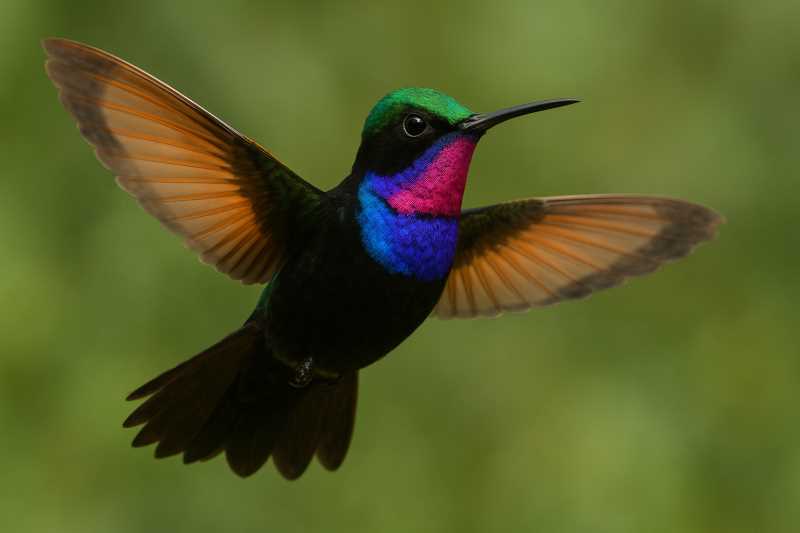
The Garnet-throated Hummingbird measures approximately 12–12.4 centimetres in length and weighs about 5.6–7.1 grams. The male has iridescent green upperparts, a white postocular spot and a short, straight black bill. Its most distinctive feature is the brilliant rose-pink to garnet throat, which contrasts with the darker greyish underparts. The wings are largely rufous or chestnut, while the broad tail is dark purple with paler greyish edges to the outer feathers.
The female is less brightly coloured. She retains the iridescent green upperparts, but the throat and underparts are mainly dusky grey, often with a few pink feathers on the throat. The outer tail feathers have narrow whitish tips. Immature birds resemble females, although young males may have darker underparts and buff feather fringes on the head and breast.
Range and Habitat
The species has a discontinuous range from the Mexican states of Guerrero, Puebla, Veracruz, Oaxaca and Chiapas south through Guatemala, El Salvador and western Honduras. It is a regional highland species rather than a long-distance migrant, although individuals may make seasonal movements to different elevations.
It usually occurs between about 1,200 and 3,000 metres, with many records concentrated in the middle and upper parts of this range. Preferred habitats include cloud forest, humid evergreen forest, pine-oak woodland, forest edges and adjoining scrub. Populations are geographically separated, and variation in size and plumage has led to proposed subspecies, but the species is currently treated cautiously as a single taxon in widely used global checklists.
Where to See This Species
Parque Nacional Pico de Orizaba, Veracruz and Puebla, Mexico
The Garnet-throated Hummingbird has been recorded during biological monitoring in Parque Nacional Pico de Orizaba. The park’s high-elevation forests and surrounding montane habitats provide suitable conditions, particularly where flowering plants occur along forest edges and community-monitored trails. Look in humid woodland and transitional areas rather than on the exposed summit slopes.
Nearby accommodation: Orizaba, Ciudad Serdán and nearby mountain communities provide hotels, guest houses and other basic accommodation.
Parque Nacional Chicabal, Quetzaltenango, Guatemala
The species is listed in the protected area’s management documentation for Parque Nacional Chicabal. The volcanic landscape includes humid montane forest and highland vegetation suitable for this hummingbird. Quietly checking forest edges, flowering shrubs and sheltered trails is more productive than searching the open lake shore.
Nearby accommodation: Quetzaltenango is the most practical base, with hotels, guest houses and self-catering accommodation, while smaller communities near the park offer simpler lodging.
Parque Nacional La Tigra, Francisco Morazán, Honduras
Lamprolaima rhami is included in the park’s bird records for Parque Nacional La Tigra, a publicly accessible montane forest reserve north-east of Tegucigalpa. The reserve’s humid cloud forest, forest edges and flowering plants provide suitable habitat. Early morning visits offer the best chance of detecting active hummingbirds before the forest becomes busier.
Nearby accommodation: Tegucigalpa is the main gateway, with hotels and guest houses, while limited rural accommodation may be available near the park entrances.
Behaviour and Diet
The Garnet-throated Hummingbird is active and fast-flying, frequently hovering at flowers and making sudden, energetic flights between perches and feeding sites. It often forages from low to middle levels of the forest, but may also feed higher in the canopy.
Nectar from flowering shrubs and trees forms the main part of its diet. Plants recorded as food sources include members of the genera Inga and Erythrina. The bird also captures insects and other small arthropods, including by making short hawking flights from a perch. This animal food is particularly important when adults are feeding young.
Males may defend flower-rich feeding areas from other hummingbirds and can be aggressive towards intruders. The species is generally solitary outside breeding interactions. It is considered largely resident, although some birds move to higher elevations during the breeding period.
Breeding timing varies geographically. Nesting has been recorded in different months on the Pacific and Atlantic slopes. The female builds a relatively bulky cup-shaped nest using moss, plant material, leaf fragments and spider silk. Some nests are placed close to the ground, including among exposed roots or low vegetation. Records commonly involve two eggs, and the female is responsible for incubation and feeding the young.
Identification Tips
- Look for a medium-sized hummingbird with a dark purplish tail and conspicuously chestnut or rufous wings.
- Adult males show a brilliant rose-garnet throat, iridescent green upperparts and a small white spot behind the eye.
- Females and immature birds are duller, with dusky grey underparts and narrow white tips on the outer tail feathers.
- The species is strongly associated with highland cloud forest and pine-oak woodland, so elevation and habitat are useful identification clues.
- Berylline Hummingbird and Stripe-tailed Hummingbird can also show rufous or reddish wing areas, but the Garnet-throated Hummingbird usually has more extensively chestnut wings combined with its distinctive dark tail and, in males, the shining pink throat.
Conservation Status
The Garnet-throated Hummingbird is currently assessed as Least Concern on the global IUCN Red List. This classification does not mean that every population is secure. The species has a fragmented distribution and depends heavily on montane and cloud-forest habitats, which are vulnerable to deforestation, agricultural expansion, forest degradation and changes in local flowering patterns.
Conservation measures should focus on protecting remaining cloud forest, maintaining connections between isolated highland forest patches and retaining flowering plants along forest edges. Monitoring is especially important in regions where populations are naturally separated or where habitat is being converted to farmland and settlements. National protection categories may differ between countries, and some local populations receive additional protection through national parks and other reserves.
Frequently Asked Questions
Where does the Garnet-throated Hummingbird live?
It occurs in discontinuous highland habitats from southern Mexico through Guatemala and El Salvador to western Honduras. It is most closely associated with cloud forest, humid montane woodland and pine-oak forest.
How can the Garnet-throated Hummingbird be identified?
The male is recognised by his shining rose-pink or garnet throat, green upperparts, white postocular spot, dark purple tail and chestnut wings. Females and immature birds are greyer below and have whitish tips on the outer tail feathers.
What does the Garnet-throated Hummingbird eat?
It feeds mainly on nectar from flowering plants, including shrubs and trees such as Inga and Erythrina. It also captures insects and other small arthropods in flight or from vegetation.
Is the Garnet-throated Hummingbird migratory?
It is generally considered a resident species, but individuals can make seasonal movements between elevations. Some birds move higher during the breeding period.
Where is the best place to see this hummingbird?
The best opportunities are in protected cloud forests and humid pine-oak woodlands within its range. Suitable documented sites include Parque Nacional Pico de Orizaba in Mexico, Parque Nacional Chicabal in Guatemala and Parque Nacional La Tigra in Honduras.
Is the Garnet-throated Hummingbird endangered?
Globally, it is classified as Least Concern. However, habitat loss and fragmentation remain important local threats because the species depends on highland forest and flowering resources.
References
- Birds of the World, Cornell Lab of Ornithology
- IUCN Red List of Threatened Species
- National protected-area records from CONANP and CONAP
Related posts