Introduction
The White-tailed Goldenthroat (Polytmus guainumbi) is a small hummingbird in the family Trochilidae. It is associated mainly with open, wet habitats across tropical and subtropical South America, where it feeds on nectar and small arthropods close to the ground.
Physical Description
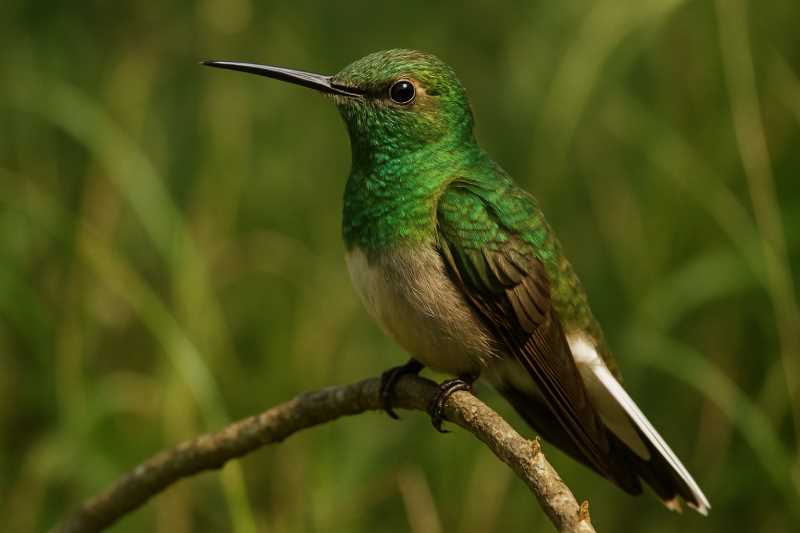
The White-tailed Goldenthroat measures approximately 10.5–11 cm in length. It has predominantly green plumage, a noticeably curved bill, and a rounded tail that is green with contrasting white tips or white outer feathers. White facial markings above and below the eye are important identification features.
The sexes are broadly similar, although females tend to show more yellowish facial markings, a paler chin and more yellowish underparts. The throat and upper breast may show green or golden-green iridescence, particularly in good light. Juveniles resemble females and may have pale edging on the head feathers.
Range and Habitat
The species occurs from Colombia, Venezuela and Trinidad and Tobago eastwards through Guyana, Suriname and French Guiana, and south through Brazil, Peru, Bolivia, Paraguay and northern Argentina. Several geographic forms are recognised, including populations associated with the northern part of the range and the southern and central South American distribution.
It favours open savannas, wet grasslands, marshes, seasonally flooded areas, pastures and scrubby vegetation near water. It may also occur along wetland margins and in open country adjoining woodland, but it is not primarily a forest bird. In Peru, its distribution is particularly localised, including the Pampas del Heath region of Madre de Dios.
The White-tailed Goldenthroat is generally resident, although seasonal or post-breeding movements may occur in some parts of its range.
Where to See This Species
Caroni Swamp, Trinidad, Trinidad and Tobago
Caroni Swamp is a protected wetland containing freshwater and saltwater marshes, mangrove habitats and open wet areas. The White-tailed Goldenthroat is documented from the Caroni Swamp wetland, although it is not considered one of the most regularly encountered birds there. Look around marsh edges, low scrub and flowering vegetation, particularly during careful morning searches.
Nearby accommodation: Chaguanas and the wider Port of Spain area provide practical options including hotels, guest houses and self-catering accommodation.
Sete Cidades National Park, Piauí, Brazil
The White-tailed Goldenthroat is included in the published bird inventory for Sete Cidades National Park. The park’s ecotonal landscape includes open vegetation, seasonal water sources and scrubby habitats that suit the species. Search quiet edges of grassland, wet depressions and open woodland, especially where flowering plants occur.
Nearby accommodation: Piripiri is the main gateway town, with hotels, guest houses and other basic visitor accommodation.
Behaviour and Diet
This is a diurnal hummingbird that usually flies and forages at low levels, often close to the ground. It is commonly seen alone rather than in flocks. Individuals may hover in front of low flowers and produce sharp, high-pitched calls while feeding.
Nectar forms the main part of the diet. Recorded food plants include Heliconia and flowering shrubs, as well as flowers from groups such as legumes, mallows and rubiaceous plants. The species also takes small insects and spiders from vegetation, providing an important source of protein.
Although hummingbirds may defend profitable flowers, the White-tailed Goldenthroat is not regarded as strongly aggressive or dominant in all feeding situations. It may share feeding areas with other hummingbird species, particularly where several scattered flower patches are available.
Breeding seasons vary geographically. In Trinidad, breeding is associated with the wet season, while breeding has been recorded at other times of year in parts of mainland South America. The female builds a small, cone-shaped or cup-like nest from plant material and other fine materials, often on a low shrub or branch over or near water. A clutch usually contains three eggs. Incubation lasts about 14–15 days, and young remain dependent on the female for approximately 20–30 days after hatching.
Identification Tips
- Look for a small green hummingbird with a distinctly curved bill and a rounded tail.
- The white facial stripes above and below the eye are conspicuous at close range.
- The tail is mainly green but shows clear white tips or white outer feathers, especially in flight.
- It usually feeds low over marsh vegetation, wet grassland or scrub rather than high in the forest canopy.
- Females and juveniles are generally less richly coloured and may show more yellow on the face and underparts.
- The combination of a curved bill, rounded green-and-white tail and open wetland habitat helps separate it from many smaller, straighter-billed hummingbirds.
Conservation Status
The White-tailed Goldenthroat is currently classified as Least Concern on the IUCN Red List. This assessment reflects its broad geographic distribution and the absence of evidence for a population decline severe enough to qualify it for a threatened category. A reliable global population estimate is not available.
Potential local pressures include the drainage or conversion of wetlands, loss of savanna and marsh vegetation, agricultural expansion, fires and other forms of habitat degradation. Protecting wetlands, maintaining natural flowering vegetation and managing open habitats without excessive drainage or burning are important conservation measures.
Frequently Asked Questions
Where does the White-tailed Goldenthroat live?
It occurs across much of northern, central and eastern South America, as well as Trinidad and Tobago. Its preferred habitats include savannas, wet grasslands, marshes, scrub and other open areas near water.
What does the White-tailed Goldenthroat eat?
It feeds mainly on nectar from low flowers and flowering shrubs. It also takes small insects and spiders from vegetation.
How can the White-tailed Goldenthroat be identified?
Look for a small green hummingbird with a curved bill, white facial stripes and a rounded green tail marked with white tips or outer feathers. It is often found close to the ground in open wet habitats.
Is the White-tailed Goldenthroat migratory?
It is generally resident, but seasonal or post-breeding movements may occur in some regions. The extent of these movements varies across its range.
Where does the White-tailed Goldenthroat build its nest?
The female builds a small nest low in a shrub or on a low branch, often close to or directly above water. Breeding records indicate that nests may be only about 50 cm to 1 m above the ground or water surface.
What is the conservation status of the White-tailed Goldenthroat?
The species is classified as Least Concern by the IUCN. Nevertheless, local populations may be affected by wetland loss, habitat conversion, fire and other environmental changes.
References
- IUCN Red List of Threatened Species
- IOC World Bird List
- Instituto Chico Mendes de Conservação da Biodiversidade
Related posts