Introduction
The White-vented Violetear (Colibri serrirostris) is a medium-sized South American hummingbird of open and semi-open habitats. Its green plumage, violet-blue ear coverts and clean white undertail coverts make it distinctive among the hummingbirds of the Cerrado, savannas, scrublands and montane landscapes it inhabits.
Physical Description
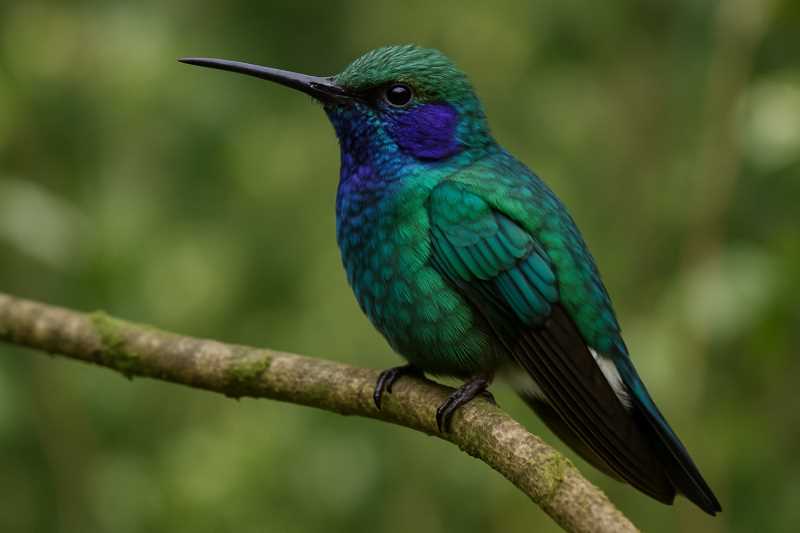
The White-vented Violetear is approximately 12–15 centimetres long. Adults have predominantly green plumage, with a violet-blue patch around the ear coverts and sides of the head. The under-tail coverts are white, forming the most obvious feature behind the bird’s common name. The tail is green with a bluish sheen and a darker band towards the tips.
The bill is relatively long and slightly curved. The upper mandible may have a finely serrated edge, reflected in the scientific name serrirostris. Males are generally more vividly coloured, while females are paler and greyer overall, with less intense violet on the head. Juveniles are duller than adults and may show less clearly defined facial markings.
Range and Habitat
The species occurs in Brazil, Bolivia, Paraguay and northern Argentina. In Brazil, its distribution extends across much of the central, eastern and southern parts of the country. In Argentina, it is recorded mainly in the north-west, including the provinces of Jujuy, Salta, Tucumán and Catamarca.
White-vented Violetears favour open and semi-open environments, including cerrado, savanna, grassland, shrubby areas, forest edges, clearings, parks and gardens. They may occur from near sea level to approximately 3,600 metres, although they are most often encountered at moderate elevations. In some regions, birds move locally between higher and lower elevations in response to seasonal conditions and flowering resources. The species is not considered a long-distance migrant.
Where to See This Species
Parque Nacional de Brasília, Federal District, Brazil
The White-vented Violetear is included in the official bird guide for Parque Nacional de Brasília. The park’s cerrado, open woodland, forest edges and flowering vegetation provide suitable habitat, and the species may be sought along accessible trails and around open areas during periods of activity. The park is open to visitors, subject to current access conditions and visitor regulations.
Nearby accommodation: Brasília is the practical base, with hotels, guest houses, serviced apartments and other accommodation in the city.
Parque Nacional Baritú, Salta, Argentina
The species is documented in Argentina’s protected-area biodiversity records, including Parque Nacional Baritú. The park protects extensive Yungas mountain forest and associated open habitats in a remote part of Salta. Birdwatchers should expect challenging conditions and should arrange access with local guides, particularly during the drier season when roads and trails are generally more manageable.
Nearby accommodation: Los Toldos is the main gateway settlement and offers small cabin complexes, family-run accommodation and basic camping options. Accommodation and supplies should be arranged before entering the park.
Behaviour and Diet
White-vented Violetears are active hummingbirds that commonly forage alone. They are strongly territorial around favoured flowers and may chase other hummingbirds, nectar-feeding birds and even insects from productive feeding areas. A bird often returns to an exposed perch between feeding visits.
The diet consists mainly of nectar from a wide variety of native and cultivated flowers, trees and shrubs. Small insects and other arthropods are also taken, either in short aerial sallies or from vegetation. These animal foods are particularly important when birds are feeding nestlings.
The species produces sharp, sometimes harsh calls and may repeat a simple phrase for extended periods from a regular perch. Breeding information is less complete than for some better-studied hummingbirds, but the female builds the small cup-shaped nest, incubates the eggs and raises the young without assistance from the male. A clutch normally contains two white eggs, and published field accounts report an incubation period of approximately 15–16 days.
Identification Tips
- Look for a green hummingbird with conspicuous violet-blue ear coverts and white under-tail coverts.
- The white vent is most easily seen when the bird turns, fans its tail or pauses on a perch.
- The tail usually shows a green to bluish sheen with a darker subterminal area.
- Listen for repeated, sharp calls from an exposed perch, especially near a defended flower patch.
- In open Brazilian habitats, compare it with other green hummingbirds by checking for the combination of violet ear coverts, white undertail coverts and the relatively robust violetear shape.
Conservation Status
The White-vented Violetear is currently assessed as Least Concern. Its broad distribution and occurrence in a range of modified habitats, including parks and gardens, reduce its immediate global conservation risk. Nevertheless, local populations may be affected by the clearing of native vegetation, agricultural expansion, urban development, pesticide use and changes in flowering patterns caused by climate change.
Protecting cerrado, savanna, forest-edge and montane habitats, maintaining native flowering plants and limiting unnecessary pesticide use can support the species. More information is needed about population trends and seasonal movements in several parts of its range.
Frequently Asked Questions
Where does the White-vented Violetear live?
It occurs in Brazil, Bolivia, Paraguay and northern Argentina, mainly in open and semi-open habitats such as cerrado, savanna, scrubland, grassland and forest edges.
How can the White-vented Violetear be identified?
Key features are its green plumage, violet-blue ear coverts, white undertail coverts and bluish-green tail. Its territorial behaviour and repeated calls from an exposed perch are also useful clues.
What does the White-vented Violetear eat?
It feeds mainly on nectar from flowering plants and supplements this diet with small insects and other arthropods.
Is the White-vented Violetear migratory?
It is generally sedentary or only locally mobile. Some populations may move between elevations or nearby habitats as conditions and food availability change.
Where can I see a White-vented Violetear?
Documented public wildlife-viewing locations include Parque Nacional de Brasília in Brazil and Parque Nacional Baritú in Argentina. It may also occur in suitable parks, gardens and protected areas elsewhere within its range.
Is the White-vented Violetear endangered?
No. It is currently assessed as Least Concern, although habitat loss, pesticide use and broader environmental change can create local pressures.
References
- BirdLife International
- IOC World Bird List
- Instituto Chico Mendes de Conservação da Biodiversidade, ICMBio
Related posts