Introduction
The Tundra Swan (Cygnus columbianus) is a large migratory waterbird of the Arctic and sub-Arctic. It breeds mainly in Alaska and northern Canada before travelling to temperate wetlands, lakes, estuaries and coastal waters in North America. The species includes the North American Whistling Swan and the Eurasian Bewick’s Swan, which are generally treated as subspecies of Cygnus columbianus by major taxonomic authorities.
Physical Description
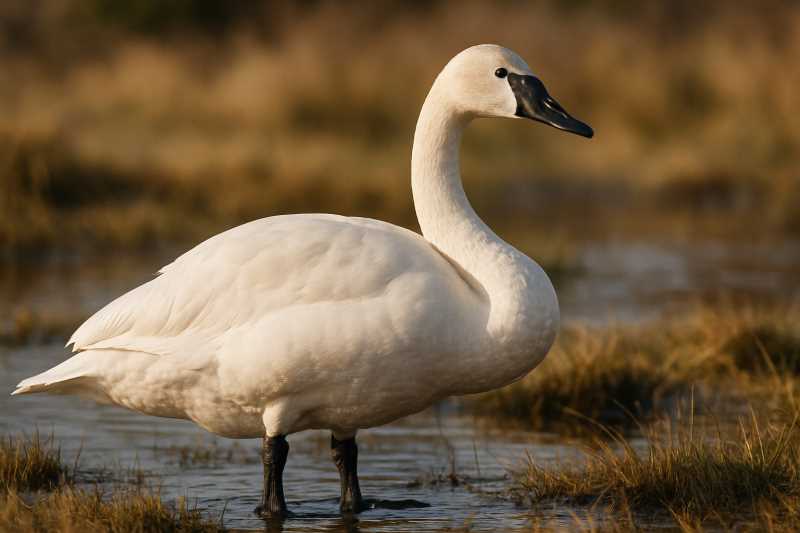
The Tundra Swan is a very large, long-necked swan with entirely white adult plumage, black legs and feet, and a mostly black bill. A small yellow patch at the base of the bill, in front of the eye, is often present in the North American form, although its size varies and it may be absent. Adults measure approximately 120–147 cm in length, weigh about 3.8–10.5 kg, and have a wingspan of around 168 cm. Males are generally slightly larger and heavier than females, but the sexes are otherwise alike in appearance.
Juveniles are greyish or dusky white, particularly on the head, neck and wings. Young birds have a paler, often pinkish bill with black areas and gradually acquire the clean white plumage of adults as they mature.
The species is also known as the Whistling Swan in North America. Its name refers partly to the whistle-like sound produced by air passing through its wings in flight, as well as to its vocal calls. Adults produce a variety of smooth, high-pitched bugling and contact calls.
Range and Habitat
Tundra Swans breed across Arctic and sub-Arctic regions of Alaska and northern Canada. They typically nest beside lakes, ponds, river deltas and wet meadows, especially where extensive wetlands and long shorelines provide aquatic vegetation. Some breeding sites occur inland and below the treeline.
The species is a long-distance migrant. The eastern North American population moves south-east through the interior of Canada and the United States to winter mainly around the Great Lakes, Chesapeake Bay and Atlantic coastal wetlands, including areas from Delaware to North Carolina. The western population winters along the Pacific coast from British Columbia and Vancouver Island to California, as well as at suitable inland lakes and wetlands.
During migration and winter, Tundra Swans use estuaries, bays, rivers, lakes, ponds and flooded wetlands. They may also leave the water to feed in agricultural fields containing waste grain or growing winter crops. In Eurasia, the subspecies Cygnus columbianus bewickii, known as Bewick’s Swan, breeds in the Russian Arctic and migrates to parts of western Europe and eastern Asia.
Behaviour and Diet
Tundra Swans are highly social outside the breeding season and commonly travel, feed and roost in large family groups or flocks. They usually fly with the neck fully extended and the legs trailing behind. Their wingbeats can produce an audible whistling sound, while flock members use calls to maintain contact during flight and at roosts.
Pairs establish and defend breeding territories during the Arctic summer. They generally form long-term pair bonds and may remain together throughout the year. Both adults help build a substantial mound of grasses, sedges, mosses, lichens and other tundra vegetation, often close to open water. The female usually lays three to five eggs, which are incubated for approximately 31–32 days. The cygnets hatch with their eyes open, are able to walk soon after hatching, and are cared for by both parents. They are capable of flight at about 65 days of age.
The diet is primarily plant-based. Tundra Swans eat the roots, tubers, stems and leaves of aquatic plants, including sedges and pondweeds, as well as grasses and other wet-meadow vegetation. They feed by dipping or submerging the head and neck, and may tip forward in the water like a dabbling duck. On migration and in winter, they may consume waste grain and growing crops such as wheat, rye and barley. In some coastal areas, particularly Chesapeake Bay, they use their bills and feet to obtain clams and other mollusks from soft sediments. Small arthropods and other invertebrates are eaten occasionally.
Identification Tips
Look for the following combination of features:
- Very large, all-white waterbird with a long neck and heavy body.
- Black legs and feet.
- Mostly black bill, often with a small yellow patch at the base in front of the eye.
- Straight neck when swimming and fully extended neck when flying.
- Large, vocal flocks during migration and winter.
- Greyish head, neck or wings on immature birds.
The Tundra Swan is smaller than the Trumpeter Swan, although size can be difficult to judge in the field. The yellow mark at the base of the bill strongly favours Tundra Swan, but it is variable and should not be treated as an essential feature. Tundra Swans usually have a more rounded head and a gently dished bill profile, whereas Trumpeter Swans tend to show a longer, more uniformly black bill and a straighter head-and-bill profile.
Snow Geese are considerably smaller and show black wingtips in flight. Mute Swans have an orange-and-black bill, a prominent black knob at the bill base, and a more curved neck posture. The Eurasian Bewick’s Swan generally has a larger yellow area on the bill than the North American Whistling Swan.
Conservation Status
The Tundra Swan is classified as Least Concern on the IUCN Red List. In North America, the species is monitored as eastern and western populations, and the U.S. Fish and Wildlife Service reports that continental population sizes exceed 200,000 and have generally increased since the early 1980s. A single global population trend should be treated cautiously because monitoring methods and taxonomic treatment vary across the species’ range.
Important threats include the loss and degradation of wetlands at breeding sites, migration stopovers and wintering areas. Arctic industrial development, including oil and gas activity, can disturb breeding habitat. Lead poisoning from spent ammunition, fishing tackle and contaminated sediments is also a recognised risk, particularly where swans feed in shallow wetlands or sediment-rich coastal habitats. Disease, collisions, disturbance and regulated hunting may affect local populations.
Conservation measures include protecting Arctic wetlands and coastal wintering sites, maintaining migratory stopover habitat, monitoring population numbers, managing hunting through permits and population thresholds, and reducing exposure to lead in important feeding areas.
Frequently Asked Questions
Where does the Tundra Swan breed?
Tundra Swans breed mainly on Arctic and sub-Arctic wetlands in Alaska and northern Canada. They nest beside lakes, ponds, river deltas and wet meadows, usually close to open water.
Where can Tundra Swans be seen in winter?
In North America, they winter around the Great Lakes, Chesapeake Bay and the Atlantic coast, as well as along the Pacific coast from British Columbia to California. Some also use inland lakes, rivers, wetlands and agricultural fields.
What does the Tundra Swan eat?
Its diet consists mainly of aquatic plants, sedges, grasses, roots, tubers, stems and leaves. During migration and winter it may feed on waste grain and winter crops, and in some coastal areas it digs for clams and other mollusks.
How can a Tundra Swan be distinguished from a Trumpeter Swan?
Tundra Swans are generally smaller and often have a yellow patch at the base of the black bill. They also tend to have a rounder head and more gently dished bill profile. The yellow patch is variable, so several features should be considered together.
Do Tundra Swans mate for life?
Tundra Swans usually form long-term pair bonds and often remain with the same mate year-round. Both adults defend the breeding territory, build the nest and care for the cygnets.
Is the Tundra Swan endangered?
No. The species is currently classified as Least Concern globally. Nevertheless, wetland loss, lead poisoning, industrial disturbance, disease and other pressures can threaten local populations and important migratory sites.
References
- BirdLife International. 2026. Tundra Swan Cygnus columbianus Species Factsheet. BirdLife DataZone. Accessed 8 September 2026. https://datazone.birdlife.org/species/factsheet/tundra-swan-cygnus-columbianus
- Cornell Lab of Ornithology. n.d. Tundra Swan Identification. All About Birds. Accessed 8 September 2026. https://www.allaboutbirds.org/guide/Tundra_Swan/id
- Cornell Lab of Ornithology. n.d. Tundra Swan Life History. All About Birds. Accessed 8 September 2026. https://www.allaboutbirds.org/guide/Tundra_Swan/lifehistory
- Cornell Lab of Ornithology. n.d. Tundra Swan Range Map. All About Birds. Accessed 8 September 2026. https://www.allaboutbirds.org/guide/Tundra_Swan/maps-range
- Gill, F., Donsker, D. and Rasmussen, P., eds. 2026. IOC World Bird List, version 15.2. International Ornithologists’ Union. Accessed 8 September 2026. https://www.worldbirdnames.org/
- U.S. Fish and Wildlife Service. n.d. Tundra Swan (Cygnus columbianus). Accessed 8 September 2026. https://www.fws.gov/species/tundra-swan-cygnus-columbianus
- Canadian Wildlife Service. 1998. Tundra Swan. Environment Canada, Canadian Wildlife Service. Government of Canada Publications. Accessed 8 September 2026. https://www.publications.gc.ca/site/eng/9.851267/publication.html
- Limpert, R. J. and Earnst, S. L. 1994. Tundra Swan (Cygnus columbianus), version 2.0. In A. Poole and F. Gill, eds., The Birds of North America. Cornell Lab of Ornithology, Ithaca, New York.
Related posts