Introduction
The Pale-browed Tinamou (Crypturellus transfasciatus) is a secretive, ground-dwelling bird of the dry forests of western Ecuador and north-western Peru. It belongs to the tinamou family, Tinamidae, within the palaeognathous birds. Although it is more often heard than seen, its pale eyebrow, barred flanks and finely patterned plumage provide useful identification features. The species was described by Philip Lutley Sclater and Osbert Salvin in 1878, not by Frank Chapman. (worldbirdnames.com)
Physical Description
The Pale-browed Tinamou is approximately 27–29 cm long. It has a compact, rounded body, short tail and strong legs adapted for walking through leaf litter and dense undergrowth.
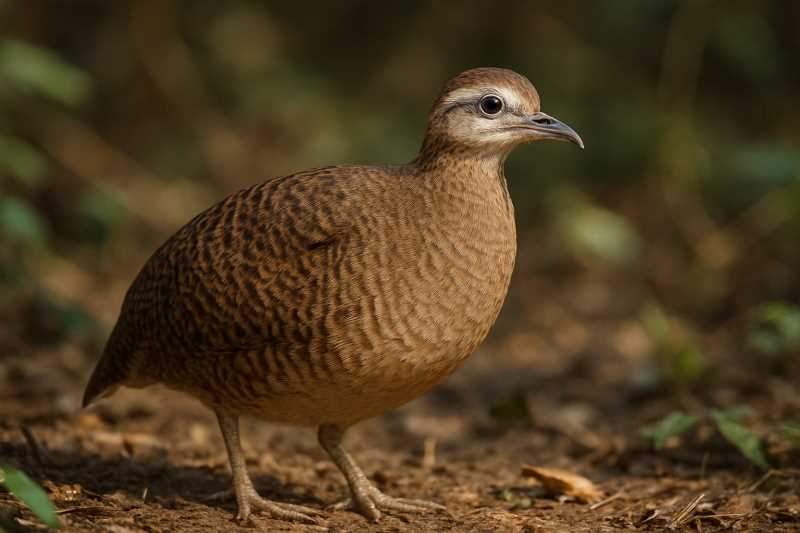
Adults have brown to greyish-brown upperparts with fine vermiculation and darker barring. The head is relatively dark, contrasting with a conspicuous whitish supercilium that broadens behind the eye. The throat is white, while the breast and belly are pale greyish, buff or ochraceous. The flanks are distinctly barred, and the legs are pinkish.
Sexes differ in plumage pattern. Adult females are generally more extensively barred, especially across the upperparts, and may show broader pale markings on the wing-coverts. Juveniles are less well documented and are likely to appear duller and less sharply marked than adults. (api.pageplace.de)
Range and Habitat
The species is restricted to the Tumbesian region of the Pacific slope. Its range extends through western Ecuador, including parts of Manabí, Guayas, El Oro and Loja, and into north-western Peru, particularly Tumbes and western Piura. It is resident rather than migratory. (datazone.birdlife.org)
The Pale-browed Tinamou is associated mainly with tropical and subtropical deciduous forest, dry woodland and locally regenerating scrub. It uses areas with dense ground cover, leaf litter and patches of relatively open vegetation for feeding. Most records are from low elevations, generally below about 800 m in the Pacific lowlands, although the species has been recorded to approximately 1,500–1,600 m in parts of Ecuador. (oiseaux.net)
The species is closely associated with the Ecuadorian dry-forest and Tumbes–Piura dry-forest regions. Its distribution is naturally limited and has been reduced and fragmented by the loss of dry forest.
Behaviour and Diet
Pale-browed Tinamous are diurnal and terrestrial. They are shy, secretive birds that usually move quietly through vegetation and rely on cryptic plumage rather than flight to avoid detection. They may occur singly, in pairs or in small groups outside the breeding period, although their social organisation is not fully documented.
The diet is omnivorous, with plant material forming an important component. Food includes fallen fruit, seeds, tender leaves, buds and roots, supplemented by insects and other small invertebrates. Feeding takes place mainly on the ground, where the bird searches through leaf litter while walking slowly with its head lowered. (en.wikipedia.org)
Its call is a soft, resonant whistle that may carry through dry forest and dense scrub. As with other tinamous, vocal communication is particularly important because individuals are difficult to see in their habitat.
Breeding information for this species is limited. Tinamous generally lay their eggs in a simple ground nest or scrape, often concealed by vegetation, and the male incubates the eggs and cares for the young. Available summaries indicate clutches of approximately four to seven eggs, but detailed information on the Pale-browed Tinamou’s breeding season and nesting success remains scarce. (oiseaux.net)
Identification Tips
Look for a medium-sized, low-slung tinamou in dry forest or scrub. The most useful field marks are:
- A prominent pale or whitish eyebrow, contrasting with the darker crown and face.
- A white throat and pale greyish to buff underparts.
- Strong blackish barring on the flanks and lower body.
- Finely patterned brown upperparts that blend with leaf litter and dry woodland.
- Pinkish legs.
- A quiet, terrestrial habit and a resonant whistle that may be heard before the bird is seen.
The combination of the bold pale eyebrow, white throat and barred flanks is more reliable than overall colour, which can vary with lighting and habitat. Care is needed when identifying the species from calls alone, because several tinamous have repeated, far-carrying whistles.
Conservation Status
The Pale-browed Tinamou is currently classified as Near Threatened on the IUCN Red List. BirdLife International identifies habitat loss and degradation as important concerns, particularly the clearing and fragmentation of dry forest, agricultural expansion, logging and livestock grazing. Hunting near settlements may also add pressure in some parts of its range. The population is considered to be declining, although a precise global population estimate should not be assumed from the available information. (datazone.birdlife.org)
Conservation depends on protecting remaining Tumbesian dry forests, maintaining habitat corridors and improving the management of protected areas and private reserves. Reducing uncontrolled grazing, preventing further forest clearance and monitoring hunting pressure are also relevant measures. Further field research is needed on population size, distribution, breeding ecology and the effects of habitat fragmentation.
Frequently Asked Questions
Where does the Pale-browed Tinamou live?
It lives in dry forest, deciduous woodland and dense scrub on the Pacific slope of western Ecuador and north-western Peru, mainly at low and middle elevations.
Is the Pale-browed Tinamou migratory?
No. It is regarded as a resident species, although individuals may make short local movements in response to rainfall, food availability or changes in habitat conditions.
What does the Pale-browed Tinamou eat?
Its diet includes fallen fruit, seeds, leaves, buds and roots, together with insects and other small invertebrates collected from the forest floor.
How can the species be identified?
The strongest identification features are the pale eyebrow, white throat, barred flanks, brown finely patterned upperparts and pinkish legs. It is often detected by its whistle before it is seen.
Does the male Pale-browed Tinamou incubate the eggs?
Yes. As in other tinamous, the male performs the main incubation duties and cares for the chicks after hatching. Species-specific breeding observations remain limited.
Why is the Pale-browed Tinamou threatened?
The main concerns are the loss and fragmentation of dry forest, agricultural expansion, logging, livestock grazing and local hunting pressure. These pressures are especially significant because the species has a restricted geographic range.
References
- BirdLife International. 2026. Pale-browed Tinamou Crypturellus transfasciatus Species Factsheet. BirdLife Data Zone. Accessed 8 September 2026. https://datazone.birdlife.org/species/factsheet/pale-browed-tinamou-crypturellus-transfasciatus
- Gill, F., Donsker, D. and Rasmussen, P. (eds). 2026. IOC World Bird List, version 15.2. International Ornithologists’ Union. Accessed 8 September 2026. https://www.worldbirdnames.org/
- Hilty, S. L., del Hoyo, J., Brown, W. L., Christie, D. A., Sargatal, J. and de Juana, E. (eds). 2019. Birds of Northern South America: An Identification Guide, Volume 1: Species Accounts. Lynx Edicions.
- Remsen, J. V. Jr. et al. n.d. South American Classification Committee: A Classification of the Bird Species of South America. American Ornithological Society. Accessed 8 September 2026. https://www.museum.lsu.edu/~Remsen/SACCBaseline.htm
- Sclater, P. L. and Salvin, O. 1878. On the birds collected by the late Mr. Osbert Salvin in the province of Chiriqui, and on other new or little-known species. Proceedings of the Zoological Society of London, 1878, part 1, p. 141, plate 13. Biodiversity Heritage Library. https://www.biodiversitylibrary.org/item/90438
- Servicio Nacional de Áreas Naturales Protegidas por el Estado. 2023. Birdwatching Guide for Protected Natural Areas. Government of Peru. https://birdwatching.peru.travel/Imagenes/archivos/5/birdwatching-guide-for-protected-areas.pdf
- Tobias, J. A. et al. 2022. AVONET: morphological, ecological and geographical data for all birds. Ecology Letters, 25(3), 581–597. https://doi.org/10.1111/ele.13898
Related posts