Introduction
The Fork-tailed Woodnymph (Thalurania furcata) is a small South American hummingbird recognised for the male’s iridescent green, violet and blue plumage and deeply forked tail. It occurs mainly in humid forest, forest edges, secondary growth and other wooded habitats across much of tropical and subtropical South America.
Physical Description
The Fork-tailed Woodnymph is a small hummingbird measuring about 9.5 cm in length. It shows marked sexual dimorphism.
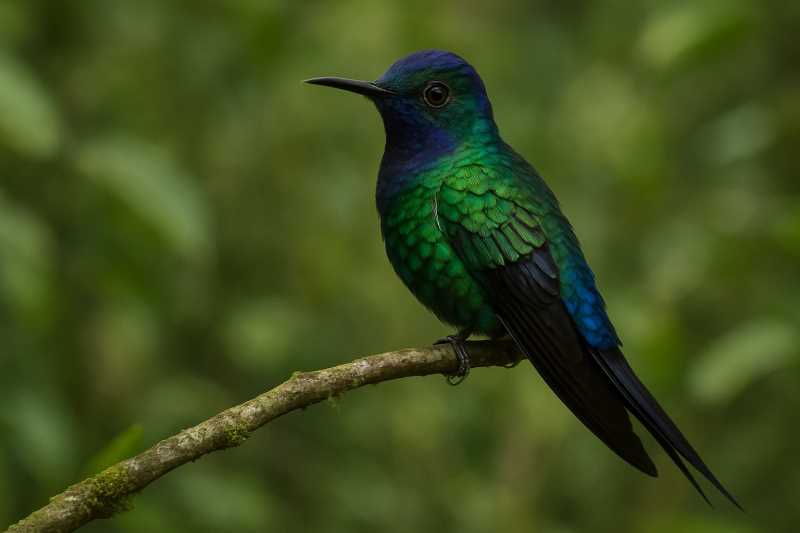
Adult males have an iridescent green head, throat and upper breast, with violet to blue coloration on the lower breast and belly. The back is green, while the wings and deeply forked tail are dark and often appear bluish or blue-black depending on the light. White undertail coverts may be visible when the bird is perched or manoeuvring.
Females are duller and more cryptically coloured. They are green above and pale grey below, with a green-and-blue forked tail and pale or greyish tail tips. Immature birds resemble females until adult male plumage develops.
Range and Habitat
The Fork-tailed Woodnymph is distributed across a broad area of South America east of the Andes. Its range includes parts of Colombia, Venezuela, the Guianas, Brazil, Bolivia, Peru, Ecuador, Paraguay and northern Argentina, with regional variation among recognised subspecies.
It is associated mainly with humid lowland and foothill forests, gallery forest, forest margins, treefall gaps, secondary woodland and gardens with suitable flowering plants. It may also occur in disturbed habitats where sufficient vegetation and nectar resources remain. The species is generally regarded as resident rather than migratory, although local movements may occur in response to food availability.
Where to See This Species
Parque Nacional de Sete Cidades, Piauí, Brazil
The official bird guide for Parque Nacional de Sete Cidades documents the Fork-tailed Woodnymph in humid forest habitats, including gallery forest and sheltered ravines. These habitats provide flowering plants and shaded cover suitable for a forest-edge hummingbird. The species may be easier to locate during periods of flowering and in the cooler parts of the day.
Nearby accommodation: Piracuruca is the practical gateway town, with hotels, guest houses and other basic accommodation suitable for park visits.
Parque Nacional de Brasília, Federal District, Brazil
The Fork-tailed Woodnymph is included in the official bird guide for Parque Nacional de Brasília. Look in wooded areas, especially gallery forest and other sites with dense vegetation and flowering plants. Identification should be made carefully because the park also supports similar green-and-violet hummingbirds.
Nearby accommodation: Brasília is the nearest major accommodation centre, offering hotels, guest houses and self-catering options.
Behaviour and Diet
Fork-tailed Woodnymphs are active, agile hummingbirds that usually forage alone. They move rapidly between flowers, hovering briefly while feeding and often perching in nearby vegetation between feeding bouts.
Nectar forms the main part of the diet and is taken from a variety of flowering plants. Small insects and spiders are also eaten, providing protein and other nutrients. Males may defend productive flowers or feeding areas from other hummingbirds, using rapid chases and aerial displays to deter intruders.
The species is not known for long-distance migration. Local movements may occur when flowering conditions change or when birds move between forest, edge and garden habitats.
Identification Tips
- Look for a small, fast-moving hummingbird with a clearly forked tail.
- Adult males show a bright green head and upper breast, with violet or blue lower underparts that can look almost black in poor light.
- Females are green above and grey below, with a paler, less vividly coloured appearance.
- The slightly down-curved bill, deeply forked tail and preference for wooded habitats are useful supporting features.
- Watch forest edges, gallery forest, clearings, gardens and flowering shrubs rather than only the deep forest interior.
- The Crowned Woodnymph and other Thalurania hummingbirds can be similar, so location, the precise pattern of the male’s green and violet plumage, and the appearance of the female should all be considered.
Conservation Status
The Fork-tailed Woodnymph is currently assessed as Least Concern by the IUCN Red List and BirdLife International. Its broad distribution and use of some secondary and disturbed habitats reduce its immediate global risk.
Deforestation, forest fragmentation and the loss of flowering vegetation remain potential local threats, particularly where humid forest is cleared or isolated. Maintaining forest reserves, gallery vegetation, secondary woodland and native flowering plants can help conserve habitat for this and other hummingbirds. A reliable global population estimate is not stated here because a precise figure has not been verified for this article.
Frequently Asked Questions
Where does the Fork-tailed Woodnymph live?
It lives mainly in humid forests, gallery forests, forest edges, secondary woodland and gardens across much of tropical and subtropical South America.
What does the Fork-tailed Woodnymph eat?
It feeds primarily on nectar from flowering plants and supplements this diet with small insects and spiders.
How can I identify a male Fork-tailed Woodnymph?
The male has an iridescent green head and upper breast, violet or blue lower underparts and a deeply forked, dark tail.
How can I identify a female Fork-tailed Woodnymph?
The female is green above and pale grey below. Her tail is forked but less striking than the male’s, with green and bluish tones and paler tips.
Is the Fork-tailed Woodnymph migratory?
It is generally considered resident across its range, although individuals may move locally when flowering conditions and food availability change.
Is the Fork-tailed Woodnymph endangered?
No. It is currently classified as Least Concern, although habitat loss and fragmentation can affect local populations.
References
- BirdLife International
- IOC World Bird List
- Instituto Chico Mendes de Conservação da Biodiversidade
Related posts