Introduction
The Rufous Potoo (Phyllaemulor bracteatus) is a small, nocturnal bird of the Neotropical region and the only species in the genus Phyllaemulor. It belongs to the potoo family, Nyctibiidae, and occurs mainly in lowland Amazonian forests. Formerly placed in the genus Nyctibius, it was moved to Phyllaemulor because of its distinctive morphology, behaviour, osteology and deep genetic divergence from other potoos.
Physical Description
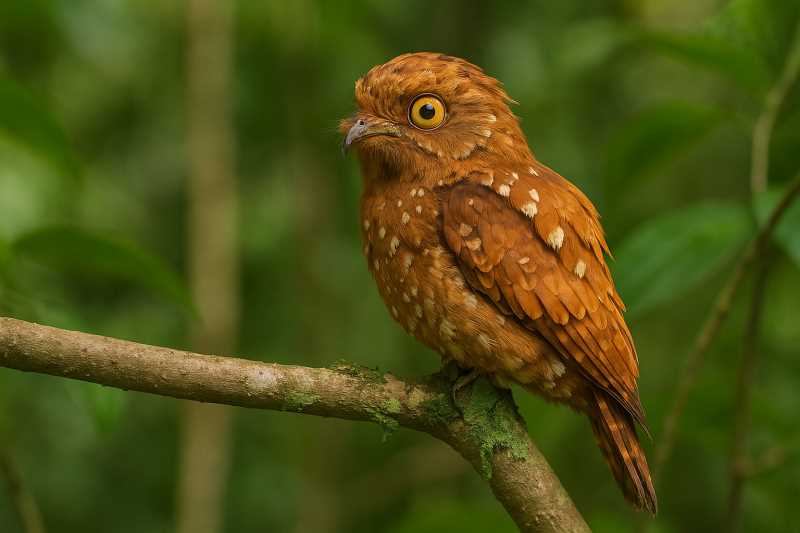
At approximately 26 cm in length, the Rufous Potoo is the smallest potoo. It has predominantly rich rufous plumage, lightly vermiculated with darker markings and conspicuous white spots on the wing coverts, breast, belly, flanks and undertail coverts. Its broad head, very large eyes and wide, flattened bill are typical of potoos.
The species’ plumage closely resembles bark, dead twigs and mottled vegetation. When perched upright against a broken branch or stump, its outline and colour can be extremely difficult to detect. A distinctive marking in the iris is also reported in the species. Reliable information on sexual dimorphism, juvenile plumage and age-related variation remains limited, although chicks have been documented.
Range and Habitat
The Rufous Potoo is distributed across parts of the Amazon Basin and the Guiana Shield. Its recorded range includes Brazil, Colombia, Ecuador, French Guiana, Guyana, Peru and Venezuela. It is resident rather than migratory, although its apparent scarcity and highly secretive behaviour mean that its distribution is probably incompletely documented.
It is associated mainly with lowland humid forest, especially mature terra firme forest and well-developed secondary forest. Records also come from white-sand forest, nutrient-poor soils, blackwater regions and swampy palm-dominated campinarana. The species usually occupies the understorey and middle levels of the forest, and has been recorded to about 550 m above sea level.
Behaviour and Diet
The Rufous Potoo is nocturnal and spends daylight hours perched motionless, often adopting a vertical posture on a broken branch or trunk. Its cryptic plumage provides protection while it rests and may also reduce the chance of detection by predators.
At dusk and during the night, it hunts from a perch. It sallies out to capture flying insects and commonly returns to the same or a nearby perch after each sortie. Its diet consists mainly of insects, with prey recorded from several insect orders.
The species has a limited but distinctive vocal repertoire. Its song has been described as a soft, rapidly descending series of roughly 10 to 15 notes, with additional short calls used in other situations. Singing may be concentrated around a few nights near the full moon, although the available observations are limited.
Very little is known about reproduction. The Rufous Potoo lays a single egg directly on the top of a broken branch or tree stump rather than constructing a conventional nest. Nesting records suggest that breeding may occur from about September to February, but the timing and duration of the breeding season require further study. Incubation, chick development and parental care are also poorly documented.
Identification Tips
Look for the following combination of features:
- Small size compared with other potoos, at about 26 cm long.
- Rich, almost entirely rufous plumage.
- Strong white spotting on the wing coverts and underparts.
- Fine vermiculated markings that resemble bark texture.
- A compact appearance and relatively short tail compared with larger potoos.
- A preference for forest interior, especially mature terra firme and white-sand habitats.
- A habit of sitting upright and motionless on a broken branch or stump.
The rich rufous colour and prominent white spots are particularly useful for separating it from other potoos. Identification is more difficult in poor light, when the bird’s camouflage can make it appear to be part of the perch. The species is also easily overlooked because it is most active at night and may remain silent for long periods.
Conservation Status
The Rufous Potoo is currently assessed as Least Concern. Its global population has not been quantified, and its secretive habits make abundance and population trends difficult to assess.
The principal conservation concern is the loss and fragmentation of lowland Amazonian forest through logging, agricultural expansion, mining, roads and other land-use changes. Protection of large, connected areas of mature forest, including white-sand and other specialised forest types, is important. Further surveys are needed to clarify its distribution, habitat requirements, population trend and tolerance of disturbed habitats.
Frequently Asked Questions
Where does the Rufous Potoo live?
It occurs in lowland Amazonian and Guiana Shield forests in Brazil, Colombia, Ecuador, French Guiana, Guyana, Peru and Venezuela.
What does the Rufous Potoo look like?
It is a small potoo with rich rufous plumage, fine darker vermiculation and conspicuous white spots on the wings and underparts. Its camouflage makes it resemble a mottled branch or tree stump.
Is the Rufous Potoo nocturnal?
Yes. It rests during the day and becomes active at dusk and during the night, when it hunts flying insects from a perch.
What does the Rufous Potoo eat?
Its diet consists mainly of flying insects captured during short sallies from a perch. The bird generally returns to its perch after making a feeding flight.
Does the Rufous Potoo build a nest?
No conventional nest is constructed. The female lays a single egg directly on the top of a broken branch or tree stump.
Why is the Rufous Potoo difficult to find?
It is nocturnal, occurs in dense forest and spends the day sitting motionless in a highly cryptic posture. Its rufous, spotted plumage closely matches bark and dead vegetation.
References
- Barreiros, M. H. M., Tolentino, M. and Leite, G. A. 2022. Breeding ecology of Rufous Potoo Nyctibius bracteatus in central Amazonian Brazil. Bulletin of the British Ornithologists’ Club 142(1): 145–152. https://doi.org/10.25226/bboc.v142i1.2022.a9
- Costa, T. V. V., Whitney, B. M., Braun, M. J., White, N. D., Silveira, L. F. and Cleere, N. 2018. A systematic reappraisal of the Rufous Potoo Nyctibius bracteatus (Nyctibiidae) and description of a new genus. Journal of Ornithology 159(2): 367–377. https://doi.org/10.1007/s10336-017-1511-2
- Cohn-Haft, M. and Kirwan, G. M. 2022. Rufous Potoo (Phyllaemulor bracteatus), version 1.1. In: Sly, N. D. (ed.), Birds of the World. Cornell Lab of Ornithology, Ithaca, New York. https://doi.org/10.2173/bow.rufpot1.01.1
- Gill, F., Donsker, D. and Rasmussen, P. (eds). 2026. IOC World Bird List, version 15.2. International Ornithologists’ Union. Accessed 8 September 2026. https://www.worldbirdnames.org/
- BirdLife International and Handbook of the Birds of the World. 2025. HBW and BirdLife International Digital Checklist of the Birds of the World, version 10. BirdLife International and Lynx Edicions.
- Remsen, J. V. Jr., Areta, J. I., Bonaccorso, E., Claramunt, S., Jaramillo, A., Lane, D. F., Pacheco, J. F., Robbins, M. B., Stiles, F. G. and Zimmer, K. J. 2024. A Classification of the Bird Species of South America. South American Classification Committee, American Ornithological Society. Accessed 8 September 2026. https://www.museum.lsu.edu/~Remsen/SACCCountryLists.htm
Related posts