Introduction
The Maccoa Duck (Oxyura maccoa) is a compact African stiff-tailed diving duck in the family Anatidae. It is found in disjunct populations in eastern and southern Africa, where it uses freshwater and, occasionally, saline or alkaline wetlands. The species is notable for the striking breeding plumage of the male, its bright blue bill, and its habit of diving for food.
Physical Description
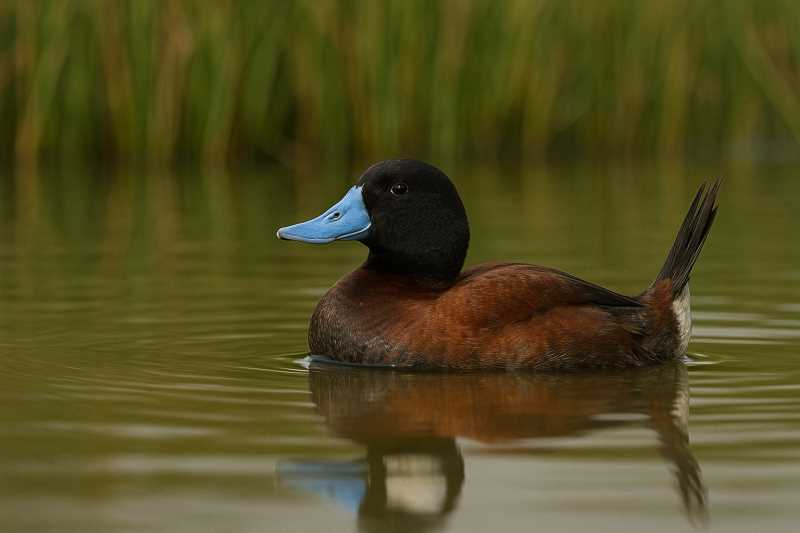
The Maccoa Duck measures approximately 48–51 cm in length. It is a squat, heavy-bodied duck that sits low in the water, often with its stiff tail raised or angled upwards. The wings are relatively small, reflecting its adaptation to diving rather than sustained long-distance flight.
Breeding males have a dull black head, neck and throat, rich chestnut plumage across much of the body, and a bright blue bill. The eyes are dark brown, while the legs and feet are grey. Outside the breeding season, males become duller and may resemble females, although the darker head and breast can remain apparent.
Females are predominantly dark brown and grey-brown, with a distinctive pale stripe running below the eye from the lores towards the nape. The chin and throat are whitish, and the bill is dark brown. Juveniles are generally more uniform and less distinctly marked than adults, but otherwise resemble females.
Range and Habitat
The Maccoa Duck is confined to Africa. Its range is divided into disjunct populations in the Ethiopian Highlands, eastern Africa and southern Africa. It has been recorded in Eritrea, Ethiopia, Kenya and Tanzania, as well as Angola, Botswana, Lesotho, Namibia, South Africa and Zimbabwe.
It occupies inland wetlands including lakes, ponds, marshes, farm dams and sewage ponds. Breeding birds generally favour shallow, nutrient-rich freshwater wetlands with emergent vegetation such as reeds, sedges and bulrushes. Outside the breeding season, birds may gather on larger open waters where emergent vegetation is sparse or absent. The species can also occur on temporary wetlands and on saline or alkaline waters.
The Maccoa Duck is not regarded as a long-distance migrant, although local and seasonal movements occur in response to changing water conditions, food availability and breeding requirements. Its distribution is naturally localised because suitable wetlands are scattered across the continent.
Behaviour and Diet
Maccoa Ducks are strong divers and usually forage underwater. They take aquatic invertebrates from bottom sediments, including insect larvae, worms, molluscs and small crustaceans. Plant material also forms an important part of the diet and may include algae, seeds, roots and other parts of aquatic vegetation. The species therefore should not be described as exclusively insectivorous.
Foraging birds commonly dive and use the bill to sift through submerged sediment and plant debris. They are often quiet and unobtrusive when not breeding, and may escape danger by diving rather than flying. Groups can form on suitable wetlands, particularly outside the breeding season.
Breeding behaviour varies geographically and is broadly associated with rainfall and local water conditions. The species is polygynous, and males defend territories during the breeding period. The female builds the nest among reeds, sedges or other dense vegetation, although nests of coots and grebes may sometimes be used. Clutches usually contain five or six eggs, but larger clutches can result when eggs are laid by more than one female. Incubation lasts about 25–27 days and is carried out by the female, which also cares for the ducklings after hatching.
Identification Tips
- Look for a compact, low-sitting diving duck with a stiff tail that may be held upright.
- A breeding male is distinctive, with a blackish head and throat, rich chestnut body and bright blue bill.
- The female is darker and duller, but the pale horizontal stripe below the eye is a useful field mark.
- The species often dives when disturbed and may be difficult to observe at close range.
- Female Maccoa Ducks can be confused with female Southern Pochards (Netta erythrophthalma). The Maccoa Duck has a pale stripe running below the eye, whereas the Southern Pochard has a more vertical pale crescent behind the eye. The Maccoa Duck also has a stiffer, more conspicuously pointed tail and a more compact stiff-tailed-duck profile.
Conservation Status
The Maccoa Duck is listed as Endangered on the global IUCN Red List assessment cited by BirdLife International. Earlier assessments listed the species as Near Threatened or Vulnerable, so older references may show a different category.
The global population is considered to be declining. Important threats include the drainage and degradation of wetlands for agriculture and urban development, pollution, altered water regimes, disturbance at breeding sites and entanglement in fishing nets. Invasive vegetation and introduced fish may also alter wetland structure or reduce food availability. Because the species feeds in bottom sediments, pollutants can accumulate through the food chain and present an additional risk.
Conservation priorities include protecting important wetlands, maintaining suitable water levels, reducing pollution, managing invasive species, limiting disturbance during breeding, monitoring populations and improving knowledge of movements between wetland sites. The species is included under the Convention on Migratory Species and the African-Eurasian Migratory Waterbird Agreement, which support international cooperation despite its mainly local movements.
Frequently Asked Questions
Where does the Maccoa Duck live?
The Maccoa Duck lives in disjunct populations in eastern and southern Africa. Its range includes countries such as Ethiopia, Kenya, Tanzania, Angola, Botswana, Namibia, South Africa and Zimbabwe.
What does the Maccoa Duck eat?
It feeds underwater on aquatic invertebrates, including insect larvae, worms, molluscs and small crustaceans. It also eats algae, seeds, roots and other aquatic plant material.
How can a male Maccoa Duck be identified?
A breeding male has a dull black head and throat, a rich chestnut body and a bright blue bill. Its stiff tail is often held upwards, and it sits low in the water.
Are Maccoa Ducks migratory?
They are not considered long-distance migrants, but they make local and seasonal movements between wetlands as water levels, food supplies and breeding conditions change.
Where do Maccoa Ducks breed?
They breed in freshwater wetlands with emergent vegetation, including reeds, sedges and bulrushes. Females may also use old nests built by coots or grebes.
Why is the Maccoa Duck threatened?
The main threats are wetland loss and degradation, pollution, altered water regimes, disturbance, fishing-net entanglement and the effects of invasive species. These pressures are particularly serious because the species depends on scattered wetland habitats.
References
- BirdLife International. 2021. Oxyura maccoa. The IUCN Red List of Threatened Species 2021: e.T22679820A181759055. https://doi.org/10.2305/IUCN.UK.2021-3.RLTS.T22679820A181759055.en. Accessed 8 September 2026.
- BirdLife South Africa. 2025. “Maccoa Duck (Oxyura maccoa).” Red Data Book of Birds of South Africa, Lesotho and Eswatini. https://www.birdlife.org.za/red-data-book/red-list/maccoa-duck/. Accessed 8 September 2026.
- Carboneras, C., G. M. Kirwan and C. J. Sharpe. 2020. “Maccoa Duck (Oxyura maccoa).” In Birds of the World, version 1.0, edited by J. del Hoyo, A. Elliott, J. Sargatal, D. A. Christie and E. de Juana. Cornell Lab of Ornithology, Ithaca, New York. https://doi.org/10.2173/bow.macduc1.01.
- Clark, A. 1964. “The Maccoa Duck (Oxyura maccoa (Eyton)).” Ostrich 35: 264–276.
- Convention on Migratory Species. 2024. “Maccoa Duck (Oxyura maccoa).” CMS Species. https://www.cms.int/sites/default/files/publication/Species.pdf. Accessed 8 September 2026.
- International Union for Conservation of Nature. 2024. The IUCN Red List of Threatened Species, Version 2024-2. IUCN, Gland, Switzerland. https://www.iucnredlist.org/. Accessed 8 September 2026.
- Siegfried, W. R. 1976. “Social Organization in Ruddy and Maccoa Ducks.” The Auk 93: 560–568.
- South African National Biodiversity Institute. 2015. “Maccoa Duck (Oxyura maccoa).” Red List of South African Species. https://speciesstatus.sanbi.org/assessment/last-assessment/3110/. Accessed 8 September 2026.
- Wetlands International and African-Eurasian Migratory Waterbird Agreement. 2009. International Single Species Action Plan for the Conservation of the Maccoa Duck (Oxyura maccoa). AEWA Technical Series No. 14. https://www.unep-aewa.org/sites/default/files/publication/ts_14_maccoa_duck_final_0.pdf. Accessed 8 September 2026.
- Gill, F., D. Donsker and P. Rasmussen, eds. 2026. IOC World Bird List, version 15.2. International Ornithologists’ Union. https://www.worldbirdnames.org/. Accessed 8 September 2026.
Related posts