Introduction
The Roraiman Nightjar is a scarce, poorly known nightjar of the Pantepui, or Guiana Highlands, in northern South America. Its current scientific name is Tepuiornis whitelyi (Salvin, 1885), although it has traditionally been treated as Setopagis whitelyi. The species is endemic to the tepui region, where it occurs in Venezuela, western Guyana and adjacent northern Brazil.
Physical Description
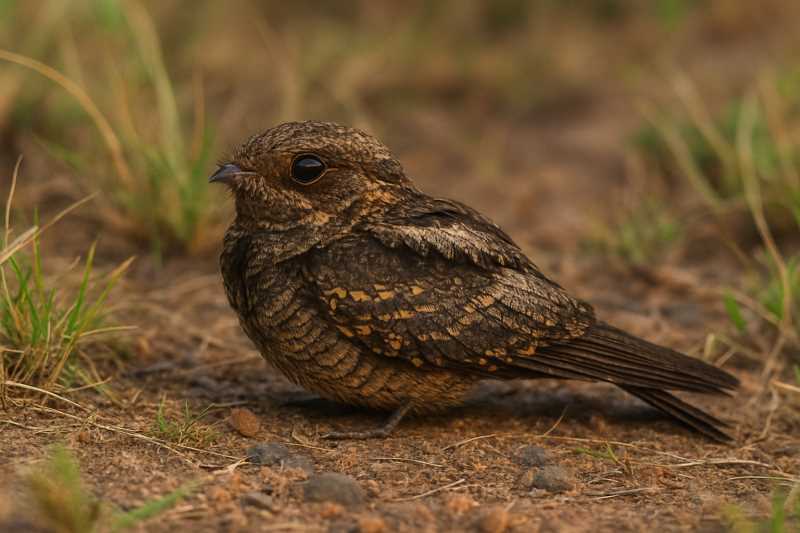
The Roraiman Nightjar is a medium-sized nightjar, measuring approximately 21–22 cm in length. It is predominantly dark or blackish, with cryptic mottling that helps it blend into rocky ground, leaf litter, scrub and sparsely vegetated tepui habitats.
Distinctive features include white patches on the throat that extend laterally onto the sides of the neck, together with white bands and spots on the wings and tail. Males have conspicuous white tips on some wing coverts and generally more prominent white markings than females. Unlike several related nightjars, males do not have greatly elongated outer tail feathers.
The species has large eyes and a broad, deeply cleft bill typical of nightjars. Reliable measurements of wingspan, body mass and age-related plumage variation are limited, and the sexes can be difficult to distinguish in the field except when the male’s white wing markings are visible.
Range and Habitat
The Roraiman Nightjar is restricted to the Pantepui mountain region at the meeting point of south-eastern Venezuela, western Guyana and northern Brazil. Documented localities include Mount Roraima, Ptari-tepui, Jaua, Urutaní and Cerro Duida in Venezuela, as well as sites in the Pacaraima Mountains of Guyana and adjacent Brazil.
It has been recorded from approximately 850 to 1,800 metres above sea level, although the available records are scattered and the full range may not be known. The species is associated with open or semi-open tepui environments, including summit and slope savannas, shrubland, bush islands, clearings, forest edges and areas with scattered stunted trees.
The Roraiman Nightjar is considered resident rather than migratory. Its distribution is naturally fragmented because suitable habitat occurs as isolated patches on and around the region’s table-top mountains.
Behaviour and Diet
The Roraiman Nightjar is nocturnal and is likely to be most active after dusk and before dawn. It is often detected by its distinctive vocalisation rather than seen. The recorded song has been described as a short, rough or burry note that rises and falls in pitch and is repeated at intervals of roughly one to two seconds.
Its diet is expected to consist mainly of flying insects, as in other nightjars, but detailed information about the species’ prey and foraging technique is lacking. It may forage from the ground or a low perch, or capture insects during continuous flight, but these possibilities have not been adequately studied.
The breeding biology of the Roraiman Nightjar remains poorly documented. No detailed account of its nest, eggs, incubation or parental care is currently available. Like other nightjars, it is expected to lay its eggs directly on the ground or among sparse vegetation rather than construct a conventional nest, but this should be regarded as an informed comparison rather than a confirmed observation for this species.
Identification Tips
- Look for a medium-sized, dark nightjar in open tepui scrub, savanna, rocky clearings or forest edges.
- Listen for a short, rough, rising-and-falling note repeated at regular intervals after dark.
- The white throat patches extending onto the sides of the neck are useful features when the bird is visible.
- Males may show noticeable white tips on the wing coverts, as well as white wing and tail markings.
- The species is larger and darker overall than the similar Blackish Nightjar, Nyctipolus nigrescens, and lacks the latter’s more extensive blackish appearance and different pattern of pale markings. Local identification should be confirmed carefully because both species occur in the Guiana Highlands and field observations are uncommon.
Conservation Status
The Roraiman Nightjar is currently assessed as Least Concern on the IUCN Red List. Nevertheless, its population size and trend are not well quantified, and the species’ restricted, fragmented distribution makes it difficult to monitor.
The principal conservation concern is the degradation or modification of tepui vegetation, including damage caused by fire. High-elevation tepui plant communities can be slow to recover and may be replaced by less suitable vegetation after severe disturbance. Protecting intact summit and slope habitats, preventing uncontrolled fires and improving surveys of the species’ distribution, abundance and breeding biology are important conservation priorities.
Frequently Asked Questions
Where does the Roraiman Nightjar live?
It lives in the Pantepui region of the Guiana Highlands, including parts of south-eastern Venezuela, western Guyana and northern Brazil. It is associated mainly with open tepui scrub, savanna, clearings and forest edges.
What is the scientific name of the Roraiman Nightjar?
The current name used by recent global taxonomic treatments is Tepuiornis whitelyi. The species was long known as Setopagis whitelyi, which remains an important synonym in older literature and existing databases.
How large is the Roraiman Nightjar?
It is approximately 21–22 cm long. More detailed measurements, including reliable average wingspan and body mass for both sexes, are not well established.
What does the Roraiman Nightjar eat?
It is believed to feed mainly on nocturnal flying insects. However, its precise prey and foraging behaviour have not been studied in detail.
Is the Roraiman Nightjar endangered?
It is currently listed as Least Concern, but this does not mean that it is well studied or free from risk. Its restricted range and vulnerability to tepui habitat degradation and fire require continued monitoring.
References
- BirdLife International. n.d. “Roraiman Nightjar Setopagis whitelyi.” BirdLife Data Zone species factsheet. Accessed 8 September 2026. https://datazone.birdlife.org/species/factsheet/roraiman-nightjar-setopagis-whitelyi
- Costa, T. V. V., van Els, P., Braun, M. J., Whitney, B. M., Cleere, N., Sigurðsson, S. and Silveira, L. F. 2023. “Systematic revision and generic classification of a clade of New World nightjars.” Avian Systematics 1(6): 55–99. https://www.aviansystematics.org/uploads/texteditor/AS_1_6_PDFA.pdf
- O’Shea, B. J., Milensky, C. M., Claramunt, S., Schmidt, B. K., Gebhard, C. A., Schmitt, C. G. and Erskine, K. T. 2007. “New records for Guyana, with descriptions of the voice of Roraiman Nightjar Caprimulgus whitelyi.” Bulletin of the British Ornithologists’ Club 127(2): 118–127. https://repository.si.edu/handle/10088/7472
- Sigurðsson, S. and Cracraft, J. 2014. “Deciphering the diversity and history of New World nightjars (Aves: Caprimulgidae) using molecular phylogenetics.” Zoological Journal of the Linnean Society 170(3): 506–545. https://doi.org/10.1111/zoj.12109
- West, M. and Schulenberg, T. S. 2024. “Roraiman Nightjar Tepuiornis whitelyi, version 1.1.” In T. S. Schulenberg, ed., Birds of the World. Cornell Lab of Ornithology, Ithaca, New York. https://doi.org/10.2173/bow.rornig1.01.1
- AviList Core Team. 2025. AviList: The Global Avian Checklist, version 2025. International Ornithologists’ Union and partner organisations. Accessed 8 September 2026. https://www.avilist.org/
- Gill, F., Donsker, D. and Rasmussen, P., eds. 2026. IOC World Bird List, version 15.2. International Ornithologists’ Union. Accessed 8 September 2026. https://www.worldbirdnames.org/
Related posts