Introduction
The Crowned Woodnymph (Thalurania colombica) is a small Neotropical hummingbird in the family Trochilidae. It is also known in some sources as the Violet-crowned Woodnymph. The species is noted for the intense iridescence of the adult male and its preference for humid forest, forest edges and other well-vegetated habitats.
Physical Description
The Crowned Woodnymph is a compact hummingbird with a slender bill, rapid wingbeats and a deeply forked tail in the adult male. Males are about 9.5–11.5 centimetres long and weigh approximately 4–5.5 grams. Females are smaller, usually about 8.5–9.2 centimetres long and weighing around 3.5–4.2 grams.
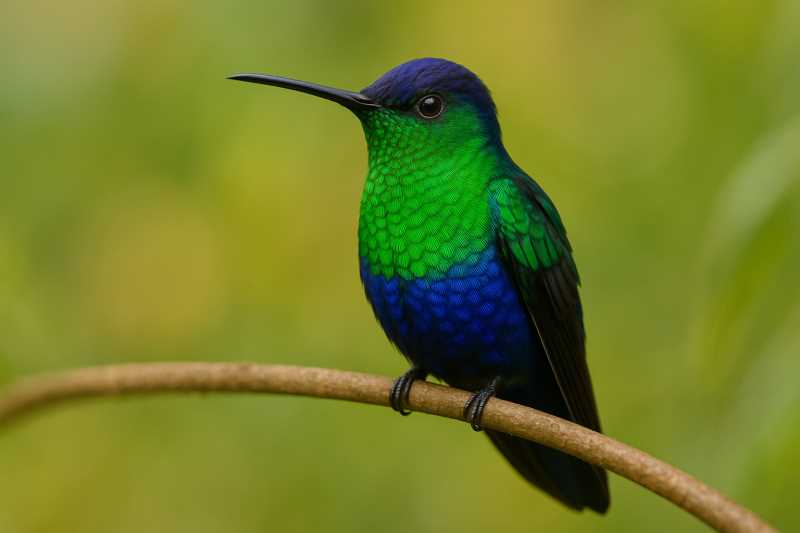
Adult males are highly iridescent. In the nominate form, the forehead, crown, upper back and belly are violet, while the throat and chest glitter green. The nape is bronzy green, the lower back and rump are darker bluish green, and the deeply forked tail is blue-black.
Females have bright green upperparts, a pale grey throat and chest, and a darker grey belly. Their shorter, more rounded tail is dark with conspicuous white tips on the outer feathers. This strong difference between the sexes makes identification comparatively straightforward when both plumages are seen clearly.
Immature males are duller and may lack most of the violet iridescence. Immature females are generally less brightly coloured above and paler below. Plumage varies geographically, and some populations have green rather than violet crowns or show different proportions of green, blue and violet on the body.
Range and Habitat
The Crowned Woodnymph occurs from Belize and eastern Guatemala through much of Central America to Panama, and across northern and western South America. Its South American range includes Colombia, western Venezuela, western Ecuador and north-western Peru. Several geographic forms are recognised within the species, although the treatment of some populations and former species names has changed between taxonomic authorities.
It inhabits humid lowland forest, foothill forest, montane forest, forest edges, secondary growth, clearings and well-vegetated gardens near woodland. It is generally found from sea level to about 1,900 metres, although the usual elevation varies among regions and populations. The species is resident rather than a long-distance migrant, but local movements may occur in response to flowering conditions and seasonal food availability.
Where to See This Species
Manuel Antonio National Park, Puntarenas, Costa Rica
The species is listed in the park’s official bird inventory. The park protects humid coastal forest, secondary vegetation and forest edges, all of which provide suitable feeding habitat. Look along shaded trails and flowering vegetation, particularly during the morning when hummingbird activity is high.
Nearby accommodation: Quepos and the Manuel Antonio area provide hotels, guest houses, lodges and self-catering accommodation.
La Cangreja National Park, San José Province, Costa Rica
The species is included in the park’s official fauna records. La Cangreja protects forest, streams and regenerating vegetation in the Puriscal region, with trails passing through habitats suitable for nectar-feeding hummingbirds. The park is open to visitors, although access conditions can vary and some roads may require a suitable vehicle during wet weather.
Nearby accommodation: Mastatal and Santiago de Puriscal are the practical gateway areas, with small lodges, guest houses, cabins and rural self-catering accommodation.
Behaviour and Diet
The Crowned Woodnymph is usually solitary and active during daylight. It forages in the understory, along forest edges and in the middle storey, visiting flowers on shrubs, small trees, vines, heliconias, bromeliads and other flowering plants. During the breeding season, males may feed higher in the canopy while females spend more time in the understory.
Nectar provides most of its energy. The species also takes small insects and spiders, either by making short aerial sallies from a perch or by gleaning prey from foliage. Both sexes may defend productive feeding areas, and individuals can be aggressive towards other hummingbirds near rich flower patches.
Breeding periods differ across the range. The female builds a small cup nest from plant fibres and other fine material, binding it with spider silk and often decorating the exterior with moss or lichen. The nest is usually placed on a horizontal twig beneath a leaf, commonly a few metres above the ground. A typical clutch contains two white eggs, and the female alone undertakes incubation and care of the young.
Identification Tips
- Look for a small hummingbird with a slender bill and rapid, agile flight in shaded forest or along forest edges.
- Adult males show a glittering green throat and chest, violet or green crown depending on geographic form, and a deeply forked blue-black tail.
- Females are green above with greyish underparts and white-tipped outer tail feathers.
- The deeply forked tail of the adult male helps separate it from many similarly sized hummingbirds, although tail shape can be difficult to judge during hovering flight.
- Do not rely on crown colour alone. Some populations have predominantly green crowns, while others show strong violet or blue-violet plumage.
- The Fork-tailed Woodnymph (Thalurania furcata) is a genuinely similar species in parts of South America. Careful attention to range, tail shape, crown colour and the pattern of the underparts is important where both species occur.
Conservation Status
The Crowned Woodnymph is classified as Least Concern on the IUCN Red List. It has a broad geographic range and occurs in a variety of natural and modified habitats. A precise global population estimate is not given here because a reliable figure was not identified in the sources reviewed.
The main conservation concerns are the loss and fragmentation of humid forest through agricultural expansion, logging, infrastructure development and urban growth. The species can use secondary vegetation and some fragmented landscapes, but the protection of remaining forest and the maintenance of connected habitat are important for preserving local populations and their food plants.
Frequently Asked Questions
Where can the Crowned Woodnymph be found?
It occurs from Belize and Guatemala through Central America to Panama, and in northern and western parts of South America, including Colombia, Venezuela, Ecuador and north-western Peru.
What does the Crowned Woodnymph look like?
The adult male has a glittering green throat and chest, violet or green iridescent crown feathers, and a deeply forked blue-black tail. The female is green above, greyish below and has white-tipped outer tail feathers.
What does the Crowned Woodnymph eat?
It feeds mainly on nectar from a wide variety of flowers. It also catches small insects and spiders, which provide additional protein.
Is the Crowned Woodnymph migratory?
It is considered a resident species rather than a long-distance migrant. Local movements may occur when birds follow flowering plants or changes in food availability.
Where does the Crowned Woodnymph build its nest?
The female usually builds a small cup nest on a horizontal twig beneath a leaf, often a few metres above the ground. Plant fibres, fine material and spider silk are used in construction, with moss or lichen sometimes added to the outside.
Is the Crowned Woodnymph endangered?
No. It is currently classified as Least Concern, although forest clearance and habitat fragmentation remain important threats in parts of its range.
References
- BirdLife International
- IOC World Bird List
- Sistema Nacional de Áreas de Conservación, Costa Rica
Related posts