The Southern White-faced Owl: An Enchanting Raptor of the African Night
The Southern White-faced Owl (Ptilopsis granti) is a fascinating bird of prey that inhabits the diverse landscapes of sub-Saharan Africa. Revered for its distinctive appearance and vocal abilities, this owl plays a significant role in the ecosystems it occupies. Despite being less known than some of its avian counterparts, the Southern White-faced Owl’s unique characteristics make it an intriguing subject for ornithologists and bird enthusiasts alike.
Physical Description
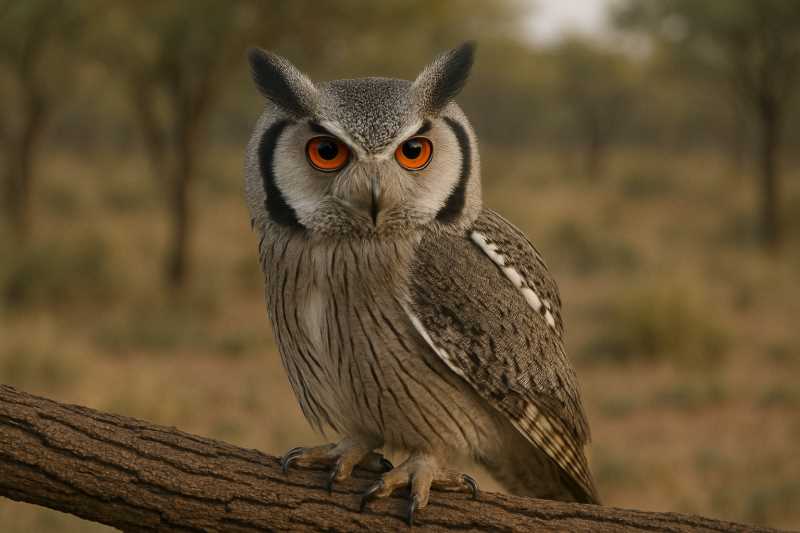
The Southern White-faced Owl is renowned for its striking appearance. It is a small to medium-sized owl, measuring approximately 22 to 28 centimeters in length with a wingspan ranging from 54 to 61 centimeters. Its most distinctive feature is its facial disc, which is stark white and bordered by a thin black line, creating a mask-like effect. This facial disc is not just for show; it plays a crucial role in enhancing the owl’s hearing by directing sound waves towards its ears.
The owl’s plumage is primarily a mix of gray and brown, providing excellent camouflage against tree bark and foliage. This coloration aids in protecting the owl from predators and allows it to stealthily approach prey. The Southern White-faced Owl’s large, orange-red eyes are adapted for excellent night vision, facilitating its nocturnal lifestyle.
Distribution and Habitat
Ptilopsis granti is widely distributed across the savannas, woodlands, and open forests of southern Africa. Countries such as South Africa, Botswana, Namibia, and Zimbabwe host significant populations of this species. The owl shows a preference for arid and semi-arid environments, often choosing habitats with sparse vegetation that offer ample hunting opportunities.
This owl is remarkably adaptable, thriving in areas ranging from lowland scrub to mountainous regions. However, it avoids dense forests and deserts, preferring habitats where it can easily spot prey from a perch.
Behavior and Diet
The Southern White-faced Owl is primarily nocturnal, although it can sometimes be observed hunting during the early evening or dawn. It is a solitary hunter, relying on its acute hearing and vision to locate prey in the dark. Its diet consists mainly of insects, small mammals, and occasionally small birds and reptiles.
This owl employs a sit-and-wait strategy, perching silently and using its excellent camouflage to blend into its surroundings. Once prey is detected, it launches a swift and silent attack, using its powerful talons to capture its meal.
Another remarkable aspect of the Southern White-faced Owl’s behavior is its ability to transform its appearance when threatened. In response to potential predators, the owl can flatten its feathers and elongate its body, making itself appear larger and more intimidating. This defensive mechanism, known as ‘mimicry’, is a fascinating adaptation that illustrates the owl’s ability to deter predators.
Vocalizations
The vocal repertoire of the Southern White-faced Owl is as captivating as its physical appearance. Its calls are varied, ranging from soft coos to piercing whistles. These vocalizations serve multiple purposes, including territory defense and mating communication.
During the breeding season, males perform a series of calls to attract females and establish territories. The owl’s vocal ability is enhanced by its facial disc, which amplifies sound in the same way it aids in hearing. This unique adaptation makes the Southern White-faced Owl a standout among its peers.
Conservation Status
Currently, the Southern White-faced Owl is classified as ‘Least Concern’ by the International Union for Conservation of Nature (IUCN). Despite facing threats such as habitat loss and human encroachment, its wide distribution and adaptability have helped maintain stable population levels.
Conservation efforts focus on preserving habitats and conducting further research to monitor population trends. As human activities continue to impact natural environments, understanding the ecology and behavior of species like the Southern White-faced Owl becomes increasingly important.
Conclusion
The Southern White-faced Owl is a captivating species that embodies the beauty and mystery of the African night. Its unique adaptations, such as its striking appearance, vocal abilities, and remarkable defensive strategies, make it a subject of fascination for birdwatchers and researchers. As we continue to learn more about this owl, we gain valuable insights into the complexities of avian life and the ecosystems they inhabit.
Preserving the habitats of the Southern White-faced Owl and understanding its role within these environments are crucial steps towards ensuring that future generations can continue to appreciate this enchanting raptor. As we strive to balance human development with conservation, the Southern White-faced Owl stands as a symbol of the delicate interplay between nature and wildlife.
Related posts