The Buff-breasted Paradise-Kingfisher (Tanysiptera sylvia) is one of Australia’s most striking and elusive avian treasures. With its brilliant plumage, long streamer-like tail feathers, and enchanting presence, this tropical kingfisher captivates birdwatchers and nature enthusiasts alike. Found in the rainforests of northern Queensland during the breeding season, the species undertakes an impressive migratory journey each year from New Guinea to Australia. Its life history is a fascinating tale of adaptation, endurance, and beauty.
Identification and Physical Features
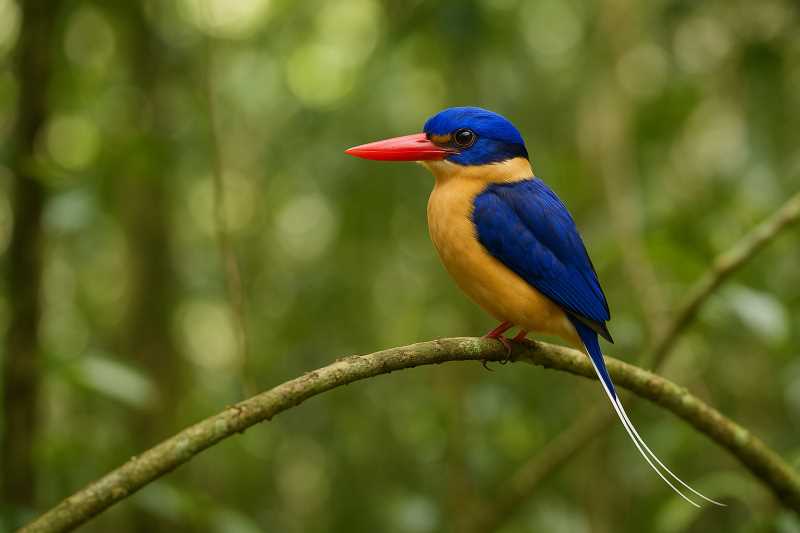
The Buff-breasted Paradise-Kingfisher is instantly recognisable due to its dazzling colours and elegant form. Measuring about 31–36 cm in length—including its long tail streamers—this kingfisher presents a vibrant palette:
- Head, nape, and back: Glossy deep blue
- Breast and belly: Warm buff to rich orange-buff, which gives the species its common name
- Tail streamers: Elongated white central tail feathers, flowing well beyond the body length
- Bill: Large, bright red, slightly flattened and well-adapted for catching insects and small prey
- Eyes: Dark and alert, contributing to its charismatic appearance
Sexes are similar in appearance, though females may have slightly shorter tail streamers. Juveniles, in contrast, lack the elongated tail feathers and exhibit a duller plumage overall.
Range and Migration
This species has a remarkable migratory pattern. The Buff-breasted Paradise-Kingfisher breeds in northeastern Queensland, particularly from Cape York Peninsula down to around Ingham and sometimes further south in suitable habitat.
After the breeding season, which occurs during the Australian summer (typically November to March), the birds migrate northward across Torres Strait to the lowland rainforests and gallery forests of New Guinea. This migration involves a perilous overwater flight of around 80 km or more, an impressive feat for a bird that is primarily adapted to dense terrestrial habitats.
Habitat Preferences
In Australia, the Buff-breasted Paradise-Kingfisher is strongly associated with lowland tropical and subtropical rainforests, monsoon forests, and well-vegetated gullies. During the breeding season, they favour habitats with soft, friable soils where they can excavate nesting burrows.
When in New Guinea outside the breeding season, the species inhabits a broader range of rainforest and secondary growth habitats at low to mid elevations.
Breeding Behaviour
One of the most intriguing aspects of the Buff-breasted Paradise-Kingfisher’s life history is its nesting strategy. Unlike many kingfishers that nest in riverbanks, this species often nests in termite mounds, particularly those built by terrestrial termites. The birds excavate a horizontal tunnel into the mound and create a nesting chamber where they lay 3–4 white eggs.
Both parents share the incubation and chick-rearing duties. The choice of a termite mound offers the advantage of a stable, insulated environment with reduced risk of predation and temperature extremes. However, this nesting strategy requires significant effort, with both adults working hard to hollow out a suitable tunnel.
Diet and Feeding
The Buff-breasted Paradise-Kingfisher is an agile hunter of small terrestrial prey. Its diet consists mainly of:
- Insects (beetles, grasshoppers, caterpillars)
- Spiders
- Small reptiles (skinks)
- Occasionally small amphibians
It typically hunts by perching low in the forest understorey and sallying to the ground to seize prey. The species also uses its large, robust bill to dig through leaf litter or soft soil to uncover hidden invertebrates.
Conservation Status
The Buff-breasted Paradise-Kingfisher is currently listed as Least Concern on the IUCN Red List. However, its dependence on intact rainforest and suitable nesting sites makes it vulnerable to habitat loss and fragmentation.
In Australia, protection of lowland rainforest habitats is critical to the species’ long-term survival. While some populations benefit from occurring within national parks and reserves (such as the Daintree and surrounding areas), continued conservation efforts are needed to manage threats from land clearing, invasive species, and climate change.
Birdwatching Tips
Seeing a Buff-breasted Paradise-Kingfisher in the wild is a true highlight for any birder visiting tropical Queensland. Here are some tips:
- Visit rainforests in far north Queensland during the breeding season (December to February is optimal).
- Listen for the bird’s distinctive calls—sharp “chip” notes and soft whistles—often heard in the early morning.
- Scan the forest understorey for low perches and look for the glistening blue back and trailing white tail streamers.
- Be patient—these birds can be secretive and often remain still for extended periods.
Conclusion
The Buff-breasted Paradise-Kingfisher is a marvellous example of the wonders of avian migration and rainforest adaptation. Its striking beauty, fascinating nesting behaviour, and long-distance travels make it a true symbol of the richness of Australia’s tropical birdlife. Protecting the rainforest habitats that this species depends on will ensure that future generations can continue to admire this dazzling paradise kingfisher.
Related posts