The Papuan Pitta (Erythropitta macklotii) is a stunning ground-dwelling bird found throughout Southeast Asia, the Philippines, Indonesia, and parts of northern Australia. Renowned for its vibrant plumage and elusive behaviour, this species is one of the most colourful and enchanting inhabitants of the tropical forest understorey. With its vivid red belly, deep blue wings, and secretive lifestyle, the Papuan Pitta is both a visual delight and a rewarding challenge for birdwatchers and naturalists alike.
Identification and Description
The Papuan Pitta is a small to medium-sized passerine, measuring about 18–20 cm in length. It has a compact, robust body, strong legs, and a short tail—features typical of the pitta family, which is known for terrestrial foraging.
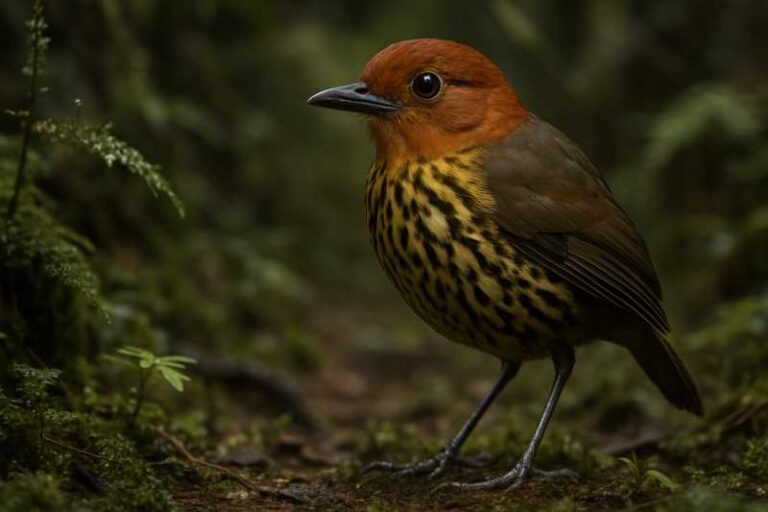
The bird’s plumage is breathtaking. The underparts are a brilliant crimson red, contrasting sharply with the dark greenish-blue back and wings. The head is typically dark, with some subspecies showing a black or chestnut crown and nape, while others have a blue wash on the crown or upper back. The face is dark, and a narrow black band may run across the chest in some forms. The bill is dark and slightly curved, and the legs are pale pink or flesh-coloured.
Due to the species’ wide range, numerous subspecies have been described, exhibiting regional variation in plumage colour and markings. Some authorities have split certain populations into separate species, reflecting ongoing debates in pitta taxonomy.
Distribution and Habitat
The Papuan Pitta is distributed across Southeast Asia, including the Philippines, Sulawesi, Borneo, the Maluku Islands, and New Guinea, as well as extending into Cape York Peninsula in northern Australia. Its range covers a variety of tropical and subtropical forest ecosystems, from lowland rainforests and mangroves to hill forests and secondary woodland.
In Australia, it is mostly found in the monsoonal forests and vine thickets of Cape York, particularly during the wet season, when it becomes more vocal and active.
The species is highly secretive and almost exclusively terrestrial, preferring dense undergrowth where it can forage in peace. Though occasionally seen perched low, it spends most of its time hopping quietly on the forest floor, foraging among leaf litter.
Behaviour and Ecology
Papuan Pittas are solitary or found in pairs, especially during the breeding season. They are typically quiet and unobtrusive, relying on their camouflaging back plumage to blend into the dappled light of the forest floor.
Their diet consists mainly of invertebrates, including insects, spiders, earthworms, and snails, which they pick from leaf litter or extract from the soil with their strong bills. Foraging behaviour involves short hops, sudden pecks, and occasional scratching.
Though often silent, the Papuan Pitta has a soft, melodious call, usually a series of clear, whistling notes repeated from a hidden perch. During the breeding season, both males and females vocalise more frequently to defend territories or attract mates.
Breeding and Nesting
Breeding seasons vary depending on geography but generally align with the wet season, when food is abundant and vegetation is thick enough to conceal nests. In northern Australia, breeding typically occurs between December and April.
The nest is a domed structure, often built on or near the ground and well hidden among tree roots, under logs, or in dense shrubs. It is made from twigs, moss, leaves, and rootlets, with a side entrance and soft inner lining.
The female lays 2 to 4 eggs, which are white to cream with reddish speckles. Both parents share in incubation and feeding duties. Chicks fledge after about 15–17 days but may remain close to the nest site for some time while learning to forage.
Conservation Status
The Papuan Pitta is classified as a species of Least Concern by the IUCN, thanks to its wide distribution. However, some regional populations—especially those on smaller islands—are vulnerable to habitat loss and fragmentation.
Key threats include:
- Deforestation for agriculture and logging
- Conversion of forest to plantations or development
- Predation by invasive species, such as rats and cats
- Disturbance from human activity, especially during the breeding season
In Australia, the species is uncommon but considered secure within protected areas such as Iron Range National Park, where appropriate habitat remains largely intact.
Continued monitoring and habitat protection are important to safeguard the species, especially in regions where deforestation is accelerating.
Observation and Birdwatching
Seeing a Papuan Pitta in the wild is a highlight for birdwatchers, especially in regions like Cape York, Borneo, and the Philippines, where the bird is more vocal and visible during the breeding season.
Due to its shy nature, patience is essential. Early morning or late afternoon are the best times to detect them, often by following their soft whistles or watching for movement on the forest floor. Staying still and quiet in likely areas near creeks, leaf-littered clearings, or tangled vines can sometimes yield a rewarding glimpse of this tropical gem.
Conclusion
The Papuan Pitta is a dazzling yet elusive inhabitant of the tropical forest floor—a bird whose colours rival any parrot, but whose behaviour is more akin to a shadow in the undergrowth. It exemplifies the richness and fragility of the forest ecosystems it inhabits. While globally secure, its continued survival depends on the preservation of tropical forests and careful management of human impacts across its diverse range.
Related posts