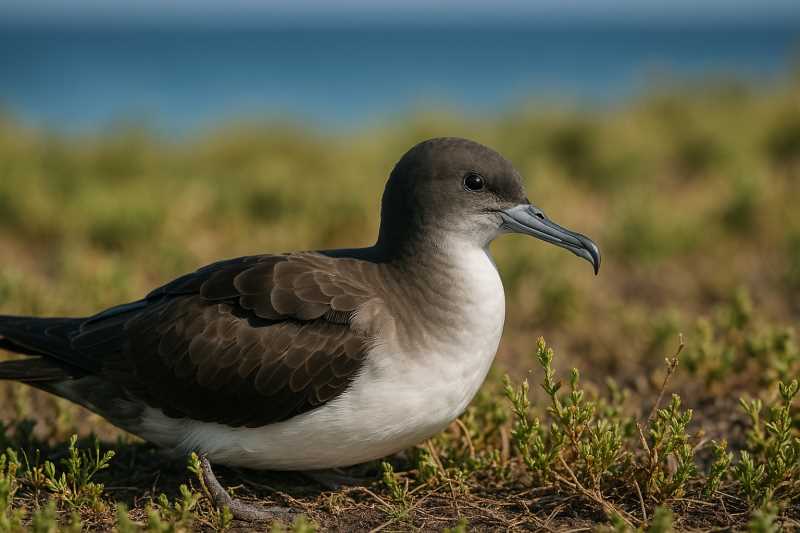
The Wedge-tailed Shearwater (Ardenna pacifica) is a remarkable seabird known for its distinctive wedge-shaped tail and its extensive range across the tropical and subtropical waters of the Pacific and Indian Oceans. This bird is an exemplar of adaptability, existing in harmony with both land and sea, and has intrigued ornithologists and bird enthusiasts alike with its unique behaviors and life cycle.
Physical Characteristics and Identification
The Wedge-tailed Shearwater is medium-sized, measuring approximately 41 to 46 centimeters in length, with a wingspan ranging from 95 to 110 centimeters. These birds are primarily characterized by their slender bodies, long wings, and the eponymous wedge-shaped tail. They exhibit two color morphs: a light morph with pale underparts and a dark morph, which is predominantly grayish-brown. Regardless of the morph, the Wedge-tailed Shearwater possesses a long, slender bill adapted to its diet of fish and squid.
Habitat and Distribution
The Wedge-tailed Shearwater is widely distributed across the tropical and subtropical regions of the Pacific and Indian Oceans. Key breeding colonies are found on islands such as Hawaii, the Seychelles, and various atolls throughout the Pacific. These seabirds are highly pelagic, spending most of their life at sea, coming to land only for breeding purposes. Their choice of breeding sites is often secluded islands or coastal areas with minimal human disturbance, which are crucial for the safety of their nesting activities.
Behavior and Ecology
Wedge-tailed Shearwaters are known for their graceful flight, often gliding low over the ocean surface in search of food. They are predominantly nocturnal feeders, using their keen eyesight and sense of smell to hunt for fish and squid. These shearwaters employ a technique known as ‘dynamic soaring’ to conserve energy while covering long distances in search of food.
Breeding occurs annually, with birds returning to the same nesting sites where they were born, exhibiting strong site fidelity. The breeding season varies by location but generally begins around early spring. Wedge-tailed Shearwaters are monogamous, with pairs forming long-term bonds. They nest in burrows dug into the ground, where a single egg is laid. Both parents share incubation duties and feeding responsibilities once the chick hatches.
Challenges and Conservation
Despite their adaptability, Wedge-tailed Shearwaters face significant challenges. Habitat loss due to human development and recreational activities poses a threat to their nesting sites. Additionally, light pollution can disorient fledglings, leading to increased mortality rates. Invasive species such as rats and feral cats are also a major concern, as they prey on eggs and young chicks.
Conservation efforts are crucial to ensuring the survival of these seabirds. Protective measures include habitat restoration, the establishment of protected areas, and the control of invasive species. Public education campaigns also play a vital role in reducing human disturbance and promoting coexistence with these remarkable seabirds.
Conclusion
The Wedge-tailed Shearwater is a fascinating species that offers valuable insights into the adaptability and resilience of seabirds. Their ability to thrive in the open ocean, coupled with the challenges they face from human activities, underscores the importance of continued conservation efforts. By protecting their habitats and minimizing human impact, we can help ensure that future generations will continue to marvel at the beauty and grace of the Wedge-tailed Shearwater.
As we continue to study these birds, the Wedge-tailed Shearwater serves as a reminder of the delicate balance between nature and human influence, and the ongoing need to preserve the natural world for the benefit of all species.
Related posts